


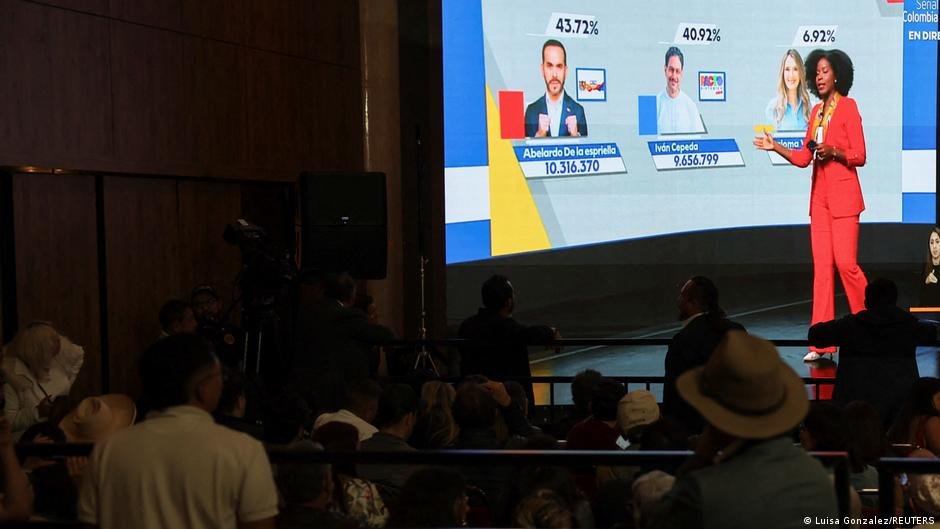
Colombians head to the polls this Sunday in what is one of the most important elections in the country’s recent history.
The presidential runoff pits left-wing senator and human rights activist Ivan Cepeda against far-right lawyer and businessman Abelardo de la Espriella. The two lawmakers hold fundamentally different views on the state’s role, security and society.
This runoff is about much more than who will succeed President Gustavo Petro in office, observers say. The election is seen as a decision on whether Colombia will continue on its course of social reform and negotiations with Colombia‘s armed rebels, or whether the the country will embark on a significantly more conservative, security-focused path.
In 2022, Petro became the first left-wing lawmaker to win the presidency. His government promised to enact social reforms, allow greater participation for disadvantaged groups, implement the FARC guerrilla peace deal, and adopt a new strategy for dealing with armed groups in the country.
“The results are somewhat mixed,” says Viviana Garcia Pinzon, a researcher at the Arnold Bergstraesser Institute in Freiburg, Germany, which specializes in transregional studies. Petro has made progress in poverty reduction, land restitution and improving social inclusion, says the researcher. At the same, other key reforms failed or have not been fully implemented. For example, Garcia Pinzon says Petro’s “total peace” strategy had not significantly reduced violence against civilians.
Sabine Kurtenbach, a professor who heads Hamburg’s German Institute for Global and Area Studies, shares that opinion, telling DW that while Petro championed a “very progressive, socially transformative agenda, [he] delivered very little.” She also criticized a lack of strategy with regard to the peace process. This had led to “anger and disappointment,” even among government supporters.
This is why the upcoming runoff election is also being seen as a vote on Petro’s political track record.
Who is Ivan Cepeda?
Cepeda, 63, is one of the best-known figures on the Colombian left. Unlike Petro, he does not have a guerrilla background and comes from the field of human rights. He has “always operated within institutional and legal frameworks,” Garcia Pinzon told DW. His political career has been marked by a “very strong commitment to human rights,” she added.
Cepeda is the son of left-wing Senator Manuel Cepeda Vargas, who was assassinated in 1994. Cepeda spent years committed to fighting political violence. He has also participated in peace talks with the FARC guerrillas and the ELN.
Politically, he stands for a continuation of Petro’s agenda in terms of advancing social welfare, implementing the peace deal, negotiating with armed groups and pushing ahead with Colombia’s socio-ecological transformation. Shifting away from fossil fuels is one of his key priorities.
Yet while many Colombian voters consider him competent, they don’t see him as particularly charismatic. He is a serious politician who struggles to stir up emotions, Kurtenbach says.
Who is Abelardo de la Espriella?
Cepeda’s opponent, Abelardo de la Espriella, is almost his exact opposite. Few people knew the lawyer and entrepreneur before he launched his campaign. Now, however, he is slightly ahead in the polls.
Politically his positioning is similar to the new right movement in Latin America and the US. Garcia Pinzon says his views are not unlike those of Donald Trump, Nayib Bukele of El Salvador and Javier Milei of Argentina. While not a career politician, he maintains close links to powerful economic and political elites.
De la Espriella’s campaign has relied on social media posts, high-impact staging and strong messaging. He promises a leaner government, a stronger private sector and an uncompromising crackdown on armed groups. He is supported by Trump, Milei and Ecuador’s President Daniel Noboa, among others.
Many of his supporters say he embodies economic success and traditional family values. But Garcia Pinzon warns that he could pursue a more authoritarian path, because he represents “a right-wing movement unlike anything Colombia has ever seen.”
Security remains key
Colombia’s security situation remains the most crucial factor shaping this election. Many parts of the country are still troubled by armed groups and beset by drug trafficking and violence, despite the 2016 peace agreement.
While Cepeda counts on negotiations and the continuation of the peace process, de la Espriella favors a hardline policy. He has announced that he will end talks with guerrilla groups and take a similarly tough stance to El Salvador’s Bukele.
Adopting such a stance could come with considerable risks, says Kurtenbach. While the peace efforts had not been entirely successful, ending them abruptly was not a good idea, she told DW. Colombia’s structural problems remain unresolved, with a “new cycle of violence looming.”
Garcia Pinzon also fears an escalation, saying that seeking to resolve political conflict purely through military means could exacerbate polarization and cause violence to spread from armed groups into society at large.
Regional ramifications
The election is being closely followed throughout Latin America. This is because the vote is not only about Colombia’s future, but also about the political development of the region as a whole, says Garcia Pinzon, as both would pursue very different foreign policy agendas.
De la Espriella is considered pro-American, with Kurtenbach telling DW he is “clearly on Trump’s side.” His election victory would shift the political balance in Latin America even further to the right.
If Cepeda wins, Colombia is likely to place greater emphasis on cooperation with the left-wing governments of Brazil and Mexico and to continue its efforts in resolving conflicts through negotiation rather than by military means.
Whatever the outcome, major challenges lie ahead. Colombia is mired in violence and social inequality, and suffers from a fragmented party system and an increasingly polarized society.
Currently polls say both candidates have almost the same chance of winning.
This article was translated from German
About The Author







