Commentary: China is betting on spreading AI faster than the US can contain it
China is showing it can pursue frontier AI while deploying it widely in the real world. For Asia, that may matter more than who has the smartest new model, says Enodo Economics’ Diana Choyleva.
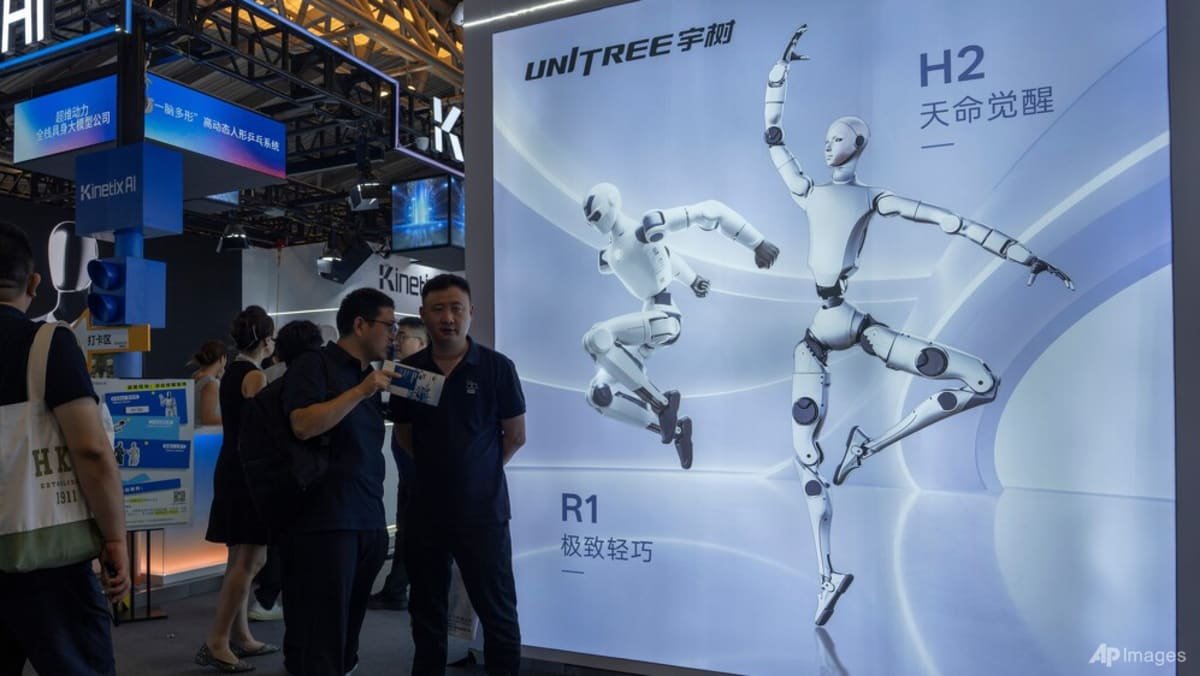
Visitors stand near advertisement for leading Chinese commercial humanoid robotics firm Unitree Robotics during the World AI Conference in Shanghai, China, on July 18, 2026. (AP Photo/Ng Han Guan)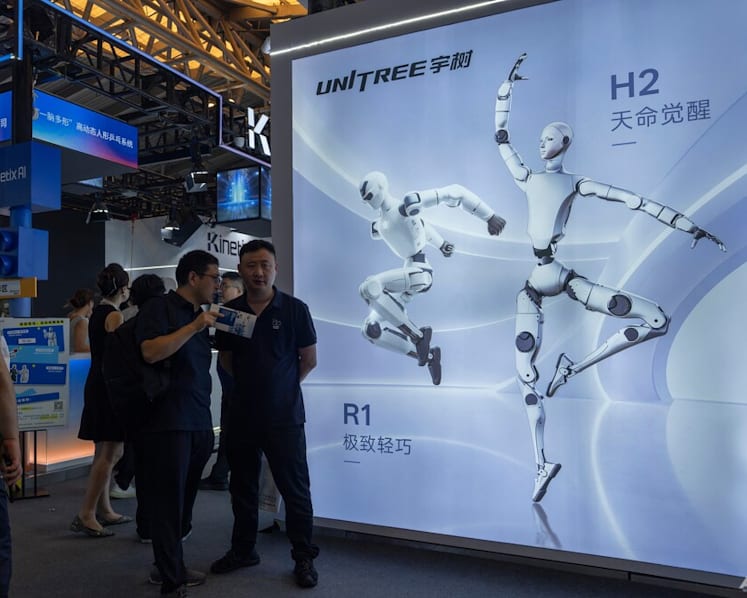
New: You can now listen to articles.

This audio is generated by an AI tool.

Read a summary of this article on FAST.
Get bite-sized news via a new
cards interface. Give it a try.
Click here to return to FAST
Tap here to return to FAST
FAST
LONDON: Chinese AI model Kimi K3 drew so much demand that it pushed developer Moonshot’s computing capacity close to its limits within 48 hours of launch in July. Both tech giant Alibaba and start-up Z.ai claimed in August that their new models can compete with leading Western models on several benchmarks.
Yet, for all the buzz, the most consequential Chinese AI development of the past few weeks may not be a new large language model – but a chipmaking machine in Shanghai.
China is still largely dependent on foreign equipment to make advanced chips. But in late July, a little-known state-backed company reportedly began producing China’s first domestically developed immersion deep-ultraviolet (DUV) lithography machines.
This is a rung below the most advanced extreme-ultraviolet (EUV) systems made by Dutch company ASML, which remain indispensable for making leading-edge semiconductor chips. Such EUV systems have been unavailable to China for years, after the Dutch government withheld export licences amid US pressure.

Guess Word
Crack the word, one row at a time

Buzzword
Create words using the given letters

Mini Sudoku
Tiny puzzle, mighty brain teaser

Mini Crossword
Small grid, big challenge

Word Search
Spot as many words as you can
The US-China AI contest is often described as a race to the frontier: who can build the most powerful model with the most advanced chips first.
So when China makes progress in developing its own advanced chipmaking equipment, the instinctive reading is that it is catching up. But that would be missing the point.
NOT THE SMARTEST, BUT THE MOST WIDELY DEPLOYED
China’s AI wager is not necessarily the smartest model, but the most widely deployed one.
The United States and China have different centres of gravity in AI. America’s lies closer to the frontier – ever more powerful models, trained and run on enormous quantities of cutting-edge compute.
Constrained in its access to the best chips, China has placed much more weight on diffusion. If it can make capable AI cheap enough, open enough and ubiquitous enough, the technology can spread through the real economy.


Frontier progress and diffusion are not separate pursuits. They reinforce each other.
According to San Francisco-based research firm Artificial Analysis, DeepSeek’s new V4-Flash is by far the cheapest well-known model to run on its benchmark tests. The firm estimated an average cost of US$0.03 per test, more than 100 times cheaper than US$3.16 for Anthropic’s Claude Fable 5.
China is still climbing towards the frontier, but that also serves the aim of diffusion.
The cheaper a capable AI model is, the more widely it can be used, making it more strategically valuable. It becomes easier to embed in factory systems, logistics, robots and thousands of mundane business processes that never make an AI leaderboard.
Sometimes very mundane indeed. Researchers recently tested a robot on a pig farm in Hebei that uses computer vision to identify the correct area near a pig’s tail and administer a needle-free vaccine. It achieved a 93.3 per cent injection success rate.
Vaccinating pigs is not what anyone imagines as the pinnacle of artificial intelligence. It is almost precisely the opposite. AI begins to matter economically when it stops being remarkable.

“GOOD ENOUGH” CHIPS
Broad AI diffusion does not require every chip to be manufactured at the global frontier. It requires a huge, dependable supply of chips that are good enough to run AI in industrial equipment, vehicles, communications systems and other devices.
This is where that lithography machine in Shanghai comes in.
China can already manufacture advanced chips using imported immersion-DUV equipments. Domestic machines will still have to prove the precision, throughput and yields commercial fabs demand.
That is no small hurdle. But if they clear it, China begins to reduce one of the deepest vulnerabilities in Beijing’s strategy: dependence on foreign tools.
China is also building up its domestic ecosystem for chip production. CXMT, China’s leading producer of DRAM memory chips, raised US$8.6 billion in its Shanghai IPO in July and is now considering another fabrication plant in Beijing. Projects under development in several cities could more than double its production capacity.
WASHINGTON’S TARGET LIST KEEPS EXPANDING
Washington has noticed and tried to build a wall around China and its ability to access advanced AI hardware. Now the perimeter it must defend keeps expanding.
US restrictions have been moving downstream. In July, the Federal Communications Commission moved to block new foreign-made humanoid and quadruped robots from the US market, a measure expected to hit Chinese robotics company Unitree.
Washington has also been preparing restrictions on Chinese optical transceivers which are needed to move vast quantities of data between servers inside AI data centres. China’s Zhongji Innolight has an estimated 27 per cent of the global market for these optical modules.
Frontier compute has a relatively small number of chokepoints: a handful of GPU designers, semiconductor manufacturers and equipment suppliers.
Diffusion has a much larger set of targets. As AI spreads through the economy, so does the range of hardware, infrastructure and software needed to support it. Blocking all of those becomes progressively harder, particularly as Chinese alternatives improve.
None of this means American export controls have failed. They have raised China’s costs, constrained access to the most advanced compute and almost certainly delayed China at the frontier.
Nor has America ignored diffusion: Microsoft, Google, Amazon and Nvidia are all racing to embed AI across the economy, and Washington’s widening restrictions show policymakers increasingly see deployment as strategic too.


WHAT CHINA’S AI APPROACH MEANS FOR ASIA
China is showing it can pursue both frontier and diffusion progress at the same time. For Asia, this may prove more consequential than who tops the next model leaderboard.
Chinese AI may arrive not through a download button but on a factory floor: embedded in a robot, machine-vision system or production line bought from a Chinese supplier.
This is already starting to happen in Southeast Asia. In Singapore, autonomous vehicles from WeRide and Pony.ai are already carrying passengers. In Vietnam, Yingshen Intelligence announced it had signed agreement to deploy AI robots in footwear factories. And in Malaysia, ZTE is among the technology partners behind an AI-enabled warehouse in Selangor.
For emerging economies, the attraction may be less about whether a Chinese model beats the best American system by a few points on a benchmark and more about whether it performs the required task at one-tenth or one-hundredth of the cost.
The two powers are now competing on different axes. Washington built its technology wall around technologies whose scarcity conferred power; China is responding by trying to make increasingly capable AI abundant.
And abundance is its own kind of leverage. It is harder to sanction and even harder to reverse. America’s technology wall has not fallen but China’s AI strategy is spreading faster than the wall can expand.
Diana Choyleva is founder and chief economist of Enodo Economics and a keynote speaker on global macroeconomics, China, and US-China strategic competition. She is also a senior fellow at the Asia Society Policy Institute’s Center for China Analysis.
Source: CNA/ch
Sign up for our newsletters

Get the CNA app
Stay updated with notifications for breaking news and our best stories
Get WhatsApp alerts
Join our channel for the top reads for the day on your preferred chat app

Get bite-sized news via a new
cards interface. Give it a try.
Click here to return to FAST
Tap here to return to FAST
FAST
About The Author