Commentary: Do we only appreciate art and creativity when it’s approved?
While tension is inevitable when it comes to how public spaces are used, the speed with which we default to removal does not have to be, says arts advocate and former Nominated MP Usha Chandradas.
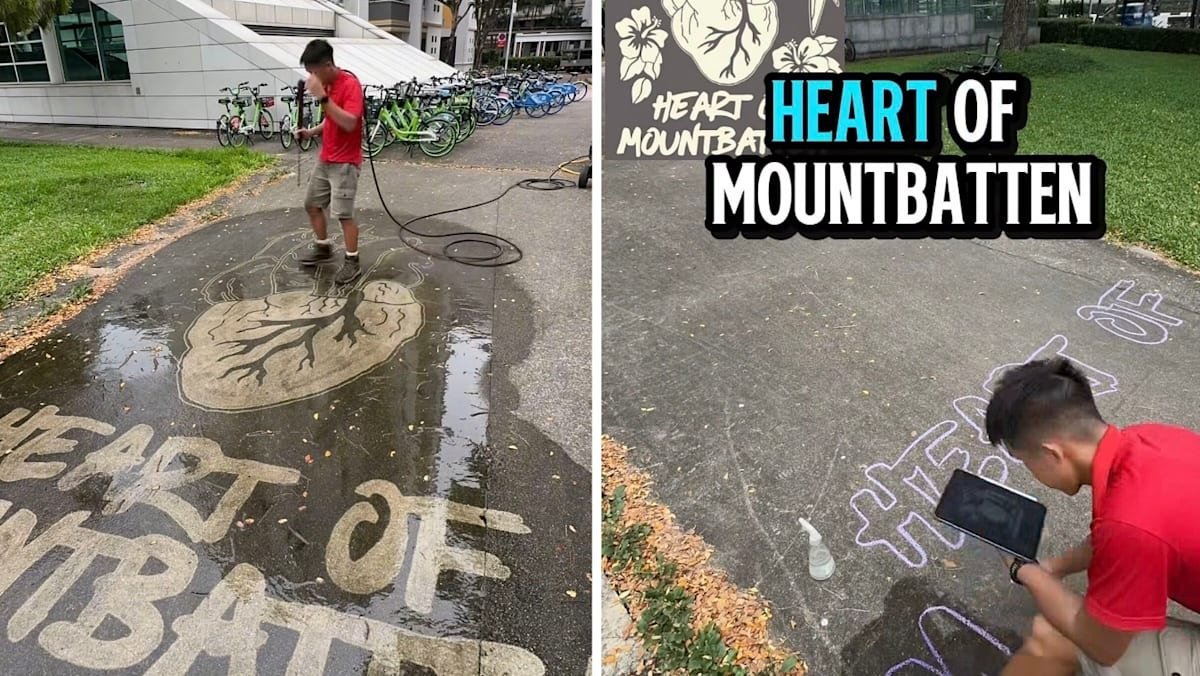
Screengrabs from artist Marcus Pang’s video showing him power-washing his artwork onto the pavement outside Mountbatten MRT. (Images: Instagram/gazing.pw)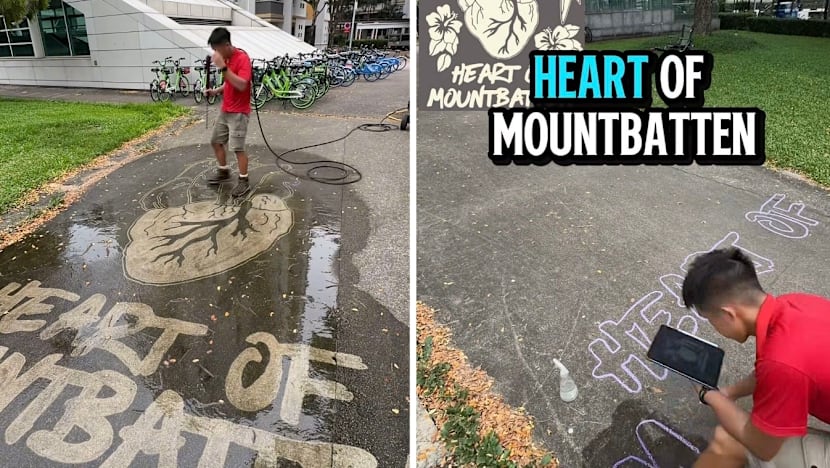
New: You can now listen to articles.

This audio is generated by an AI tool.

Read a summary of this article on FAST.
Get bite-sized news via a new
cards interface. Give it a try.
Click here to return to FAST
Tap here to return to FAST
FAST
SINGAPORE: What happens when art appears in a public space without first asking for permission?
As power-washing artist Marcus Pang found out last month, artwork that appears in public spaces without permission can be unceremoniously erased.
For the uninitiated, power washing art involves an artist using power-jet equipment to clean away sections of a dirty surface, such as an open-air pavement, to reveal an artwork. It is a rather poetic expression of working with negative space because technically, there is no actual painting or colouring of the surface concerned, only a “cleaning away” of sorts to reveal what the artist wishes to compose for viewers.
In terms of execution, it is arguably more sustainable than, for example, the use of spray paint. In this case, Mr Pang said he used rainwater for his art.

Guess Word
Crack the word, one row at a time

Buzzword
Create words using the given letters

Mini Sudoku
Tiny puzzle, mighty brain teaser

Mini Crossword
Small grid, big challenge

Word Search
Spot as many words as you can
In Singapore, though, things unfolded in a quintessentially Singaporean way. A complaint was received about Mr Pang “spraying chemicals” which led to exchanges involving SMRT, Mr Pang and the police. The latter seemed to find no immediate issue with what Mr Pang was doing but the artwork was later removed altogether.
What we see happening time and time again in Singapore is the same cycle: a complaint, an identification of a possible breach of a rule, enforcement action and finally, artwork removal or the threat of it. Mr Pang’s case is perhaps especially remarkable because his artwork bore the relatively benign words “Heart of Mountbatten” – words that one would not ordinarily assume to be approached with suspicion.
Other instances of art in public spaces coming under scrutiny include artist Sam Lo, who got in trouble with the law in 2012 for spray painting the words “My Grandfather Road” on Telegraph Street and pasting cheeky stickers bearing phrases such as “Press Until Shiok” on traffic light buttons.
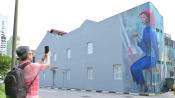
In 2017 and 2018, artist Priyageetha Dia found herself entangled with authorities after painting a Housing and Development Board staircase gold and hanging golden mylar blankets at a block of flats. Then in 2024, a mural of a samsui woman in Chinatown by multidisciplinary artist Sean Dunston became the talk of town.
DO WE EMBRACE STREET ART ONLY WHEN IT’S APPROVED?
Yet, street art and graffiti are valorised when presented within the spaces of art galleries and institutions.
In 2018, the ArtScience Museum showcased the well-received exhibition Art from the Streets. The following year, New York artist Futura, often described as the godfather of contemporary street art, chose Singapore for his first solo exhibition in Southeast Asia.
These seem to highlight a paradoxical relationship Singapore has with street art – do we only embrace it when it is curated, commissioned or formally approved?
As Zul Othman, artist and founder of urban art collective RSCLS, told me: “We want all of the hype but none of the mess that makes art beautiful.”
The irony is that counterculture and subversiveness are very much part of street art, and there is a broader question of whether the concept of “street art” can even be said to exist in a place like Singapore where there are tough rules on vandalism and where the display of public art requires licensing and permits.
That said, Futura himself noted in his 2019 trip to Singapore that it is possible for too much unrestrained street art to create a “depressing” air.
Where that fine line is, between a “desirable” state of messiness and over-manicured sterility, is something that is constantly under negotiation – not just here, but everywhere in the world. A common proposition is that public spaces are for everyone to share, and that things which appeal artistically to one segment of the population may well offend another.
In Singapore, it is also part and parcel of living in a multicultural and pluralistic society that we tolerate and embrace differences while being careful not to offend.
Yet, the recurring question raised by cases such as Mr Pang’s is whether too often, our instinct is to regulate or erase first and discuss later.
Public art, by its very nature, sits uneasily between the competing ideas of creative expression, community ownership, taxpayer dollars and bureaucratic control. The debate over creative uses of public spaces extends beyond visual art. Just a few months ago, mirrors along an underground linkway at Bayfront MRT station were frosted after complaints that dancers using the area as a makeshift practice space were obstructing pedestrian flow.
While tension is inevitable, the speed with which we default to removal, be it an artwork or the presence of dancers, arguably, does not have to be.
CREATIVITY MORE IMPORTANT THAN EVER
In my short interview with Mr Pang for this commentary, another strand emerged – the exuberance and passion of a young man who loves what he does.
Mr Pang, who openly acknowledges that he is “not the best artist around” and that his signature hearts are “traced from scientific pictures”, nonetheless sees himself “as a placemaking visionary” who is “doing something different”.
The young artist, who finances his own art-making, also noted that artistic production in his chosen field requires skills. To replicate works on the ground, he needs “to be able to control the equipment and know which parts of the work to clean and which to keep dirty,” he told me.
What struck me most was that whatever one thinks about power-washing as an art form and how it should be received by the public, Mr Pang is clearly hungry. Not perhaps in the way the term has recently been used in discussions about the Singaporean work ethic, but hungry to experiment with something he feels deeply passionate about.
The instinct to tinker, play and create is arguably more important than ever before. If there is an antidote to the anxiety surrounding AI and overreliance on the technology, it lies in continuing to nurture the very human instincts of curiosity and spontaneous creative impulse.
In fact, the creativity that leads someone to pick up a power washer and see something worth making where others see only a dirty stretch of concrete, is not so different from the instincts that lead people to build businesses, solve problems and create new economic opportunities.

One also wonders if incidents like these can be seen as meaningful learning opportunities. Before the kerfuffle in the media, how many of us even knew about power washing art or “reverse graffiti”? This has opened an opportunity for the wider public to be educated about street art and hopefully discuss the boundaries that define it in Singapore.
Interesting legal questions potentially arise as well, as there is currently no reported case law on acts of reverse graffiti. In Singapore, a number of laws govern the use of public property, but the Vandalism Act 1966 outlines the specific offence of vandalism as being inclusive of the acts of “writing, drawing, painting, marking or inscribing” on public property, as well as the “destruction or damaging” of such property. Would reverse graffiti, which power washing falls under and involves the cleaning of dirt on surfaces, fit within these statutory definitions?
Probably, not every artistic intervention should be permitted, nor should artists be given a blanket exemption from rules that apply to everyone else. Yet whether it is a major exhibition backed by a cultural institution or a self-funded intervention on a public pavement, both suggest that Singaporeans are far more interested in art, creativity and shared public experiences than we sometimes give ourselves credit for.
The challenge now is therefore how much room we are willing to make for artistic encounters when they appear in forms that we do not expect.
Usha Chandradas is co-founder of online magazine platform Plural Art Mag. She is also a consultant at Withers Khattarwong, an Adjunct Associate Professor at the Nanyang Technological University and a former Nominated Member of Parliament. Daryl Loy, Associate in Withers Khattarwong, assisted in research for this piece.
Source: CNA/zw(sk)
Sign up for our newsletters

Get the CNA app
Stay updated with notifications for breaking news and our best stories
Get WhatsApp alerts
Join our channel for the top reads for the day on your preferred chat app

Get bite-sized news via a new
cards interface. Give it a try.
Click here to return to FAST
Tap here to return to FAST
FAST