Commentary: Russian team ‘misused’ Claude AI to train a killer drone on scraped Ukrainian war footage
Any war footage, even if recorded by civilians, can be used as raw material for weapons development and deployment, says this researcher.
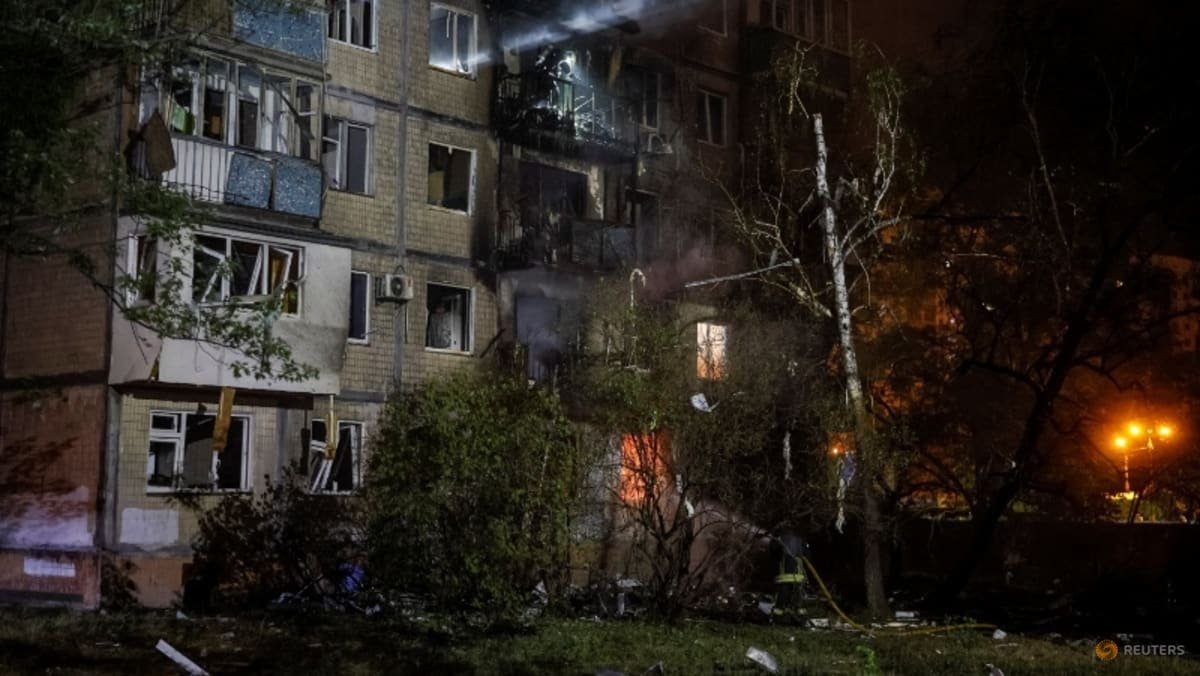
Firefighters work at a site of an apartment building hit by a Russian drone strike, amid Russia’s attack on Ukraine, in Kyiv, Sep 11, 2026. REUTERS/Gleb Garanich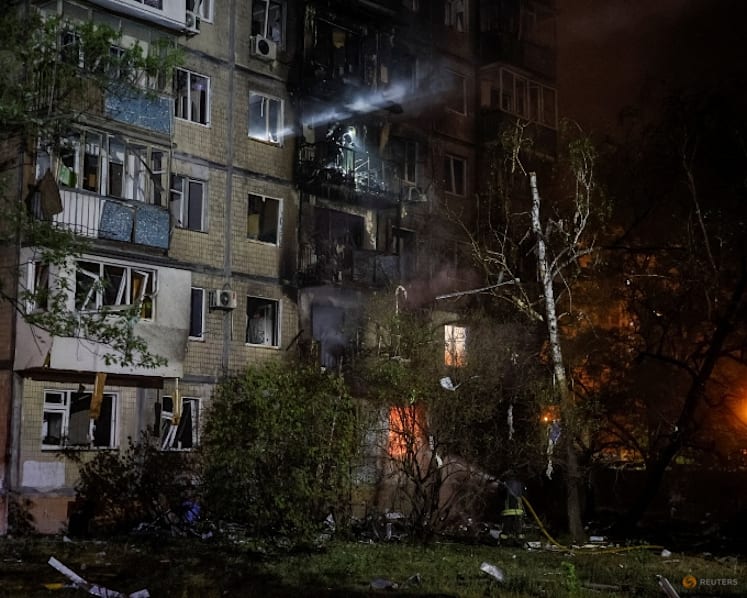
Read a summary of this article on FAST.
Get bite-sized news via a new
cards interface. Give it a try.
Click here to return to FAST
Tap here to return to FAST
FAST
ST CATHARINES, Canada: A new threat intelligence report from the artificial intelligence company Anthropic has revealed that a Russian team scraped Ukrainian combat videos to train an autonomous “kamikaze” drone to choose its own targets and destroy them.
Anthropic’s report was published on Sep 10, two days before CEO and co-founder of the company, Dario Amodei, published an essay arguing that humanity must urgently “slow the pace” of AI development.
The report is a 154-page account of the attempted misuse of Claude AI models for “malicious activity” between December 2025 and August 2026. It covers seven areas: cyber operations, influence operations, surveillance, scams and fraud, biological misuse, conventional weapons development and distillation.
One case, tracked as GTG-27005, describes a small, likely freelance team in Russia that used Claude’s coding tool to help build software for a swarm of autonomous first-person-view (FPV) “kamikaze” drones – the cheap, camera-guided munitions that have become one of the defining weapons of the war.

Guess Word
Crack the word, one row at a time

Buzzword
Create words using the given letters

Mini Sudoku
Tiny puzzle, mighty brain teaser

Mini Crossword
Small grid, big challenge

Word Search
Spot as many words as you can
This should worry anyone who has ever filmed, shared or trusted footage from the war in Ukraine – one of the most visually documented conflicts in history.
It seems that any visual footage – even that created by journalists, soldiers, civilians and researchers to update the outside world and hold nations accountable – can now feed back into a conflict as raw material for weapons development and deployment on the battlefield.
DRONES THAT PICK THEIR OWN TARGETS
Anthropic’s report states the company’s threat intelligence teams have “investigated and disrupted multiple threat actors” who used Claude models to develop software for either weapons design and development or for intelligence-gathering and procurement for weapons programs.
The report documents six cases: three in China, two in Russia and one in Yemen.
The “likely freelance Russia-based” developers in case GTG-27005 called their project “DronDoc” or “Serafim”. They began work in May and routed their traffic through commercial servers to get around Anthropic’s location-based restrictions.
The software they built could enable a drone to pick its own targets, including targets in the category “person”, and issue the command to detonate – without a human confirming the strike first. That detail made headlines and it deserved the publicity.
However, one line in the report has received far less attention: The developers trained their targeting software on scraped Ukrainian combat footage, sorted into “enemy” and “friendly”, and tested it against a simulated target location in the region of the Donetsk Oblast.

DOCUMENTED FOR EVIDENCE, USED FOR CONFLICT
The report does not specify where the footage came from. It could have come from Telegram channels used by military personnel, official and unofficial drone strike compilation accounts, open-source intelligence (OSINT) archives or open databases assembled by journalists and researchers. At this time, we simply don’t know which is the likely source.
The Centre for Information Resilience’s Eyes on Russia Map, for example, has verified and mapped more than 30,000 individual incidents using footage from volunteers, soldiers and civilians.
Drone footage and the aftermath of missile strikes are verified and geolocated by researchers who hope that they’ll be used as evidence for journalistic endeavours, war crimes investigations or simply to show the reality of the conflict in an era when generative AI can skew the narrative.
Those producing this footage are, for the most part, trying to make the war more visible and those responsible more accountable for their actions.
What this case shows is that footage built for one purpose can be repackaged for a very different one without changing at all. A clip filmed to document a strike and one that is scraped to teach a weapon what a human target looks like are, frame for frame, the same file.
Nothing about the image itself signals what use it will be put to. What determines that is who can access it and what they choose to do with it.
Ukraine’s own drone video system, OCHI, has amassed well over 2 million hours of footage since 2022, making it the largest publicly known collection of live-fire combat video globally.
A dataset of that scale is a gold mine for machine learning. However, this is not unusual when it comes to modern, digital warfare. A company in the United States, Enabled Intelligence, states that they recently packaged more than half a million hours of Ukrainian drone footage into a commercial dataset which was sold for military AI training.
Indeed, this kind of extraction is becoming routine and openly discussed. GTG-27005 demonstrates that it isn’t confined to declared, sanctioned users.

WHO ELSE IS WATCHING?
This isn’t an isolated case, either. The same report describes a separate incident, tracked as GTG-20006, and connected by Anthropic to the Russian state-linked group publicly known as Midnight Blizzard.
In that case, operators stole a software kit for a military drone’s vision system and spent days using Claude to reverse-engineer it – recovering the design, components and details of an unreleased product.
Two separate groups within the same period went after the same kind of target: the system that allows a drone to recognise what it sees. Is this the beginning of a pattern – one where a drone’s ability to visually identify a target is becoming just as valuable as its engine or explosive payload?
None of this is an argument against documenting conflict. Far from it. Those visuals remain one of the few tools that ordinary people have to hold power accountable during moments of strife.
However, it is a reason to take seriously that those producing this record – journalists, soldiers, civilians volunteer researchers – are part of a supply chain whose subsequent uses they cannot predict and never agreed to.
Most conversations about the ethics of war footage have focused on who should watch it and how. This case suggests that we also need to ask who else is watching and what are they going to do with it.
John R Heckman is a doctoral candidate in Interdisciplinary Humanities at Brock University. This commentary first appeared on The Conversation.
Source: Others/el
Sign up for our newsletters

Get the CNA app
Stay updated with notifications for breaking news and our best stories
Get WhatsApp alerts
Join our channel for the top reads for the day on your preferred chat app

Get bite-sized news via a new
cards interface. Give it a try.
Click here to return to FAST
Tap here to return to FAST
FAST