Commentary: What China’s underperforming tech stocks say about its real economy
China cannot keep boosting only one part of the economic growth equation, says public policy professor Donald Low.
People visit a terrace of a shopping mall overlooking the central business district (CBD), in Beijing, China August 11, 2025. (Reuters/Tingshu Wang)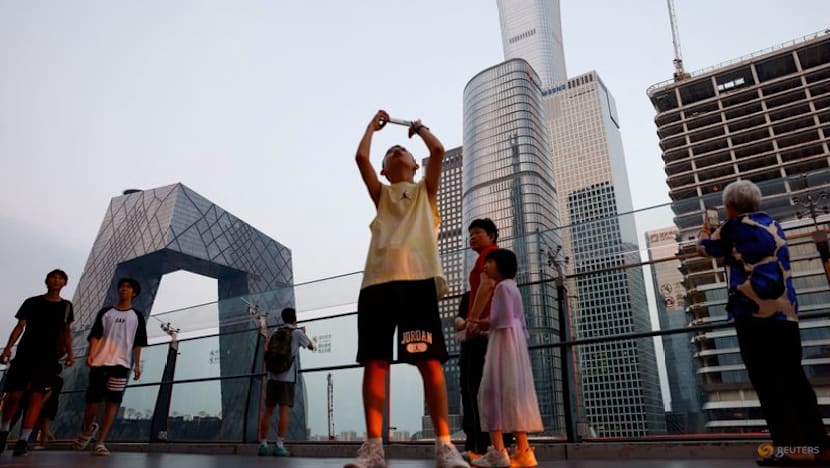
New: You can now listen to articles.

This audio is generated by an AI tool.

Read a summary of this article on FAST.
Get bite-sized news via a new
cards interface. Give it a try.
Click here to return to FAST
Tap here to return to FAST
FAST
HONG KONG: For a country that still ranks as middle-income, that China leads the world in many of the industries of the future is nothing short of remarkable. In the past decade, it has emerged as a technological superpower, outcompeting far richer countries in many areas of advanced manufacturing – from electric and autonomous vehicles to industrial robots and high-speed rail. In artificial intelligence, Chinese large language models (LLMs) rival Western counterparts.
Yet despite the considerable (and largely justifiable) hype surrounding China’s industrial and tech companies, its stock market has been underperforming badly.
Compared to its peak in February 2021, the benchmark CSI 300 index was down by nearly 15 per cent (as of end-May). By contrast, the S&P 500 rose by more than 90 per cent and the Nikkei index by about 120 per cent over the same period.
The gap in performance is even more pronounced with tech companies. Whereas the tech-heavy Nasdaq Composite nearly doubled in the last five years, the Hang Seng TECH index (which comprises the 30 largest tech companies listed in Hong Kong) fell by nearly 40 per cent over the same period.

Guess Word
Crack the word, one row at a time

Buzzword
Create words using the given letters

Mini Sudoku
Tiny puzzle, mighty brain teaser

Mini Crossword
Small grid, big challenge

Word Search
Spot as many words as you can
To make things worse, the Chinese stock market is far more volatile, leaving investors with the worst of both worlds: poorer returns and higher volatility. What, if anything, does China’s underperforming stock market say about its real economy and the country’s economic priorities?
EROSION OF HOUSEHOLD WEALTH
Some of this underperformance is induced by policy and Beijing’s techno-utopia ambitions.
At the height of the COVID-19 pandemic, Chinese regulators came down hard on leading consumer tech companies, including Alibaba and Tencent. This was ostensibly justified by concerns over personal data, financial stability given Big Tech’s impending entry into consumer finance, and the monopoly power that tech titans wield.
But it also reflected the techno-utopia China’s engineer-planners wanted to build, prioritising upstream technologies or “hard tech” like AI and semiconductors. Consumer tech companies were seen as deploying less desirable downstream technologies, diverting capital and talent away from sectors of more strategic importance.
While the crackdown on consumer tech companies has ended, its impact on investor confidence and consumer sentiment has not. Last year, an astonishing US$1 trillion of unauthorised money left the country, presumably in search of better returns abroad. This prompted financial regulators to launch a crackdown on May 22 against offshore trading platforms for helping investors evade capital controls.


Coupled with falling property prices in the last five years – the consequence of tightened controls on property developers in 2021 – the result has been significant erosion of household wealth.
Chinese consumers thus remain reluctant to spend, despite the government’s repeated pronouncements to make consumption a major engine of economic growth. Retail sales grew by just 0.2 percent in April this year compared to a year ago, the weakest growth since December 2022 when China was emerging from draconian zero-COVID restrictions.
OVERCAPACITY AND DEFLATION
This gap between the rhetoric and the reality of consumption becomes more evident with the second key feature of the Chinese real economy in recent years: overcapacity.
This overcapacity is as severe in traditional industries (such as property, steel and consumer electronics) as it is in new industries such as electric vehicles and solar panels.
Local governments previously lavished support on these new industries with subsidies, cheap land, and interest-free loans. But the cheap Chinese EVs and solar panels they produced were met with protectionist backlash in many developed countries that has constrained demand.


The result has been price wars, falling profit margins, and job losses in once lucrative industries. In the solar industry for instance, more than 40 Chinese firms have gone bankrupt, been acquired, or delisted from stock exchanges since 2024.
Not surprisingly, all this has created stubborn deflationary pressures. Consumer prices have stagnated since the start of 2023 until recently. The producer price index (PPI) was firmly in negative territory, only rising sharply in April because of negative supply shocks arising from the United States’ war on Iran rather than strong domestic demand or wage growth.
Deflation can be a self-reinforcing dynamic: Households may hold back spending because they think goods will get cheaper, and firms may delay investments. This further reduces domestic demand and limits wage increases – further entrenching deflationary expectations.
TECHNOLOGY WITHOUT PRODUCTIVITY
Given the state’s emphasis on the “new productive forces”, one would expect China’s productivity growth to have been strong in recent years. The reality is quite different.
China’s total factor productivity – how efficiently the economy combines capital and labour inputs – has slowed considerably in the last decade – from around 4 per cent growth in the first two decades of “reform and opening” to under 2 per cent in the last decade. For a middle-income economy, that is distinctly average.
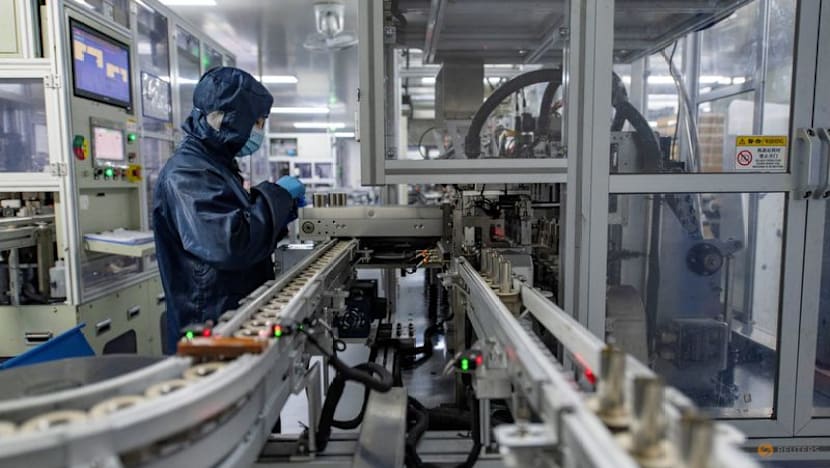
There are multiple explanations for China’s mediocre productivity performance – an ageing workforce, the slowdown in key export markets after the global financial crisis in 2008, and weak consumption growth.
Authorities have also sought to shift the economy away from less productive industries (such as property and traditional infrastructure), but they still account for a much larger share of economic activity than “new productive forces”. In other words, new industries are unlikely to make up for the contraction of traditional industries and the existing overcapacity will limit how much further their share can increase in the next few years.
HITTING THE LIMITS OF STATE-ENGINEERED GROWTH
There is little evidence that China will meaningfully rebalance its economy toward consumption.
The policies that are most needed to lift consumption structurally (instead of only for one or two years) – such as increased social spending in the countryside and hukou reform – have not materialised despite these ideas being raised repeatedly for over a decade.
Without these measures, continually boosting supply, is unlikely to make up for weak consumption growth, especially in an economy of China’s size.
China has shown that it can create globally competitive productive capacity, but it has not been able to create a matching appetite for what it produces. That remains its biggest economic challenge.
Donald Low is senior lecturer and professor of practice in the Division of Public Policy, Hong Kong University of Science and Technology. He is the author of The Price of Zero: China’s policy missteps during and after COVID (2025).
Source: CNA/zw(ch)
Sign up for our newsletters

Get the CNA app
Stay updated with notifications for breaking news and our best stories
Get WhatsApp alerts
Join our channel for the top reads for the day on your preferred chat app

Get bite-sized news via a new
cards interface. Give it a try.
Click here to return to FAST
Tap here to return to FAST
FAST
About The Author