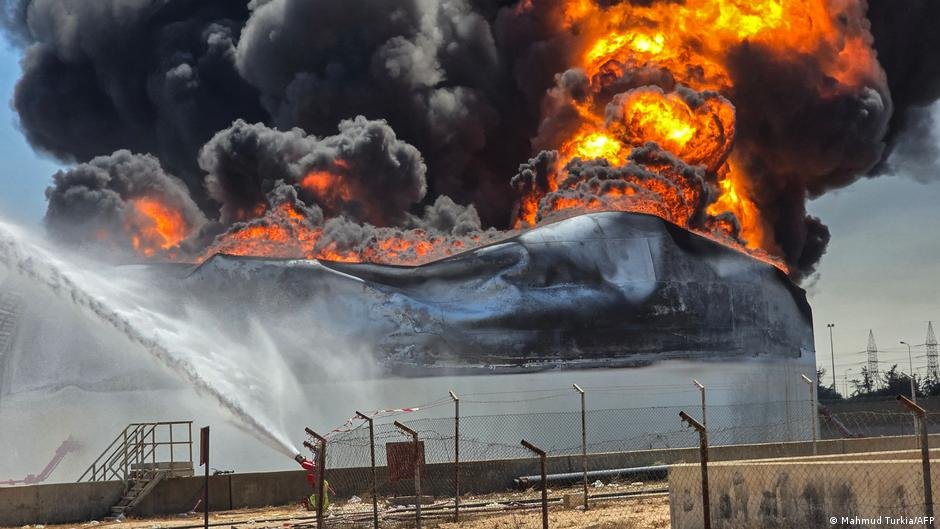
Libya‘s National Oil Corporation (NOC) said Tuesday that fires at a fuel storage facility had been quickly brought under control after a drone attack.
The Zawiya oil complex west of Tripoli is home to the country’s largest refinery and has been the scene of repeated armed clashes between warring factions fighting for primacy in the country since the fall of former strongman leader Moammar Gadhafi in 2011.
What happened in the drone attack on Libya’s Zawiya oil refinery?
Monday’s attack by an as yet undeclared actor targeted the Zawiya Oil Refining Company with explosives-laden drones, causing a tank containing about 4.5 million liters (1.2 million gallons) of gasoline to collapse after a fire.
Owner Brega Petroleum Marketing said the fires had been brought under control far faster than expected, with engineers telling Reuters news agency that damage had been limited, though operations were interrupted.
In a statement on X, Abdulhamid Dbeibah, Libya’s internationally recognized prime minister, wrote that the crime of targeting civilian infrastructure would “not go unanswered.”
“The use of drones to strike vital facilities,” wrote Dbeibah, “is not a random incident, but rather an organized and dangerous act that requires a firm response to protect the state and its institutions and prevent its recurrence.”
Officials from Libya’s electricity provider said two further drones targeted the Zawiya power plant early Tuesday morning, with one hitting the fire-fighting system but causing no damage.
What is the security situation in divided Libya?
Libya has remained divided since the 2011 uprising that toppled Gadhafi. Dbeibah’s UN-recognized government is based in Tripoli in the west, while eastern and parts of southern Libya are controlled by the Libyan National Army (LNA), a military force led by commander Khalifa Haftar.
Amid those tensions, the LNA said its head of military intelligence, Fawzi al-Mansouri, was killed in a car bombing in Benghazi on Monday night.
According to the LNA, an explosive device attached to al-Mansouri’s vehicle detonated as he left a mosque. Authorities have not identified those responsible.
Khaled Haftar, one of Khalifa Haftar’s sons, said an investigation had been opened, adding that initial “indicators point to a despicable terrorist tactic,” according to AFP news agency.
His office later said authorities had arrested a “terrorist cell” in Benghazi that was allegedly preparing acts of sabotage, but did not say whether it was linked to al-Mansouri’s killing.
Al-Mansouri was a prominent military figure close to the Haftar family and had played a key role in fighting jihadist groups in eastern Libya.
How has Libya’s political division affected oil production?
The split between dueling administrations has stunted the country’s oil producing progress and kept foreign investors wary as rival sides clash over control of the oil revenues that pour into the Central Bank of Libya.
In 2024, a standoff over control of the bank slashed the country’s oil exports by more than half.
Libya holds Africa’s largest proven oil reserves, yet has struggled to return to pre-2011 production levels of 1.6 million barrels per day. June production hit 1.44 million barrels per day, the highest output levels since 2013, but far short of its target of 2 million barrels per day.
Edited by: Saim Dušan Inayatullah
Don’t let the algorithm hide the news. If you rely on our team for trusted reporting, please take a moment to select us as your Preferred Source on Google by clicking here and hitting the “star” or “preferred” button, so you’ll always see our verified news first.