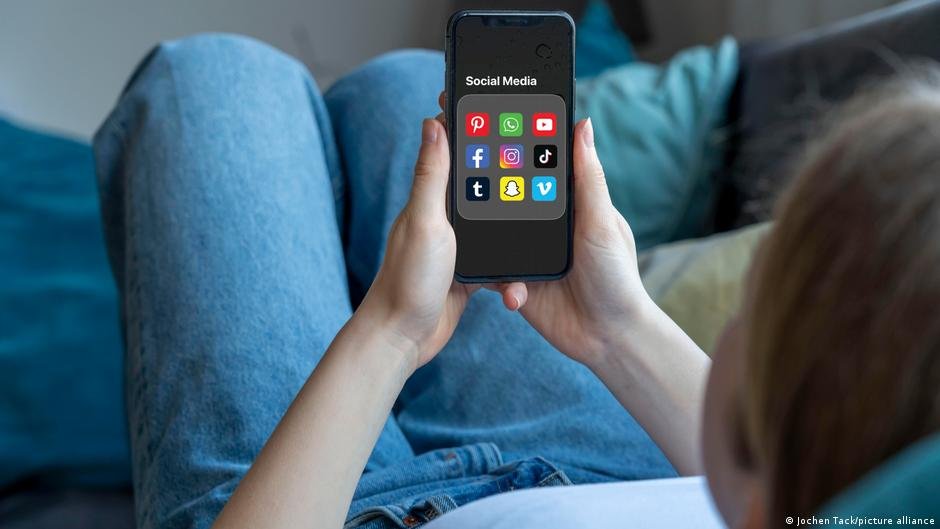
Access to social media should be allowed to under 13-year-olds only under the supervision of their carers or at school, according to a report presented in Brussels on Monday by a panel of experts advising the EU on online child protection.
The recommendation came as European Commission President Ursula von der Leyen announced that the EU’s executive body would put forward legislative proposals regarding children’s social media use after the summer.
To view this video please enable JavaScript, and consider upgrading to a web browser that supports HTML5 video
What were the panel’s social media recommendations?
The panel, which consisted of doctors, academics, youth representatives and parents, made a number of other recommendations in its report:
- Babies and toddlers should be kept away from any screens
- Children between three and 12 should be allowed only supervised use of ‘age-appropriate social media’ and devices
- Teenagers between 13 and 18 should be allowed ‘evolving autonomous use’ of social media and other digital platforms that have ‘key safety features’
Children ‘need time in the real world’ — von der Leyen
Speaking as the report was presented, von der Leyen, who commissioned the panel, called for “age-appropriate restrictions” implemented in a “phased and gradual” manner.
“Our children need time in the real world. Time to play, time to build friendships, time to make mistakes. Time to shape their own identity, their own personality, before an algorithm shapes them instead,” von der Leyen told reporters in Brussels.
“This is not about whether children can access social media. It is about whether and when social media can access our children,” she said.
To view this video please enable JavaScript, and consider upgrading to a web browser that supports HTML5 video
Australia cited as model for social media age limits
Although several members of the bloc, including Germany, have been mulling the introduction of age limits for social media, for these to be truly effective and legal, action would likely have to be taken at the EU level.
This is because the bloc is in charge of enforcing rules on major online platforms and because any laws at a national level must be compatible with EU legislation.
Von der Leyen has recently voiced concern about the impact of social media on children and has pointed to Australia as a possible model.
At the end of 2025, Australia became the first country to introduce an age limit for social media access, although the effectiveness and benefits of its action have been much debated.
Although social media giants are already legally obliged to put child-protection measures in place in the EU under the bloc’s Digital Services Act (DSA), experts say the rules need more comprehensive enforcement.
Last week, the European Commission found Meta, which owns Facebook, Instagram and WhatsApp, to have breached DSA rules owing to the addictive design of its platforms and the resulting harm to users, including minors.
Edited by: Zac Crellin
Tired of missing our real-time updates? Click here to add us as a Preferred Source on Google. Then tap the “Star” or “Preferred” to keep DW News at the top of your feed.