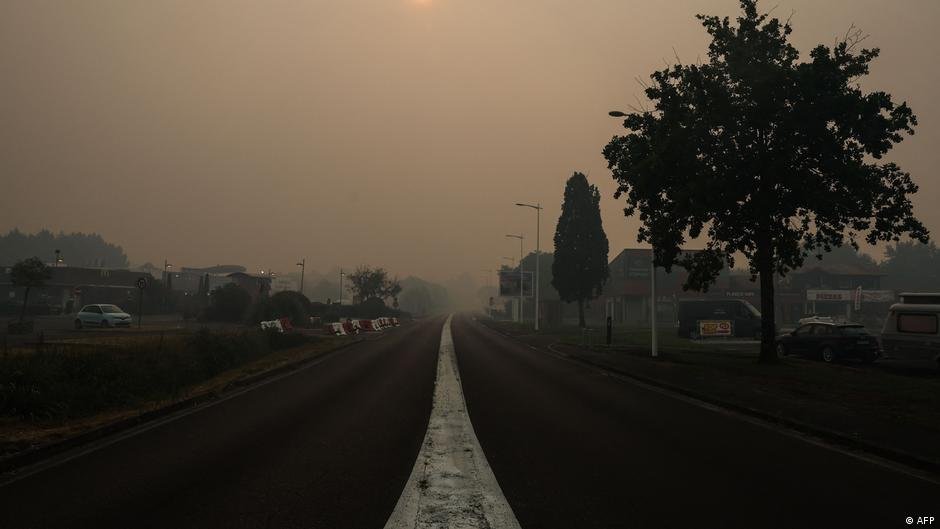
As wildfires continue to engulf massive stretches of western France and central Spain, some 200,000 people have been forced to flee, with flames devouring forests and homes near Bordeaux and Madrid.
Firefighters have said that the blazes, the largest recorded in both countries in recent years, are so massive that they cannot be tackled head on.
On France’s Atlantic coast, 44,000 people were removed from the Cap Ferret peninsula, many by boat.
Towns near Bordeaux, the famed winemaking town popular with tourists, were evacuated “as a precaution” as strong winds fueled approaching flames.
On Saturday morning, regional authorities further ordered the evacuation of three of the city’s western suburbs “to ensure residents’ safety.”
In all, French authorities say more than 140,000 people have been evacuated in France’s western Gironde and Landes departments.
In Spain, the Interior Ministry said 60,000 have been forced to flee.
To view this video please enable JavaScript, and consider upgrading to a web browser that supports HTML5 video
EU sending firefighting aircraft to France and Spain
Authorities in France say the country’s two main blazes were sparked accidentally, however, as summers become drier and hotter the magnitude of such fires has increased exponentially.
French Interior Minister Laurent Nunez, who said the government would do everything possible to protect citizens, warned that a wind shift had transformed the Cap Ferret blaze into “a large, self-sustaining fire that is extremely difficult to bring under control.”
“It is now moving east, toward the Bordeaux metropolitan area,” added Nunez, who pledged, “We are going to reorganize our response so we can fight it from the ground and prevent it from advancing toward Bordeaux.”
French President Emmanuel Macron called for European Union assistance on Friday as well as the mobilization of the French army to halt fires that have so far destroyed 22,000 hectares (54,000 acres) of land.
The European Commission announced that it is sending three firefighting aircraft to France and four to Spain in an effort to gain the upper hand.
This week’s fires have injured dozens of firefighters and killed three of them — two in western France and one in Sicily, Italy, which is now also battling blazes.
To view this video please enable JavaScript, and consider upgrading to a web browser that supports HTML5 video
Spain declares national emergency
In Spain, the government has declared a national emergency as two of the country’s three current fires, all burning near the capital Madrid, merge into one.
Madrid’s regional emergency management services said the massive blaze has now reached “its peak and is currently beyond the capacity of firefighters to contain.”
The largest active fire in the region, in Guadalajara province, has already laid waste to some 32,000 hectares.
Spanish Prime Minister Pedro Sanchez is scheduled to visit affected areas west of the capital on Saturday, as temperatures in the region are expected to top 39 degrees Celsius (102 Fahrenheit).
High winds are also in the forecast, which will make things even more difficult for firefighters.
NASA abandons comms facility amid Spain’s summer of fire
The US space agency NASA on Saturday reported that it had been forced to evacuate its Madrid Deep Space Communications Complex (MDSCC), which is located in the region. The facility is one of three worldwide that allow the agency to communicate with spacecraft in distant parts of the galaxy — the others are located in Australia and the US.
“The safety and well being of our personnel is our highest priority and our thoughts are with the families and neighbors who are also experiencing the impact of the wildfires in the surrounding communities,” said a statement released by the agency.
Spain, which regularly sees wildfires, has experienced an especially devastating summer. Earlier this month, fires in the south of the country killed 13 people.
Environmental officials say that 1,140 square kilometers (440 square miles) have already been lost to flames this year, more than five times the area burnt throughout the first half of 2025.
Edited by: Kieran Burke
Don’t let the algorithm hide the news. If you rely on our team for trusted reporting, please take a moment to select us as your Preferred Source on Google by clicking here and hitting the “star” or “preferred” button, so you’ll always see our verified news first.