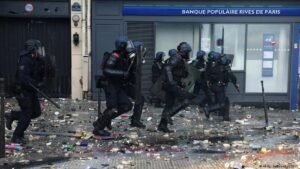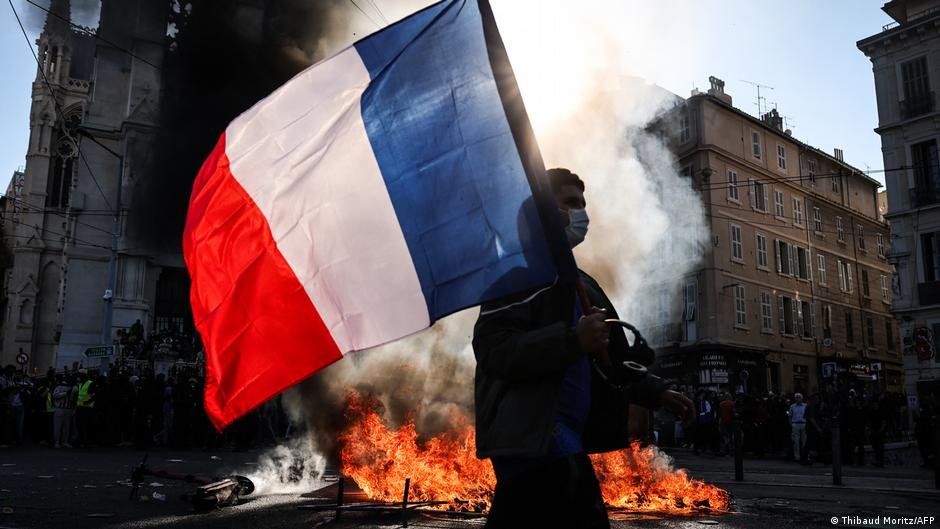
There have been clashes between police and protesters amid mass rallies across France on Saturday, over high prices and social inequalities and the state of the education system.
Police arrest hundreds nationwide
The Interior Ministry said that some 272 people had been arrested by mid-afternoon following violent incidents in Paris, Marseilles, Rennes, Toulouse and Angers.
“Such actions include attempted looting, confrontations with law enforcement, the setting of fires to street furniture and the targeting of seats of power and media outlets,” the ministry saidand blamed the unrest on what it described as the “ultra-left.”
In Paris and Marseille, police have fired tear gas at protesters during clashes.
AFP reported that the windows of the offices of French broadcasters CNews and Europe 1 in western Paris were broken by protesters, and journalists reported seeing several parked cars torched.
In Lyon, situated in central France, the city’s tourism office was set alight with flames and black smoke seen billowing from the building.
Meanwhile in Lille, protesters smashed their way into the town hall of France’s northern city of Lille and vandalised the premises before leaving, according to an AFP photographer.
Riot police within minutes confirmed that all the protesters had left.
The protests come on the heels of an initial wave of demonstrations that began last month over the situation at schools in the country, with pupils complaining about teacher absences and run-down facilities.
President Emmanuel Macron has called “for calm and respect” ahead of the protests, saying that the right to protest went hand in hand with “respect for people and property.”
To view this video please enable JavaScript, and consider upgrading to a web browser that supports HTML5 video
What do we know about the protests in France?
More than 600 demonstrations were planned across France, according to protest organizers.
Interior Minister Laurent Nunez told France 2 television that “a pretty big turnout” was expected, while a police source told the French AFP news agency that authorities estimate nearly 200,000 people will attend.
However, the Paris demonstrators faced restrictions, with police banning rallies around the Elysee presidential palace, the prime minister’s office and the Champs-Elysee avenue, along with other key locations.
A march through the center of the city has also been banned.
The main Paris demonstration began at 2 p.m. (1200 GMT) at the Place de la Republique..
Reports began emerging late on Saturday morning of riot police clashing with protesters in the Saint-Denis area on the outskirts of the capital, as well as near the Gare du Nord train station, among other areas.
Fears of violence at the French protests
Prime Minister Sebastien Lecornu said on Thursday that authorities fear there could be violence during the protests.
“This is a moment of fatigue in the country,” Lecornu said. “We are in an atmosphere of perma-crisis: wars, inflation, and issues surrounding purchasing power.”
Jordan Bardella, the head of the far-right National Rally, which is leading the polls ahead of next year’s presidential election, said he expected clashes.
“I’m extremely concerned,” he said during a visit to the Paris car show. “It will be a day of chaos for France.”
The school protests that have rocked France in recent weeks have already seen considerable violence, with several protesters and more than 900 police injured.
In one notable incident, an adolescent school pupil had one hand blown off and several fingers on the other hand injured by a stun grenade.
The internal police watchdog is investigating at least two dozen cases of alleged police violence.
Who is taking part in the protests?
Students are to be joined by trade unionists and remnants of the Yellow Vests (“Gilets jaunes”) movement, which staged mass weekly protests from November 2018 to June 2020, initially against rising fuel prices. They later morphed into protests against the high cost of living and economic inequality in general.
The student protests over the past weeks have been backed by Jean-Luc Melanchon, the leader of the hard-left France Unbowed (“La France insoumise”, or LFI), who marched in one demonstration on Tuesday.
The government has blamed the LFI for pouring fuel on the fire of widespread public discontent, an allegation the party has denied.
To view this video please enable JavaScript, and consider upgrading to a web browser that supports HTML5 video
Edited by: Karl Sexton
If you rely on our team for trusted reporting, please take a moment to select us as your Preferred Source on Google, so you’ll always see our verified news first.