


analysis
From rising star to investigation: Why Shanghai party boss Chen Jining’s case matters for China’s leadership
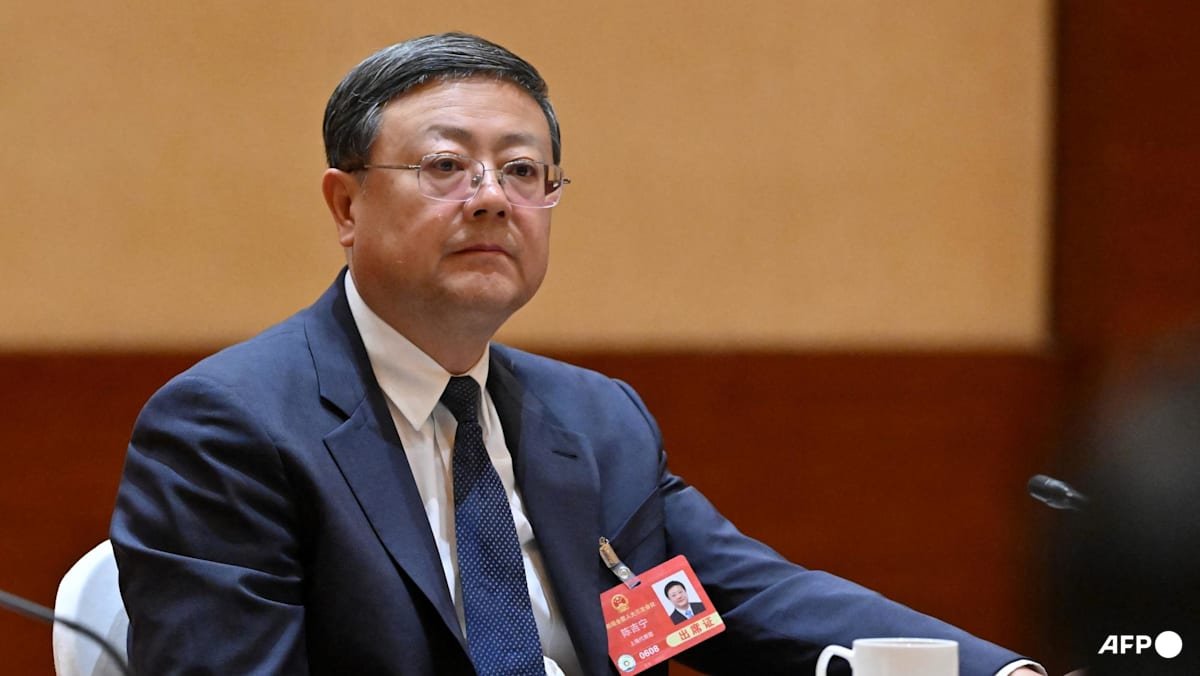
An academic-turned-politician, Chen Jining’s rapid political rise under President Xi Jinping and his prestigious Shanghai posting make his investigation particularly significant, say analysts.

New: You can now listen to articles.

This audio is generated by an AI tool.

Read a summary of this article on FAST.
Get bite-sized news via a new
cards interface. Give it a try.
Click here to return to FAST
Tap here to return to FAST
FAST
BEIJING: Once tipped for higher office, Shanghai party secretary Chen Jining has instead become the latest political heavyweight to fall under investigation in China – raising fresh questions about the selection and vetting of senior officials ahead of an expected leadership reshuffle in 2027, analysts say.
Chen, 62, was placed under investigation for “suspected serious violations of discipline and law”, state news agency Xinhua announced on Tuesday (Nov 24), without providing further details. The phrase is a common euphemism for corruption.
Analysts say the probe is particularly significant given his rapid rise under President Xi Jinping and the prestige of the Shanghai post.
“(Shanghai is) one of China’s most important political and economic centres, a post usually reserved for highly trusted figures,” Qiu Mingda, a senior analyst at political risk consultancy Eurasia Group, told CNA.

Guess Word
Crack the word, one row at a time

Buzzword
Create words using the given letters

Mini Sudoku
Tiny puzzle, mighty brain teaser

Mini Crossword
Small grid, big challenge

Word Search
Spot as many words as you can
Chen is the fourth member of the current Politburo to face investigation as a sweeping anti-graft campaign continues to reach the highest ranks of the party, state and military.
The current Politburo began its five-year term in 2022 with 24 members, but that number has since fallen to 22 following three expulsions and one appointment. Chen remains formally a member despite being under investigation.
“Xi is using anti-corruption for discipline, control, enforcement and an elimination mechanism to vet the political elite,” Stefanie Kam, an assistant professor at the S Rajaratnam School of International Studies (RSIS), a Singapore think-tank, told CNA.

A TRUSTED TECHNOCRAT UNDER SCRUTINY
An academic-turned-politician, the turn in Chen’s fortunes is “especially striking” as his rise appeared to reflect both political trust and “careful grooming” for senior office, Qiu said.
A graduate of Tsinghua University, Chen earned a doctorate from Imperial College London’s civil engineering department in 1993 before returning to China in 1998. He rose through Tsinghua’s academic ranks to become its president in 2012.
He entered government as environment minister in 2015, became Beijing’s acting mayor in 2017 and mayor the following year. In October 2022, he joined the Politburo and was appointed Shanghai party secretary, succeeding Li Qiang, who became premier in 2023.
Hong Yaonan, an assistant professor and director of the Cross-Strait Relations Research Center at Taiwan’s Tamkang University, described Chen as a model of the technocratic leadership pipeline under Xi.
He noted that Chen’s key political promotions had taken place during Xi’s tenure. Xi became Communist Party chief in November 2012 and China’s president in March 2013.
“(Chen) had no local political base or network of his own,” Hong told CNA.
“In Xi’s eyes, this was originally an advantage: Chen was useful and there was little concern about him becoming too powerful.”

Chen’s position as Shanghai party boss makes his investigation particularly noteworthy, analysts highlighted.
The Shanghai posting is among the most prestigious in Chinese politics, having served as a springboard to national leadership for figures including former president Jiang Zemin, Xi himself and current premier Li.
Kam from RSIS described Shanghai as “China’s most exposed political prize”.
“Since the early 1990s, its party secretary has held a Politburo seat by convention,” she said.
Chen’s investigation is the first involving a serving Shanghai party chief since Chen Liangyu, who was removed from office in 2006 amid a corruption scandal involving the city’s pension funds. He was sentenced to 18 years in prison in 2008 for bribery and abuse of power.
The investigation into Chen came out of the blue, with him carrying out official duties just days before it was announced.
His last reported public appearance was on Nov 19, when he visited state-owned shipping giant COSCO Shipping to discuss Shanghai’s development as an international shipping centre, according to Chinese financial news outlet Caixin.
Hours after Xinhua announced the investigation on Nov 24, Shanghai’s Party leadership convened a meeting to express support for the central authorities’ decision and reaffirm its political loyalty.
QUESTIONS OVER PERSONNEL CHOICES
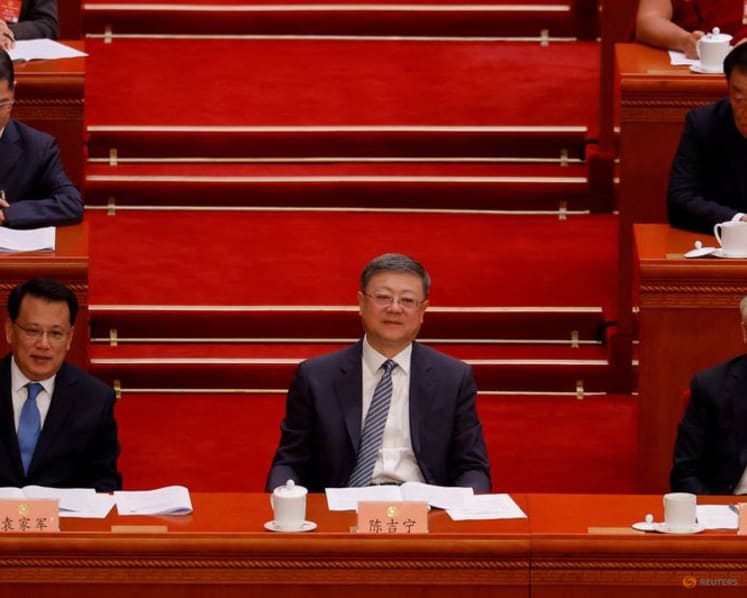
Prior to Chen, three other members of the current Politburo had already come under investigation – He Weidong, Zhang Youxia and Ma Xingrui.
He and Zhang were among China’s most senior military commanders, while Ma rose through the aerospace industry and provincial leadership ranks before becoming Xinjiang party chief. They were part of the leadership lineup selected under Xi in 2022.
The three men have since been expelled from the Communist Party and stripped of their official positions.
The investigation of four sitting Politburo members within a single term is unprecedented, noted Qiu from Eurasia Group. The Politburo is one of the Communist Party’s highest leadership bodies, sitting immediately below the apex Politburo Standing Committee.
“It shows that Xi has tightened his grip on the political elite by making clear that no rank guarantees safety,” he said.

RSIS’ Kam said the party presents such investigations as evidence that even its highest-ranking officials are subject to accountability.
But Hong from Tamkang University said they also expose an “inherent contradiction” in the approach to personnel selection.
“The system focuses only on loyalty and declarations of allegiance, but such declarations cannot distinguish who is genuinely reliable,” said Hong, whose research focuses on Chinese politics and the Communist Party.
Beyond the political implications, analysts also warned that intensified scrutiny could make officials more cautious in carrying out their duties.
For Tseng Wei-feng, an associate research fellow at National Chengchi University’s Institute of International Relations in Taiwan, the investigations reflected stronger oversight of top officials, but he warned that sustained anti-corruption pressure could inadvertently worsen bureaucratic inaction.
“Previous high-pressure anti-corruption campaigns have led officials to become passive in carrying out their duties, because from their perspective, the less they do, the fewer mistakes they make,” he said.

Kam raised similar concerns about Shanghai, where officials are expected to pursue innovation in finance and technology despite anti-corruption investigations involving regulators and banks responsible for approving such initiatives.
“This might lead officials to become more risk-averse,” she said.
Tseng of National Chengchi University also warned that tighter scrutiny could weaken government-business relations, which have traditionally played an important role in local economic development and policy implementation.
“Although such relationships can give rise to corruption, good government-business ties were previously regarded as a major driving force behind China’s rapid economic growth,” he said.
“Now, excessively close government-business networks are regarded as taboo. This will certainly affect policy implementation.”
THE STAKES AHEAD OF THE PARTY CONGRESS
Chen’s investigation has added uncertainty to personnel arrangements for the next leadership term, analysts said, with less than a year to go before the 21st Communist Party Congress, a five-yearly gathering when China’s top leadership lineup is unveiled.
Hong of Tamkang University said Chen had been widely regarded as a potential candidate for the Politburo Standing Committee in 2027, with some even viewing him as a possible successor to Premier Li.
“This time, the investigation has reached someone Xi was preparing for the next leadership term,” he said.
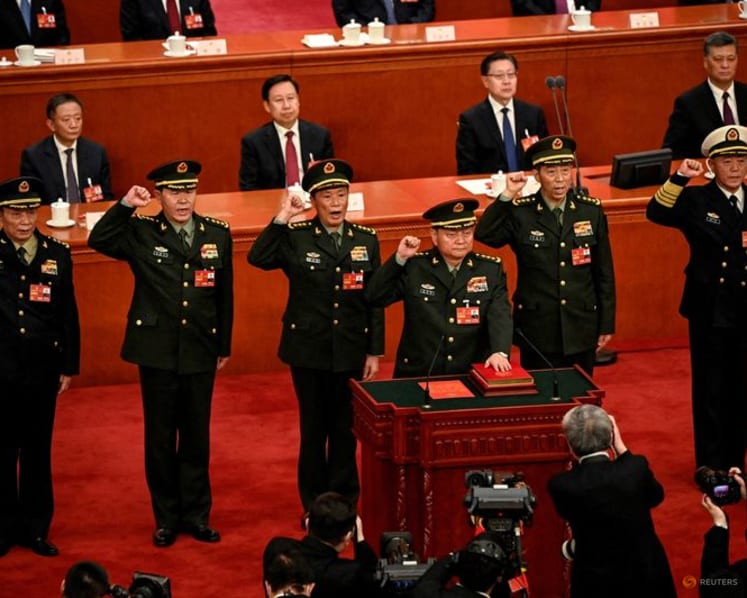

The implications could extend beyond Chen’s own political prospects, potentially affecting how Beijing approaches its next round of senior appointments, said Eurasia Group’s Qiu.
“(The case) narrows the field of trusted candidates and may prompt more caution in future appointments,” he said.
Tseng also linked Chen’s investigation to preparations for the Party Congress, as the Communist Party begins another round of leadership appointments at the central and local levels.
“We can expect to see more similar political declarations of loyalty to the central leadership in the future,” he said, referring to Shanghai’s swift endorsement of Chen’s investigation.
For now, however, authorities have yet to disclose details of the allegations against Chen, and he formally remains as Shanghai party secretary and a member of the Politburo.

Kam from RSIS said the wording of any subsequent disciplinary announcement would be revealing.
“Charges of disloyalty or clique-forming would mark the case as political,” she said.
Whatever the eventual findings, Tseng expects Beijing’s emphasis on strict Party discipline and anti-corruption to remain firmly in place.
“What I believe is institutionally certain is that Xi Jinping’s thinking on party building will remain firmly entrenched,” said Tseng.
“The continued institutionalisation of high-pressure anti-corruption efforts will not change direction.”
Source: CNA/lg(ws)
Sign up for our newsletters

Get the CNA app
Stay updated with notifications for breaking news and our best stories
Get WhatsApp alerts
Join our channel for the top reads for the day on your preferred chat app

Get bite-sized news via a new
cards interface. Give it a try.
Click here to return to FAST
Tap here to return to FAST
FAST







