Genetic study shows seafarers from Easter Island settled Hawaii
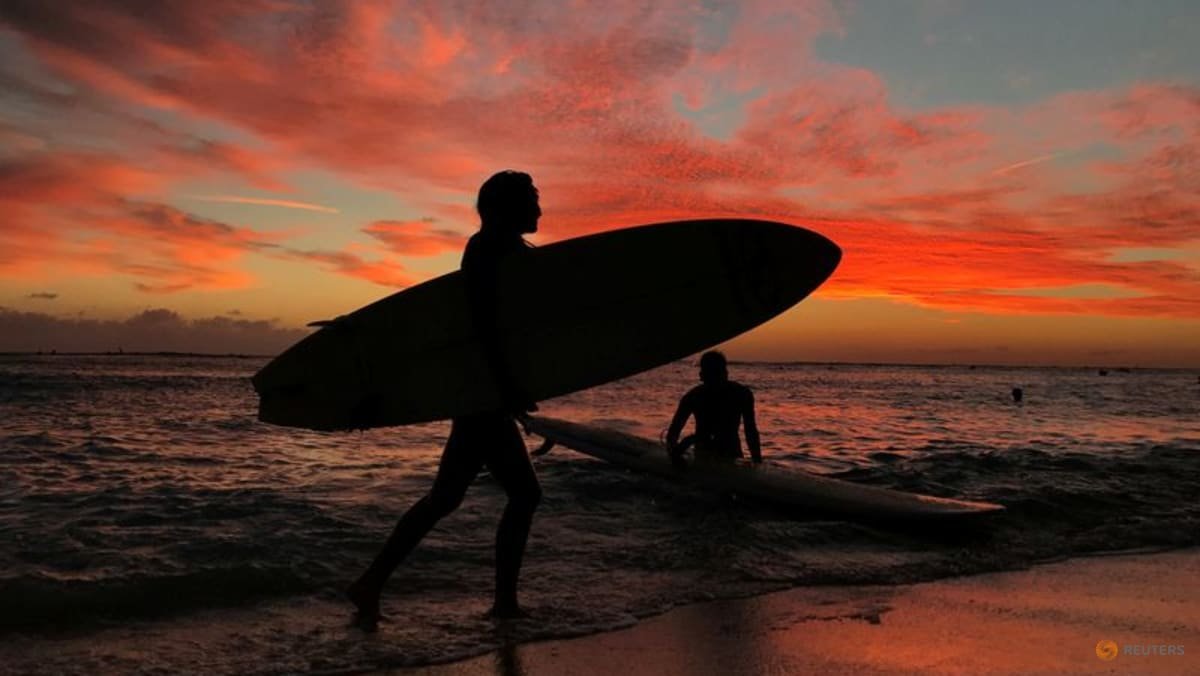
FILE PHOTO: Surfers return to the shore as the sun sets over Waikiki in Hawaii, U.S. December 20, 2016. REUTERS/Kevin Lamarque/File Photo
Read a summary of this article on FAST.
Get bite-sized news via a new
cards interface. Give it a try.
Click here to return to FAST
Tap here to return to FAST
FAST
Oct 20 : It was a difficult, almost incomprehensible, feat. A band of seafarers from Easter Island in the South Pacific set off in double-hulled sailing canoes on a voyage across Earth’s largest ocean that ended more than 4,400 miles (7,100 km) away in Hawaii, the only Polynesian island in the Northern Hemisphere.
But this oceanic odyssey centuries ago was no myth. New genetic research has determined that Native Hawaiians are genetically most closely related to the people of Easter Island, also called Rapa Nui.
“Using whole genomes, our algorithms can find DNA sequences matching perfectly between individuals on different islands, the legacy of common ancestors. From these data we can create family trees of the islands,” said Stanford University computational geneticist Alexander Ioannidis, co-senior author of the study published in the journal Science.
The findings point to a founding population of people from Easter Island arriving in Hawaii as the first humans to settle the lush volcanic island chain.

Guess Word
Crack the word, one row at a time

Buzzword
Create words using the given letters

Mini Sudoku
Tiny puzzle, mighty brain teaser

Mini Crossword
Small grid, big challenge

Word Search
Spot as many words as you can
The data indicated that the people who settled Easter Island arrived there in the 1200s after journeying from Mangareva island in French Polynesia, more than 1,500 miles (2,400 km) away, and that a subset of them subsequently set off for Hawaii. That voyage likely occurred in the same century, Ioannidis said.
“We examined shared segments of DNA, genetic variation and thousands of reconstructed family trees. In 61 per cent of those trees, Hawaii and Rapa Nui were paired together. We checked it four different ways because, frankly, we were dumbfounded and couldn’t believe it ourselves at first,” said genome scientist and study co-senior author Keolu Fox of the University of California, San Diego.
It would have been an incredible journey, Ioannidis said.
“In their canoes, they brought with them plants that they would need on the newly settled island, and they included bananas, taro and sweet potato, as well as animals like the chicken. It is believed that the Polynesians would embark on these voyages across thousands of miles of ocean in order to discover new islands rich in resources and land to settle,” Ioannidis said.
The researchers pieced together these long-ago journeys based on genetic data revealing the relatedness of present-day people from various Polynesian islands, analyzing DNA from more than 1,000 Polynesian people. These included 317 Native Hawaiians, 12 Rapa Nui and 8 Mangarevans, as well as others from the Society, Tuamotu, Marquesas, Austral, Samoan and Tongan islands.
The genetic data showed Mangarevan ancestry was second only to Easter Island ancestry for Native Hawaiians.
MONUMENTAL SEA CROSSINGS
The researchers attribute these monumental sea crossings to an ultravoyaging population they call Holomoana Nui, the Hawaiian phrase for “great ocean voyaging,” with Hawaii as the last destination reached.
They were the greatest voyaging community in human history, according to Fox, who is a Native Hawaiian.
“Polynesians were exploring and settling the Pacific centuries before Europeans began their celebrated voyages of discovery,” Fox said. “Perhaps it’s time to rethink who we call explorers.”
Using genetic data, the researchers previously tracked how Polynesian voyagers reached a succession of islands over a period of centuries in one of the most impressive settlement feats in human history, but that study traced them only as far as Easter Island.
THE FOUNDING OF TAHITI
The new study included a detailed genomic analysis of people from Tahiti, one of the Society Islands and the locale for which the researchers had the most genomes. They were able to estimate the size and date of the founding generation — roughly 800 people reaching Tahiti around the year 1070.
“Since the voyage to Hawaii was much longer, we would expect its founding population size to have been no larger and likely smaller,” Ioannidis said.
Native Hawaiians and Easter Islanders share many cultural traits found among eastern Polynesians, including a similar Austronesian language and similar foods, Ioannidis said.
The study has implications for disease risk among Native Hawaiians and other Polynesians due to genetic bottlenecks called “founder effects.”
These arise when a small portion of a population separates and founds a new population, as the Polynesians did each time they ventured to and settled on a new island. This narrowing of the gene pool can amplify the frequency of some rare genetic variants sometimes related to diseases, while others vanish entirely, Ioannidis said. The Polynesians repeated the pattern of settling on new lands, intensifying the effect.
“Repeated founder effects concentrated rare disease-associated variants in Polynesian populations. We identified variants linked to kidney disease and blindness that occur at surprisingly high frequencies in French Polynesia,” Fox said.
Founder effects have been extensively studied in certain populations including the Amish, Ashkenazi Jews and Finns, leading to standard screenings for certain genetic conditions for them.
“Why not Hawaiians?” Fox asked.
Source: Reuters
Sign up for our newsletters

Get the CNA app
Stay updated with notifications for breaking news and our best stories
Get WhatsApp alerts
Join our channel for the top reads for the day on your preferred chat app

Get bite-sized news via a new
cards interface. Give it a try.
Click here to return to FAST
Tap here to return to FAST
FAST