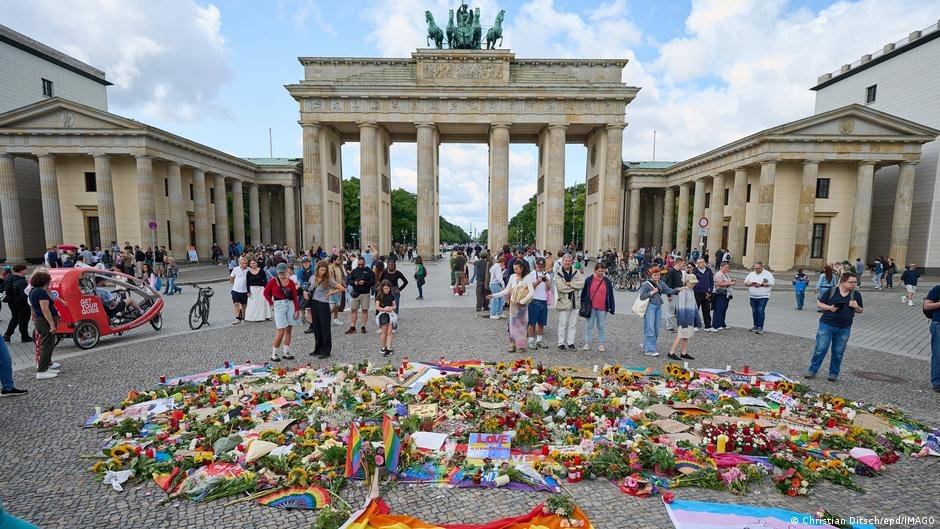
The terrorist attack that struck Berlin’s Pride celebration, or Christopher Street Day (CSD), late on Saturday evening has heightened fears and concerns about further Islamist attacks. Until Sunday evening, when security forces confronted 21-year-old Abdul B. and fatally shot him, most media outlets and the politicians responsible referred to a “suspected perpetrator” and “alleged motives”.
Investigators are now relatively certain that the perpetrator was an Islamist, a radicalized Muslim with links to the “Islamic State” terror group. Politicians and security agencies are debating stricter laws and expanded surveillance powers. Federal Interior Minister Alexander Dobrindt of the conservative Christian Social Union (CSU) is politically responsible for this area.
“With shock and profound dismay, we learned of yesterday’s inhumane attack on the CSD,” the Council of Berlin Imams stated across various channels just over twelve hours after the attack. The Council expressed its solidarity with the victims, their relatives, and the bereaved, and thanked the emergency responders. “This act, which we condemn in the strongest possible terms, demonstrates the terrible consequences to which hatred and hostility toward others can lead. Hatred leads to nothing good.”
To view this video please enable JavaScript, and consider upgrading to a web browser that supports HTML5 video
Two days later, once the perpetrator’s Islamist background had been confirmed, the Council of Berlin Imams issued a second statement, this time in greater detail. It stated that the terrorist attack once again demonstrated that “religiously motivated extremism … poses a real threat to our society.”
“As imams, we cannot emphasize often enough that terror, hatred and violence have no religious legitimacy whatsoever. Anyone who uses the religion of Islam to commit violence against people because of their identity, their beliefs or their way of life, or even to kill them, is acting in direct contradiction to the ethical principles of our religion.” The term “Islamism” does not appear anywhere in the 30-line statement.
The Council of Berlin Imams explicitly condemns “all violence against queer people and members of other minorities in our society”. Such direct references to queer people are relatively uncommon in comparable statements.
The Council has repeatedly faced criticism. Some politicians of the ruling center-right Christian Democratic Union (CDU) and several experts argue that it promotes views that are at odds with Germany’s liberal democratic constitutional system. Others dispute that assessment.
The Council’s latest statement suggests that the imams are keenly aware of the challenges involved. They note that “radicalization rarely happens overnight”. More often, it is the result of a gradual process that unfolds online and across social media platforms. The priority, they argue, must be to reach young people at an early stage and “provide them with guidance, a sense of belonging and future prospects”.
No single institution, they emphasize, can shoulder this responsibility alone.
A few months earlier, one imam had told DW that, for many young people, the internet had long since become the real mosque.
Islam is not the same as Islamism
“Some Muslims reject the term ‘Islamism’ because they fear that even the linguistic association with the word ‘Islam’ harms their religion,” sociologist and religious education scholar Mouhanad Khorchide told DW.
The 54-year-old is the founding dean of the Centre for Islamic Theology at the University of Münster. He does not regard this concern as helpful: “If we categorically deny any connection between Islam and Islamism, we make the necessary substantive engagement with the issue all the more difficult.”
After all, Khorchide argued, Islamists base their arguments on Islamic sources. They claim to speak in the name of Islam. In his view, it is therefore not enough simply to say that Islamist perpetrators have “nothing to do with Islam”. What is needed instead is a nuanced engagement with the issue in order to “deprive Islamist ideologies of their credibility in the long term”.
Berlin’s Ahmadiyya community
The members of Berlin’s Ahmadiyya Muslim community are devout Muslims belonging to a reform movement founded more than a century ago, whose teachings have led many Muslims to reject them as non-Islamic. As a result, they have also been persecuted by Islamists.
In the days following the attack, the Ahmadiyya mosque community in Berlin-Charlottenburg invited the public to a series of dialogue events scheduled for the coming days, as well as to an “open Friday prayer service on the topic of Islamism.”
Burhan Kesici, chairman of the Islamic Council for the Federal Republic of Germany, condemned the attack “in the strongest possible terms” and expressed his sympathy. He concluded with the words: “Muslims in Germany stand for peace.”
Central Council of Muslims in Germany: ‘we condemn all forms of violence’
Similarly, the much longer statement issued by the Central Council of Muslims in Germany (KRM) describes the organization as “deeply shaken” by the attack. “As Muslim religious communities in Germany, we condemn all forms of violence, extremism, terrorism, and contempt for humanity in the strongest possible terms,” it states.
Like the Council of Berlin Imams, the Central Council of Muslims in Germany avoids using the term “queer”, and states: “No one should become the target of violence because of their sexual orientation…”. Addressing the perpetrator’s “Islamist” motive, the Central Council describes the attack as yet another case “in which an extremist ideology misuses religious references to justify hatred and violence.”
Islam and pluralism
According to Professor Khorchide of the University of Münster, many mosque communities, imams and Muslim organizations remain “stuck in an apologetic posture.”
Their main concern, he says, is often “to defend Islam against sweeping accusations and to emphasize that violence and terrorism have nothing to do with Islam”. Although this is “understandable in light of widespread anti-Muslim hostility”, it does not go far enough, Khorchide said: “Anyone who wants to solve problems must first be willing to name them openly.”
Khorchide also points to the conspicuous reluctance to mention the event itself, the “CSD,” and the queer context in which it took place.
Some imams, he argues, avoid a “clear distancing from Islamism” because “on certain socio-political issues, such as attitudes toward sexual diversity or gender roles, they share conservative convictions, even though they naturally reject violence.”
Precisely for that reason, he says, they must be willing to engage in self-critical reflection. “A credible Muslim voice is not one that relativizes problems,” the academic says.
Eren Güvercin, deputy chairman of the relatively small Alhambra Society, is even more outspoken. Founded in 2017, the organization advocates a pluralistic Islam and has drawn criticism from established Muslim umbrella groups because of its broadly liberal orientation.
Güvercin speaks of a “deliberate decision” by many not to name “the motive behind the attack, namely Islamist hostility toward queer people,” nor “the target of the attack, namely queer people and the CSD.”
According to Güvercin, speaking openly about these issues would inevitably raise the question of what their own religious stance toward queer lives actually is, he told DW.
While people are generally able to clearly identify the motives behind far-right attacks, he argues that this willingness is completely absent when it comes to Islamist attacks. There is no serious or self-critical debate within Muslim communities about Islamism as an ideology, nor about hostility toward queer people or antisemitism, Güvercin says.
Muslim organizations that are unable to name problems openly will, in Güvercin’s view, be unable to provide meaningful guidance. “Instead, young people find that guidance from Islamist influencers online.”
This article has been translated from German.
About The Author