Just nowShareSaveAdd as preferred on GoogleHenry MooreandPaul Kirby

 Reuters
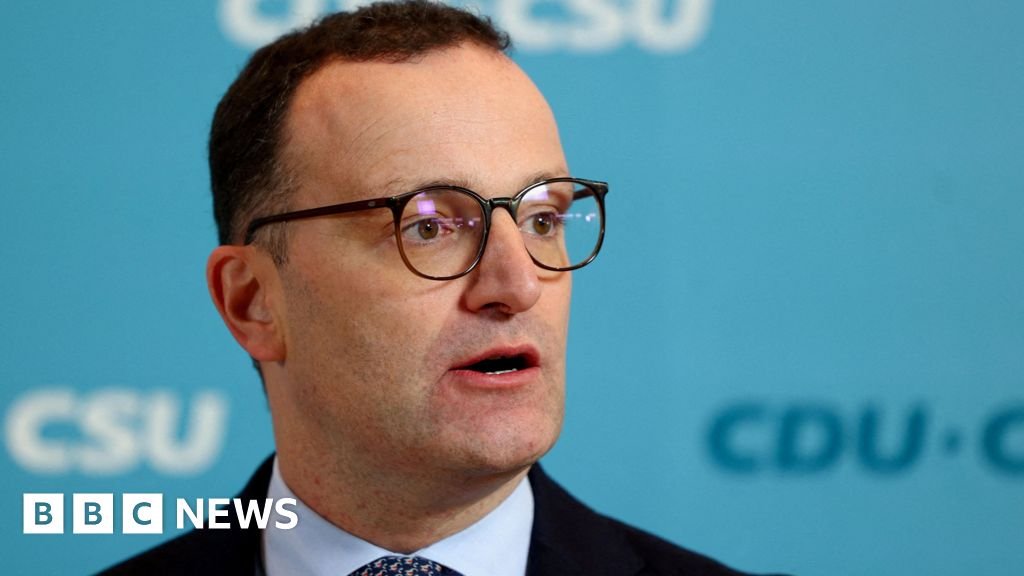
German centre-right politician Jens Spahn has resigned as parliamentary group leader of the country’s governing coalition after being accused of hypocrisy over his use of a surrogate mother in the US to have a child.
Surrogacy is prohibited in Germany – a policy backed by his Christian Democrat party (CDU) and, several years ago, by Spahn himself – although raising a child born to a surrogate mother abroad is not.
He wrote in a statement on Saturday: “I have realised that my personal happiness – founding a family together with my husband and becoming a father – is not compatible with my political office.”
Chancellor Friedrich Merz, who leads the CDU, called his decision “right” and “inevitable”.
“Credibility is the highest asset in politics,” he wrote on social media, and said he would begin the process of appointing Spahn’s replacement.
Spahn, 46, revealed earlier this week that he and his husband Daniel Funke had become parents, with their use of a surrogate abroad prompting criticism from politicians from several parties, including his own.
Announcing his resignation on Saturday, Spahn wrote: “The balancing act between my private decision to have a child through surrogacy and the understandable expectations placed on me as Chairman of our parliamentary group has become greater than I anticipated,” he added.
He also said the “increasing relentlessness in public discourse” had given him “deep pause for thought”.
“Despite all clarity and decisiveness regarding the issues, let us always remain human in our tone,” he wrote.
German media reported Alexander Hoffmann, head of the Christian Social Union parliamentary group, would take over Spahn’s duties as the parliamentary group leader of the CDU and Christian Social Union until a successor was chosen.
Hoffmann said: “Jens Spahn’s decision deserves the utmost respect.”
 Getty Images
Under the 1990 Embryo Protection Act, surrogacy in Germany is punishable with three years imprisonment or a fine.
For many German couples, single-sex or heterosexual, surrogacy abroad has become an important option.
As recently as February, Spahn’s party signed a resolution reaffirming its support for a ban on the practice within Germany itself, to stop the emergence of “commercial or neutral models that turn surrogacy into a business model”.
Critics of Spahn had pointed out that, when he was health minister in 2020, he rejected calls by the liberal FDP for a relaxation on the ban on surrogacy in Germany.
And in 2015, he wrote that “as a gay man and a Christian I find it personally very hard to warm to the idea of a rented womb”.
Prior to Spahn’s resignation, Daniel Peters, a leading CDU politician in the northern state of Mecklenburg-Western Pomerania, told tabloid newspaper Bild that Spahn’s position was “no longer tenable and he must resign”.
He said it was completely wrong that Spahn had disregarded German law and had considered it right to act one way as a private individual and vote another for his party.
Other EU countries including France, Spain and Italy also ban surrogacy, which involves a woman carrying a baby and giving birth on behalf of parents unable to have children themselves.
France’s top court, the Court of Cassation, ruled this month that babies born to a surrogate mother abroad should be legally recognised as their intended parents’ children.
Meanwhile, Italy made it illegal in 2024 for Italians to have a baby abroad through surrogacy, in a policy driven by Giorgia Meloni’s right-wing government.