Skip next section What you need to know
What you need to know
- A majority of people in Germany expect the far-right AfD party to lead at least one state after regional elections in the fall
- Hamburg residents vote against the city bidding to host the Summer Olympics
- The Brenner Pass, a major Alpine route, has reopened after a closure due to a rally against traffic jams and noise pollution
- Autopsy to be carried out on ‘Timmy’ the whale after the corpse was brought to shore in Denmark
These updates have been closed. Thank you for reading.
Below, you can review DW’s coverage from and about Germany on Saturday, May 30, and Sunday, May 31, 2026:
Tired of missing our real-time updates? Click here to add us as a Preferred Source on Google. Then tap the “Star” or “Preferred” to keep DW News at the top of your feed.
Skip next section Hamburg: residents vote against Olympic bid05/31/2026May 31, 2026
Hamburg: residents vote against Olympic bid
Residents of the northern German city of Hamburg have voted against a future Olympic bid, according to preliminary referendum results on Sunday.
Around 1.3 million people from the age of 16 were eligible to vote, with turnout at 49.5%.
Although the final results were still being counted, state electoral chief Oliver Rudolf confirmed that a majority of participants were opposed to a bid to stage either the 2036, 2040 or 2044 Summer Olympics in Germany’s second-largest city.
Hamburg was competing with Munich, Berlin and a Cologne-led Rhine-Ruhr region bid to become the German candidate, with a decision to be made by the German Olympic Sports Confederation (DOSB) on September 26 – but Sunday’s vote officially takes Hamburg out of the running.
Munich’s bid was backed by a 66.4% majority in a referendum, and Cologne/Rhine-Ruhr by 66%. In Berlin, the local parliament approved the bid without a vote.
For Hamburg, it’s the second time that residents have voted against the Olympics, after a similar referendum in 2015.
Supporters of the city’s latest effort highlighted the existence of sporting venues and the potential boost for the city’s infrastructure.
But critics argued that money should be spent on more pressing projects and pointed out uncertainties over the overall costs.
Germany has previously hosted the Summer Olympics in Berlin, under the Nazis in 1936, and in Munich in 1972, an event that was overshadowed by the murder of 14 Israeli athletes by the Palestinian terror organization Black September.
To view this video please enable JavaScript, and consider upgrading to a web browser that supports HTML5 video
https://p.dw.com/p/5Ecw6Skip next section French Open: Zverev favorite after reaching quarterfinals05/31/2026May 31, 2026
French Open: Zverev favorite after reaching quarterfinals
German tennis number one Alexander Zverev has reached the quarterfinals of the French Open for the sixth year in a row after beating Dutch wildcard Jesper de Jong in straight sets, 7-6 (7-3), 6-4, 6-1.
Zverev overcame a slow start to the match, in which he lost the opening three games before eventually taking the first set after a tie-break.
“It was a bit difficult to start with,” said Zverev, adding that he would have preferred the usual hot Paris weather rather than this weekend’s milder temperatures.
“I like it when it’s hot; my opponents usually have more problems with it,” he said. “But Paris is like Germany and the weather can change quickly. But I’m used to it and I hope I can keep playing good tennis.”
After number-one seed Jannik Sinner and record Grand Slam title holder Novak Djokovic were knocked out in the second and third rounds respectively, second seed Zverev is now the highest-ranked male player left at Roland Garros and is the favorite to win his first-ever Grand Slam.
“I just have to concentrate on the things that I can influence, and those are my matches,” said the world number three, who will now face Spanish teenager Rafael Jodar in the quarterfinals.
“It will be a very difficult challenge,” said Zverev. “I need to trust myself and I’ll be well prepared.”
https://p.dw.com/p/5EcoXSkip next section FDP elects veteran right-winger Kubicki as new leader – but divisions remain05/31/2026May 31, 2026
FDP elects veteran right-winger Kubicki as new leader – but divisions remain
Germany’s Free Democratic Party (FDP) has elected a new chairman: Wolfgang Kubicki, a 74-year-old veteran from the right of the economically liberal, pro-business party.
Kubicki was expected to be elected unopposed at Saturday’s party conference, but he faced a surprise, last-minute challenge from Marie-Agnes Strack-Zimmermann, a veteran member of the European Parliament and defense hawk who represents the more socially liberal wing of the party.
Kubicki emerged victorious with 59.3% of the votes but the fact that Strack-Zimmermann won 39% showed that the party remains divided – and those divisions played out in public this weekend as the two candidates took aim at each other via the tabloid media.
“Wolfgang knows now that it’s 60-40,” Strack-Zimmermann told BILD, warning Kubicki against taking the party too far to the right. “We will be watching very closely where the party is headed.”
Kubicki hit back, telling the same newspaper: “Marie-Agnes, you only got 40% so you know exactly what the score is. If you want to lead the FDP into irrelevance, then keep going.”
At the conference, Kubicki called on his party to be aggressive on divisive issues and lamented that the “space for debate” in German politics was getting smaller. “Real problems are automatically pigeon-holed as right wing,” he said, saying that issues such as immigration, climate and freedom of expression shouldn’t be left to the far-right Alternative for Germany (AfD).
In a speech to delegates, he specifically mentioned migration policy, criticizing “uncontrolled immigration” and the creation of “parallel societies,” and stated that economic growth should take priority over climate protection.
What is the FDP’s stance on the AfD?
Kubicki is an opponent of the so-called “Brandmauer” (firewall) strategy in which democratic German parties refuse to form coalitions with the AfD, and hasn’t ruled out forming political majorities with the party.
Parts of the AfD have been labelled “extreme right” by the Federal Office for the Protection of the Constitution (Bundesverfassungschutz or BfV).
Strack-Zimmermann argued that Kubicki’s position on the firewall might earn him “applause and a few pats on the back from reactionaries in the pub” but wouldn’t win back votes from the AfD.
The FDP formed part of the German government between December 2021 and November 2024 as the junior partner in a coalition with former chancellor Olaf Scholz‘s Social Democrats (SPD) and the Green Party.
After quitting the coalition over policy differences and failing to reach the minimum 5% required to enter parliament in the 2025 federal election, former leader Christian Lindner stepped down. The party has since been in the wilderness.
To view this video please enable JavaScript, and consider upgrading to a web browser that supports HTML5 video
https://p.dw.com/p/5EcizSkip next section WATCH: Threats to mayors pose danger to wider democracy05/31/2026May 31, 2026
WATCH: Threats to mayors pose danger to wider democracy
As in many other countries, violence and threatened violence toward people in political office is on the rise.
In Germany, even mayors are facing growing abuse and threats, causing some to quit and deterring those who might otherwise have been ready to take on this important role.
DW spoke to several mayors about the problem:
To view this video please enable JavaScript, and consider upgrading to a web browser that supports HTML5 video
https://p.dw.com/p/5EcHKSkip next section Two WWII bombs defused in Osnabrück amid mass evacuation 05/31/2026May 31, 2026
Two WWII bombs defused in Osnabrück amid mass evacuation
Bomb disposal experts in the northwestern city of Osnabrück have dealt with two bombs left over from World War II, with authorities saying some 1,600 people were ordered to leave their homes for hours while the work was going on.
One of the two 50 kg (110 lb) unexploded bombs was defused and the other underwent a controlled explosion, city officials said.
The bombs were found at the site of a former freight rail terminal where a new, practically car-free district is to be established with housing potential for some 3,500 people.
In the course of the construction work, there have so far been eight such defusal operations, during which 23 bombs were disposed of, officials said.
The biggest resulting evacuation was of 20,000 people in July 2025.
https://p.dw.com/p/5EcHBSkip next section Ukraine’s Zelenskyy thanks Germany for Iris-T air defense05/31/2026May 31, 2026
Ukraine’s Zelenskyy thanks Germany for Iris-T air defense
Ukrainian President Volodymyr Zelenskyy on Sunday expressed gratitude to Germany, saying his country had received a new launch pad for the Iris-T air defense system.
“We thank Germany for its contribution to the protection of our people,” he wrote on the Telegram messaging app.
Zelenskyy said Russia had deployed around 2,300 drones, 1,560 guided glide bombs and 108 missiles against Ukraine this week alone, making it vital to have a constant supply of air defense missiles.
Germany has not confirmed Ukraine’s reception of the air defense system, but had already supplied seven Iris-T systems to Ukraine as of 2025.
https://p.dw.com/p/5EbizSkip next section German representatives, AfD politicians to attend Putin’s economic forum05/31/2026May 31, 2026
German representatives, AfD politicians to attend Putin’s economic forum
Members of Germany’s business community are set to officially attend the economic forum in the northern Russian city of St. Petersburg in early June after staying away for four years over Moscow’s invasion of Ukraine.
The forum has been held under the auspices of the Russian president since 1997.
Its program says that German participants will include Stefan Dürr, a dairy producer operating in Russia with the EkoNiva Group, and Thomas Bruch, the longstanding managing director of Globus Holding.
Matthias Schepp, chairman of the German-Russian Chamber of Commerce, defended the attendance by German businesspeople to the dpa news agency.
“Not least with a view to the period following a ceasefire, we want, like other major Western countries, to maintain the economic bridge to Russia and protect the more than €100 billion ($116 billion) of German assets in Russia,” he said.
“The West should not leave Russia, its large market and its raw materials to Asia in the long term,” said Schepp.
US and French representatives returned to the event last year to take part in its so-called business dialogue component.
Western sanctions on thousands of Russian companies, organizations and individuals over the Ukraine invasion are still in place, with the trade volume between Germany and Russia falling beneath €10 billion ($11.66 billion) last year.
That compares with a volume of €59.7 billion in 2021 and €80 billion at its peak in 2012, making Germany Russia’s biggest trading partner in the European Union before the invasion launched in 2022.
Organizers said that several German representatives will also be attending an event about culture as way of building connections in times of crisis.
They include the conductor and pianist Justus Frantz, the founder of the popular Schleswig-Holstein Music Festival, who in 2025 received an Order of Friendship from Russian President Vladmir Putin.
The chairman of the Saxony branch of the far-right Alternative for Germany (AfD), Jörg Urban, the AfD’s chairman in the southern state of Baden-Württemberg, Markus Frohnmaier, the Berlin publisher Holger Friedrich and the filmmaker and journalist Hubert Seipel are also expected to attend.
https://p.dw.com/p/5EbTxSkip next section Vote on future Hamburg Olympic bid underway05/31/2026May 31, 2026
Vote on future Hamburg Olympic bid underway
Hamburg is holding a referendum on Sunday, with voters asked to say whether they are in favor of the northern city-state bidding to host the Olympic Games in 2036, 2040 or 2044.
Some 1.3 million people from the age of 16 can cast a ballot.
Hamburg is in competition with Munich, Berlin and the Rhine-Ruhr region, all three of which want to make a bid.
The decision on who will bid and for which year will be made by the German Olympic Sports Confederation on September 26.
The unofficial final result is expected by 10 p.m. (2000 GMT).
In 2015, Hamburg’s plan to bid for the 2024 Olympics was canceled after a referendum in which just over half of voters cast a “no” ballot.
Germany hosted summer Olympics in 1936 in Berlin and in 1972 in Munich.
https://p.dw.com/p/5EbZESkip next section One injured after explosion at Cologne shisha bar05/31/2026May 31, 2026
One injured after explosion at Cologne shisha bar
An explosion at the entrance to a shisha bar in the inner city of Cologne early on Sunday morning was deliberately caused, police believe.
They said all guests had left the bar by the time the blast went off.
A female tenant in the apartment above the bar suffered slight injuries from smoke inhalation and was treated in hospital, they said.
Witnesses said they saw several people who had caused the explosion fleeing the scene.
Firefighters called to the bar managed to extinguish a fire caused by the blast, but police said there had been severe damage to the front of the premises.
Police are investigating the cause of the explosion.
https://p.dw.com/p/5EbPQSkip next section Majority expects at least one far-right state premier after fall votes — survey05/31/2026May 31, 2026
Majority expects at least one far-right state premier after fall votes — survey
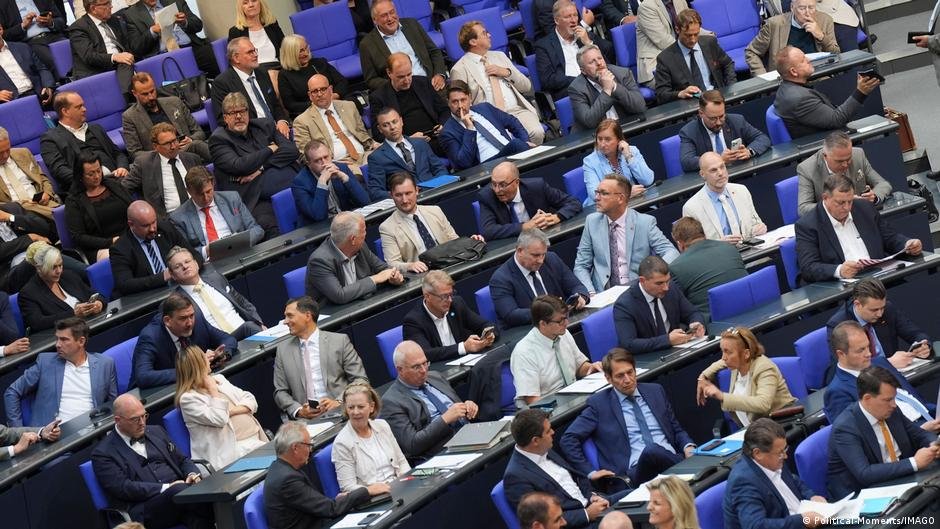
A majority of people in Germany expects a premier from the far-right Alternative for Germany (AfD) party to take office in at least one of the three states holding elections this fall.
According to the survey from the INSA polling institute conducted for the weekly Bild am Sonntag newspaper, 69% consider this a given.
Of those, 28% expect an AfD premier in not just one but several states.
Just 16% think that the AfD will not succeed in taking power in at least one state, with 15% undecided.
If the AfD fails to win an absolute majority, 40% of respondents wanted to see cooperation between the center-right Christian Democrats (CDU) and the Left Party to form a state government, as against 36% in favor of CDU/AfD cooperation.
This tendency is clearer among conservative voters, 48% of whom would prefer the CDU to cooperate with the Left Party as against 27% in favor of the CDU working with the AfD.
Altogether 38% were in favor of banning the AfD — which has long been under scrutiny by the domestic intelligence agency for possible extremist tendencies — while 47 % were against a ban.
State elections are to take place in Saxony-Anhalt, Mecklenburg-Vorpommern and Berlin in September.
https://p.dw.com/p/5EbLASkip next section Welcome back05/31/2026May 31, 2026
Welcome back
Danke schön for coming back to our coverage of the latest stories from Germany after our overnight pause.
We will possibly be returning to our big story about the protest at the Brenner Pass on Saturday, with authorities expecting traffic through the corridor to resurge massively after a day’s closure.
Sunday in Germany is also the day when newspapers tend to print results of various surveys giving insights into the trends sweeping German society, so our blog will include several of these.
Please read on for more news from Europe’s biggest economy.
https://p.dw.com/p/5EbKYSkip next section We’re pausing our coverage05/31/2026May 31, 2026
We’re pausing our coverage
We’ll be pausing our coverage of the news coming out of Germany this weekend, but we’ll be back bright and early on Sunday morning.
https://p.dw.com/p/5EbB6Skip next section All lanes open at Brenner Pass after large protest05/30/2026May 30, 2026
All lanes open at Brenner Pass after large protest
The Brenner Pass linking Austria and Italy has been reopened following a rally against heavy traffic.
“All lanes are open again,” a spokesman for the motorway operator Asfinag told the DPA news agency.
Thousands of people had crowded the Alpine pass earlier on Saturday, demanding an end to pollution, noise and traffic jams caused by heavy traffic on the key road.
While officials warned of possible traffic jams due to the rally, no major disruptions were reported in the area.
Police said 219 trucks were turned back during the hourslong protest.
https://p.dw.com/p/5EaoESkip next section IN DEPTH: Vaping becoming more popular among young people in Germany05/30/2026May 30, 2026
IN DEPTH: Vaping becoming more popular among young people in Germany
A recent study shows that e-cigarettes are becoming increasingly popular among young people in Germany, with even elementary school kids picking up vapes. Social media influencers are fueling the hype, but a senior government official hopes to ban flavors that appeal to young people.
Read our full report here.
https://p.dw.com/p/5Ea1ZSkip next section Thousands protest new gas-fueled power plants in Germany’s Hamm05/30/2026May 30, 2026
Thousands protest new gas-fueled power plants in Germany’s Hamm
Some 5,000 people took part in a protest in the northwestern German city of Hamm against government plans to construct new gas-fueled power plants, protest organizers said on Saturday.
Police estimated the number of attendees at around 2,700 people.
Germany’s ambitious strategy of switching to renewable energy sources and becoming climate-neutral by 2045 has been put under increasing pressure due to the geopolitical conflict with Russia and the more recent disruption in the Strait of Hormuz.
In response to the twin crises, the government is focusing on ensuring consistent energy supply rather than managing the long-term transition. Some climate activists have decried the shift as a quiet rollback of the official environmental goals.
The government has now pledged to construct new gas-powered plants, which would eventually be fueled by environmentally friendly hydrogen.
Even so, activists in Hamm say the state should not be investing in fossil fuels. Several environmental groups, including Fridays for Future and Greenpeace, helped organize the protest on Saturday.
“We want future, not gas, and we are joining forces against the government’s rollback of climate policy,” the organizers said.
To view this video please enable JavaScript, and consider upgrading to a web browser that supports HTML5 video
https://p.dw.com/p/5Ea6wShow more posts
About The Author