https://p.dw.com/p/4nWP0Prefer DW on Google
Domestic violence has reached a record high in Germany, with 16 women subjected to physical abuse behind closed doors each hour.
UN Women Germany is one of the 13 UN Women national committees worldwide, each an independent, non-profit, non-governmental organization committed to gender equality and the empowerment of women and girls. Their current campaign ‘Orange The World’ runs from the start of International Day for the Elimination of Violence Against Women on November 25 to December 10, International Human Rights Day. It is designed to raise awareness around violence against women in the country and worldwide. The 2026 campaign’s focus is particularly on men’s responsibility in ending gender-based violence.
“In these 16 days of activism, we can deliver a lot of information. Survivors of gender-based violence can find out where to get support and be reminded that they are not at fault,” UN Women Germany chair, politician and long-standing campaigner for women’s rights Elke Ferner told DW. “The debate helps and it’s a chance to change consciousness about the topic.”
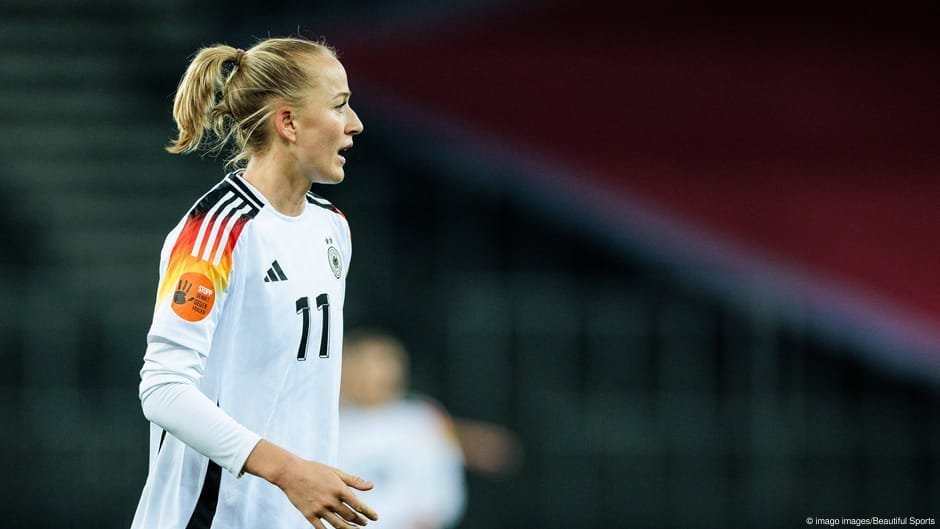
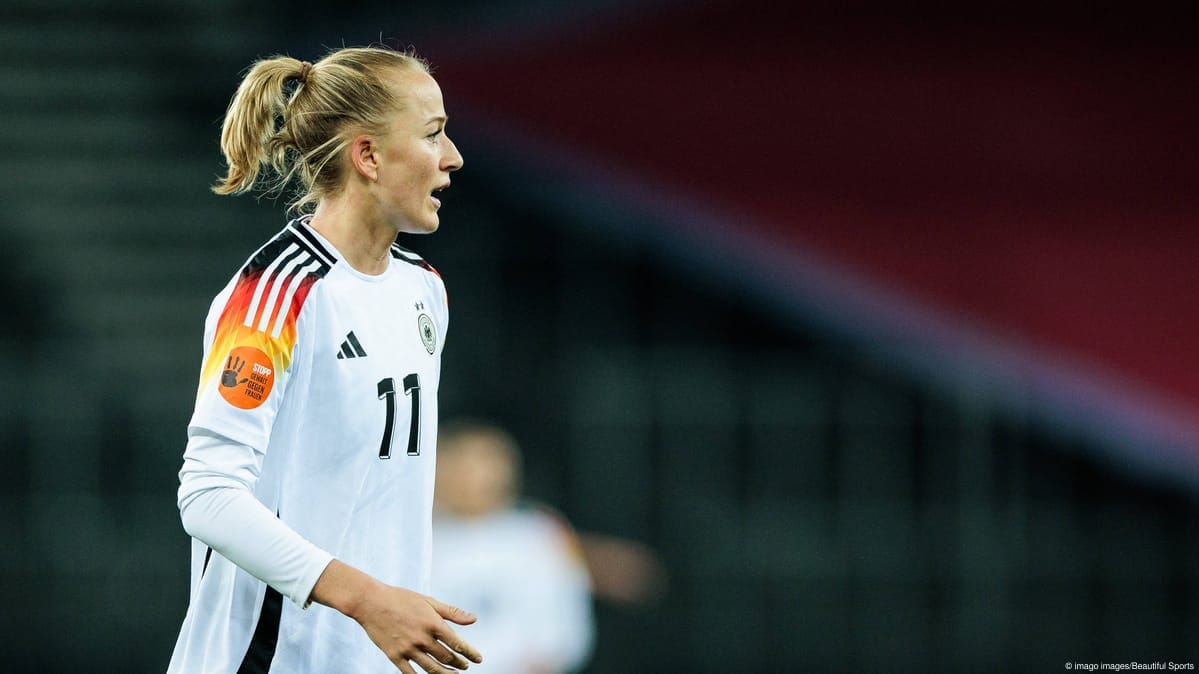
Germany captain Giulia Gwinn said in a statement via the German Football Association (DFB): “Violence against women and girls affects us all and must have no place in our society. As the women’s national team, we therefore want to once again use our reach to create awareness for this important issue and jointly set a visible sign against violence.”
The campaign with the women’s team is not new. Two years ago, the team joined the campaign, delivering a moving video that saw players reveal the truth of statements by crossing out words.
In Germany’s upcoming South America tour — part of their preparations for the 2027 World Cup in Brazil — they are to wear special UN Women Germany badges on their sleeves in their games against Argentina and Peru.
Role models pivotal for the campaign
Ferner believes the work with role models is pivotal and that the campaign is powerful, especially in a football context. A 2022 study from Warwick Business School in the UK revealed alcohol-related domestic abuse rises by nearly 50% after England’s men’s football team win a World Cup game, nevermind lose. Currently, there is no data on domestic abuse during Germany games, however during the 2026 World Cup last summer, Berlin police recorded a 31% increase in domestic violence compared to the week before.
Ferner is encouraged that sport has understood the importance of the issue, and that the German Olympic Committee (DOSB) and other sports clubs and organizations are helping move the conversation forward. In sport, this is particularly important given the problematic nature of dependency relationships that so often exist in high-performance environments. But violence against women is really a societal issue that is not specific to class, origin, religion or societal space, such as sport.
“Violence against women has structural origins and to change that you need to change the structures,” Ferner said. “You just need to do it. I always say, this isn’t about a lack of knowledge but rather a lack of action.”
Performance is an integral part of sport, but a multi-dimensional understanding of it might help shift perspective in a country that remains driven by a performance culture.
“What is performance? Higher, faster, further? Or is it managing to look after a family of three?” Ferner asked. “Why do people who repair washing machines earn more than those looking after your kids in nursery? This is about changing business culture, but also awareness around the role men play at home and in the family.
“The picture boys and young men get of girls and women in school is a problem that needs addressing. We can’t wait for generational change. This is about saving lives. We need to change societal structures.”
Male power structures a problem
Sports structures are equally in need of reform. Non-profit organization Safe Sport provides independent support for people affected by sexual, physical and psychological violence in both amateur and professional sport in Germany. They are the only organization with a specific focus on violence in grassroots sports in Germany, and one of only two in professional sport in the country. They also have to contend with structures, in a sporting context, that make spaces less safe for women.
“Gender roles have become more fluid in the last few years, but in associations and clubs management positions are still occupied by men, regardless of the sport,” Safe Sport manager Ina Lambert told DW.
“In professional sport, there are a lot fewer women involved in training and so the space remains male dominated, and, as a result, so do the power structures.
“We have people in search of advice, men included, who see the problems and want to enforce change, and we offer them support so they are not alone,” Lambert said. “But whether in a big association or a small club, perpetrators are frequently protected, incidents are ignored and so the people who want to enforce change are often prevented from doing so.”
Safe Sport, which provides free psychological and legal support, has only been in action since July 2023, but in that time the number of support requests they have received continues to grow. Psychological violence in sport in Germany is the most common case they are faced with, but sexual violence is also a major problem.
“There is finally recognition of the problem and there is a seriousness about tackling it,” Lambert said.
“There is a lot of good work being done in the right direction, with many good concepts for prevention, intervention and processing violence, as well as more education, holistic training and focus on women’s menstrual cycles.”
Comprehensive support on the way
Germany’s interior ministry is leading the process with participants from the the country’s states, organized sport, affected parties and academia to create a central hub. The center for safe sport was founded in July 2026, but investigative and sanctioning work is expected to begin in the spring of 2027.
Support from leading figures clearly makes a huge difference, but it’s also clear that more data is needed. Addressing the underlying issues, such as social norms and gender stereotyping, is a must. After all, as UN Women Executive Director Sima Bahous said: “No country has yet eliminated violence against women. Ending it requires transformative action — greater investment, innovation, and unwavering political will.”
This article was originally published on November 28, 2024 and updated on November 25, 2026.