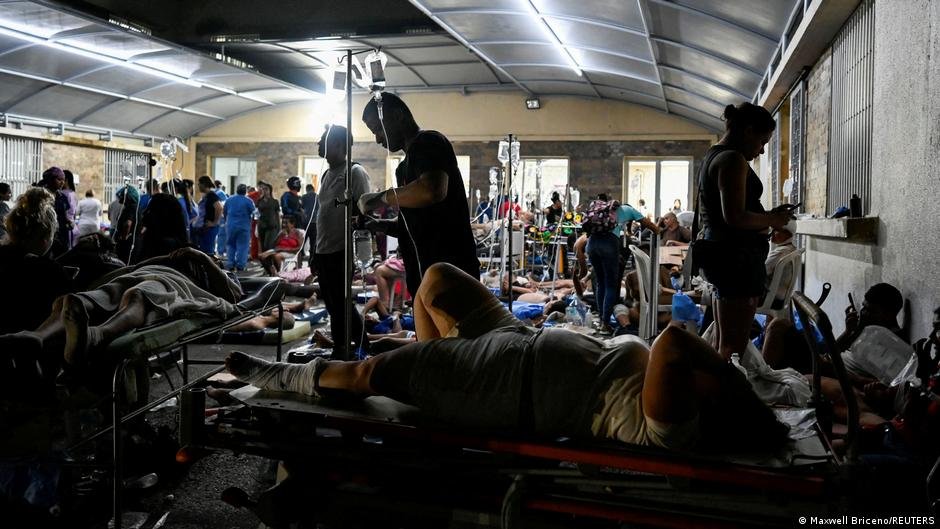
Two major earthquakes struck central Venezuela seconds apart on Wednesday, one with a magnitude 7.2 and the other with a magnitude 7.5. At least 32 people have been killed, and hundreds injured.
Extensive damage was reported in the capital, Caracas, and the nearby state of La Guaira.
Strong earthquakes are unusual in Venezuela, even though it sits near multiple fault lines along the South American and Caribbean tectonic plates. Other countries on the Pacific coast, including Mexico, Chile and the western edge of the United States, are positioned along the seismically active tectonic belt known as the Ring of Fire, responsible for about 90% of the world’s earthquakes.
However, several countries that once faced devastating losses have proven that living with earthquakes doesn’t have to mean living in fear. Their experiences show that resilience isn’t just about surviving the next earthquake but about building systems that protect lives before the ground begins to shake.
How have they done it?
Japan: Engineering harmony
Japan is one of the world’s most earthquake-prone countries. Over decades, it has transformed vulnerability into resilience, thanks to a mix of technology, architecture and public preparedness.
A key pillar is the Earthquake Early Warning system, operated by the Japan Meteorological Agency. Since 2007, this system has used over a thousand seismic sensors to detect the first, weaker P-waves (primary waves) and send alerts through phones, TV, radio and loudspeakers, giving people critical seconds before stronger shaking begins.
Japan’s resilience has also been built into its cities. After the Great Kanto Earthquake of 1923, building codes were strengthened, though it took some time.
A major shift came in 1981, when new regulations (Shin-Taishin) required all new constructions to meet stricter seismic standards. Many essential facilities, such as hospitals and government centers, now use seismic isolation systems — engineering solutions that allow structures to sway and to absorb, rather than resist, energy.
Miho Mazereeuw, an associate professor at Massachusetts Institute of Technology and director of the Urban Risk Lab, explained this approach to CNN after the 2024 Noto Peninsula earthquake. “Conceptually, it all comes back to the idea that, rather than resisting the movement of the Earth, you let the building move with it,” she said, explaining how preparedness is part of everyday life in Japan.
Earthquake drills start from a young age, evacuation routes are clearly marked and parks and schoolyards double as gathering points. Tokyo alone has over 240 official evacuation sites, which are updated regularly to adapt to the city’s growth.
Chile: Transformation forged by experience
Stretching along South America’s Pacific coast, Chile also sits on the Pacific Ring of Fire. The catastrophic 1960 Valdivia earthquake — with a magnitude of 9.5, the strongest ever recorded — reshaped the country’s disaster policies. The quake and resulting tsunami caused devastation both locally and abroad.
In response, Chile underwent sweeping changes and introduced strict building regulations requiring seismic resilience. These reforms proved their strength in 2010, when the 8.8-magnitude Maule earthquake struck and many modern buildings stood firm.
Chile’s evolution extended beyond construction, and disaster management became a national effort. Institutions such as the Chilean National Disaster Prevention and Response Service (SENAPRED) were established to align risk reduction strategies across sectors, and Chile strengthened its ties with international bodies.
“We learned that there is no single solution,” said Alicia Cebrian Lopez, SENAPRED’s national director, during a 2024 roundtable organized with the United Nations. “We need a combination of measures — from policy changes to capacity building — that can adapt to the specific realities of each community.”
Municipalities also play a crucial role, with community committees identifying local risks and developing action plans. Schools conduct regular earthquake drills, embedding preparedness early into daily life.
Mexico: From tragedy to awakening
Mexico has a long and painful history with earthquakes, but the country has also shown resilience. It sits atop several tectonic plates, including the Cocos and North American plates, making it highly seismic.
A turning point came on September 19, 1985, when an 8.0-magnitude earthquake devastated Mexico City. The disaster exposed deep flaws in construction and emergency response, triggering demand for change.
Subsequently, Mexico developed one of the world’s first public earthquake early warning systems, launching the Mexican Seismic Alert System (SASMEX) in 1991. Today, coastal sensors detect major earthquakes and provide up to a minute of warning to inland cities — enough time to seek shelter, stop trains and trigger emergency systems.
To view this video please enable JavaScript, and consider upgrading to a web browser that supports HTML5 video
When another major quake struck on September 19, 2017, Mexico was better prepared. Although the 7.1-magnitude quake caused damage and loss of life, improved buildings and faster response saved many lives.
Today, September 19 is commemorated nationally through earthquake drills involving schools, businesses and public institutions — reinforcing the idea that resilience demands constant readiness.
Canada: Creating spaces for community response
Along Canada’s west coast, cities including Vancouver and Victoria are preparing for potential seismic disasters. Situated near the Cascadia Subduction Zone, the region faces the threat of rare but devastating earthquakes.
“Roughly 3 billion people live in areas of high seismic activity, and it is projected that by 2050, populations in major cities at risk from earthquakes will double,” explained Jeff Birchall, assistant professor at the University of Alberta, in a 2019 study.
He emphasized that public gathering spaces — parks, sports fields, libraries and public squares — would be vital for survival and recovery after a disaster.
In Vancouver, this thinking has already taken hold. The city has developed a network of disaster support hubs, comprising community centers, parks and even one branch of the public library. Marked with yellow signs, these hubs are designed to serve not only as shelters but as points for emergency supplies, medical help and recovery coordination.
Rather than focusing solely on buildings, Vancouver’s strategy strengthens the fabric of community resilience. If an earthquake strikes, public spaces ready to transform into lifelines will help ensure the city can act and recover quickly when it matters most.
This article was originally written in Turkish and published on April 28, 2025. It was last updated on June 25, 2026.
About The Author