Since 2018, Abiy Ahmedhas been the most powerful man in Ethiopian politics, governing the country during some of its most trying days in recent history. From the Tigray war to a feeble but lasting peace with neighboring Eritrea, Abiy has actively shaped and reshaped Ethiopia’s role in Africa and indeed the world.
Soon, he might even get to consolidate more power and influence in his office, as Ethiopia‘s political system might fundamentally change in the future.
After weeks of consultations, there are indications that the offices of prime minister and president could be merged. This would mean that the largely ceremonial presidency could thus become the center of political power in the country.
While details of the precise redesign of the system remain unclear, local reports say that the consultations indeed resulted in a positive recommendation to create a stronger presidency.
For Abiy, that would likely be a remarkable prospect.
Support for a new office
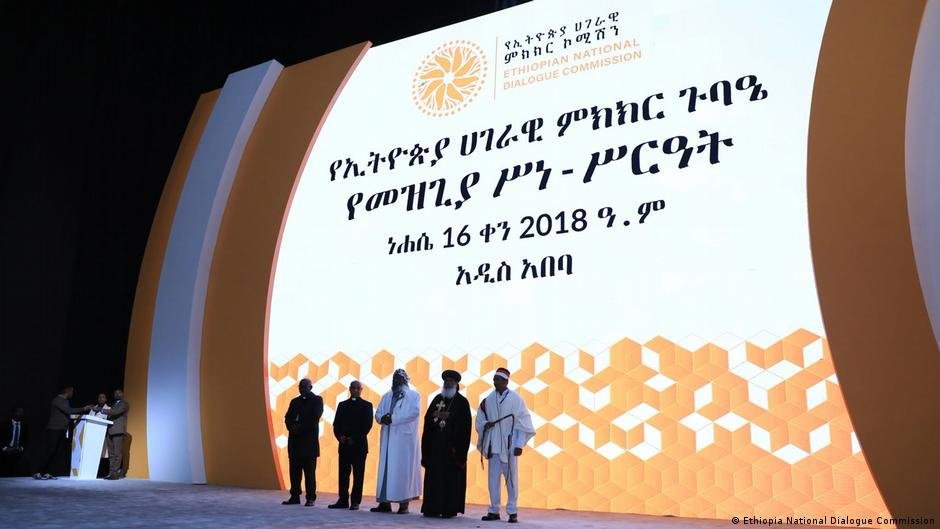
During a drawn-out national dialogue with around 4,000 delegates in Addis Ababa in recent weeks, participants discussed some of the country’s key political conflicts, including the overall structure of the state, ongoing ethnic tensions, the rule of law and human rights — as well as the role of the prime minister.
Abiy did not take part in these meetings but could benefit significantly from their endorsement of a presidential system.
One key element for any constitutional reform to be pushed through parliament is already in place: Abiy won June’s parliamentary elections with a massive majority, which could help him and his party advocate for a presidency with broader executive powers.
Benefits of a stronger presidency
Supporters of a stronger presidency see it as a way of bringing Ethiopia’s ethnically and regionally fragmented society closer together.
They say a president representing the country as a whole could help strengthen a national political identity.
Befeqadu Hailu, an Ethiopian civil rights activist and political commentator, told DW that this might be a strength of the proposed new system, and that a president directly elected by the public would have a stronger mandate to govern.
Hailu believes that in future elections, a presidential candidate would have to convince “more than one ethnic group and more than one religious group” to win, which could help strengthen democratic processes.
At the same time, he warned that “[p]residential systems are more prone to descending into dictatorship.”
How much more power is there to take?
But the key question is not who would become president, but rather what powers this office would have — as well as who would be tasked with holding the president to account.
Ethiopia already has a powerful executive branch, and since taking office in 2018, Abiy has consolidated more and more political power.
The creation of the Prosperity Party in 2019 under his leadership, formed from a number of coalition partners, has already considerably reshaped the country’s political system and significantly limited the role of the opposition.
Abiy also controls the military and security apparatus, with little power left to grab under a new system.
For British journalist and Ethiopia expert Martin Plaut, the proposed reform is therefore less of a transfer of power to one person than an act of “formalizing the situation that currently exists.”
To view this video please enable JavaScript, and consider upgrading to a web browser that supports HTML5 video
‘Legal does not mean legitimate’
The proposed reform also raises a fundamental question about democratic processes: Can such a concentration of power be viewed as the will of the people if it is enacted through legal procedures in parliament? Or should there perhaps be a plebiscite on the proposed changes?
In this context, civil rights activist Hailu highlights the importance of distinguishing between procedural and popular legitimacy.
In Ethiopia, he says, existing political institutions have “procedural legitimacy” to enact such changes while they lack broad “popular legitimacy.”
Hailu says bluntly that “no one believes that Ethiopia has ever had democratic elections,” referring to the most recent parliamentary election, which took place under difficult conditions: Voting was not possible in several conflict-ridden regions of the country, while opposition parties reported instances of restrictions and repression.
It is therefore unclear to what extent the poll result can be regarded as democratically legitimate — yet it is seen as the official result.
This is why Hailu believes that parliament may have the formal authority to amend the constitution and introduce a presidential system while still being only partially representative of the voting populace.
Who was actually included in the process?
Another issue is not only what those participating in the national dialogue recommended but also who took part — and who didn’t.
The composition of the dialogue, which eventually issued the recommendation to change the current system, is a major concern, as opposition parties boycotted the process, while influential armed groups with strong political aspirations were equally not represented.
Despite certain valid reservations about some of these movements, the result was that some of the major political forces most directly involved in Ethiopia’s current conflicts were absent.
Plaut says this leaves only one conclusion: “Without the opposition parties and armed factions, the process lacks the backing of groups that feel alienated by the current system.”
“I’m sure that the Prime Minister will get what he wants,” Plaut says, describing the dialogue as merely a “rubber-stamping exercise.”
Hailu also shared some critical views on the lack of political inclusion of opposing groups, arguing that it was ultimately aimed at implementing changes “based on the vision of the Prosperity Party itself.”
No resolution in sight for Ethiopia’s never-ending conflicts
Ethiopia’s biggest challenges meanwhile are unlikely to be solved with a different style of leadership.
Armed conflicts continue in Oromia and Amhara; the 2020-2022 war in Tigray left deep political and social divisions, with many political and territorial issues remaining unresolved despite promising peace initiatives. And nearly half the population continues to live below the poverty line.
Plaut thinks that a new system of government will hardly address these problems; he believes that the proposed reforms amount to little more than “sticking a band-aid on what is a gaping wound.”
He argues that the relationship between centralized power in Addis Ababa and Ethiopia’s more than 80 ethnic groups remains unresolved. Previous attempts to ease tensions between the center and the periphery have failed.
In Plaut’s view, the central government must first resolve the underlying tensions between itself and Ethiopia’s various ethnic and regional groups.
Edited by: Sertan Sanderson