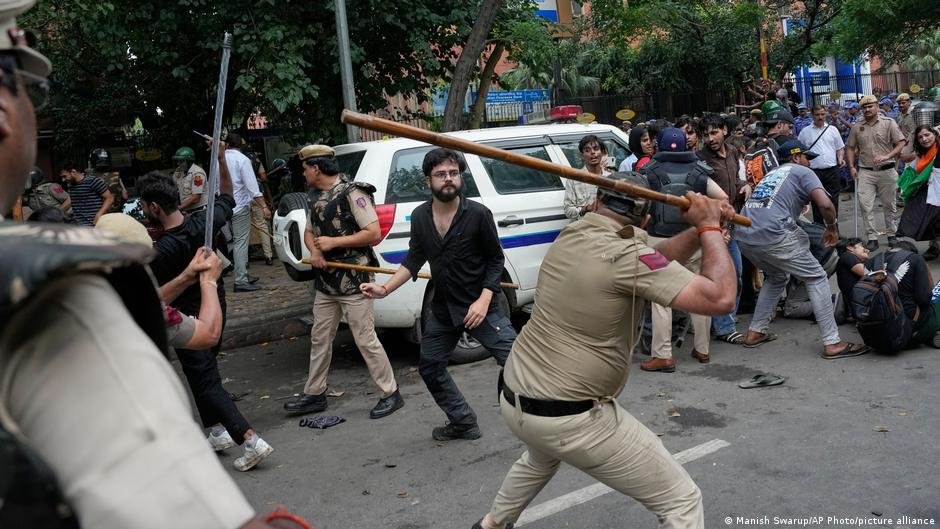
Riot police fired tear gas and used batons in New Delhi as tens of thousands of supporters of the satirical Cockroach Janta Party (CJP) marched towards India’s Parliament on Monday (July 20).
Police in the Indian capital said 60 protesters and 118 police officers were injured in the clashes between demonstrators and security forces. Mobile internet was suspended in parts of the city, including around the Jantar Mantar protest site, during the violence.
Protesters are demanding the resignation of Education Minister Dharmendra Pradhan. Earlier this year, authorities canceled the high-stakes NEET medical entrance exam over a leaked question paper, affecting millions of students and sparking outrage across India.
What is India’s Cockroach Janta Party?
The CJP began as an online campaign in May and rapidly evolved into a Gen Z street movement, giving a voice to a generation frustrated by unemployment, shrinking opportunities and a failing education system.
The youth-led “Cockroach” party is now posing an unexpected challenge for Prime Minister Narendra Modi’s government, prompting a response that combines political outreach with police action.
Modi’s rivals have also tried to step in and take advantage of the youth’s frustrations.
“Is this how a government behaves? Using tear gas and baton charges against students? This is a worthless government,” Renuka Chowdhury, an MP from India’s opposition Congress party, told DW.
Lessons from earlier protests in India
The CJP movement gained fresh momentum over the weekend after veteran reform activist Sonam Wangchuk, whose three-week hunger strike has become a symbol of the protests, was forcibly taken to a hospital by police.
It is not the first time India has experienced major protest movements. Hunger strikes, famously used by Mahatma Gandhi, remain a common and peaceful form of protest in India.
India Against Corruption (IAC) led by veteran activist Anna Hazare, managed to mobilize millions in 2011 and reshape the country’s political landscape. A decade later, yearlong farmers’ protests forced Modi to repeal controversial farm laws. However, a 2023 Olympic wrestlers’ protest over allegations of sexual harassment achieved few of their goals, despite widespread sympathy.
Analysts say the CJP lacks a nationwide organizational network, which the farmers had at their disposal. Yet like the IAC movement, it has tapped into a broader public mood.
“This protest is different because it reflects a much broader cross-section of Indian society,” said Yamini Aiyar, an analyst and senior visiting fellow at Brown University. “They are expressing their frustration with a country whose long-atrophied education system has left them with very little hope of a better future.”
“Like the IAC movement, it has drawn the middle class onto the streets,” Aiyar told DW. “But this is a far more coercive political environment. From the anti-citizenship protests to the farmers’ movement, citizens have increasingly looked beyond political parties to hold governments to account.”
Police response sparks backlash among Indian protesters
This week’s clashes have done little to quell the anger among India’s Gen Z.
“Like many young people across India, I am angry about a lack of jobs and an education system that crushes my aspirations. Even though my family supports the BJP, I managed to get away,” Rukmini Singh, a student from Meerut, told DW.
“This was an attack against our children. I saw many young boys and girls hurt and bleeding. They will never forget it but the courage these people displayed gives me hope,” Vasundara Singh, a teacher from Bihar, told DW.
As during the farmers’ protests, leftist parties and student organizations have become visible on the ground, helping mobilize supporters and giving the movement organizational backing.
“After 50 years, youth have occupied the road to parliament,” political activist Yogendra Yadav told DW. “This energy by the students shows that the path to parliament goes through the streets. It is remarkable.”
Can CJP mobilize India’s villages as easily as its cities?
The surge in protest numbers forced the government to engage with the movement after weeks of dismissing it.
Alongside the police action, senior ministers opened talks with CJP leaders. Home Minister Amit Shah met cabinet colleagues while Health Minister J P Nadda held discussions with representatives of the movement.
“We will decide on how best to address the students’ demands,” a senior Bharatiya Janata Party (BJP) MP, told DW on condition of anonymity.
Most CJP support appears to come from students and India’s urban middle class. The BJP’s strongest electoral base remains in rural India and smaller towns, where the CJP has yet to prove that its message resonates with young voters.
However, some experts believe that the CJP will do just fine beyond India’s urban centers.
“This movement is likely to resonate beyond India’s cities because the aspirations of young people in small towns and villages are no different,” political analyst Radhika Ramaseshan told DW.
To view this video please enable JavaScript, and consider upgrading to a web browser that supports HTML5 video
“For a generation that saw education as the route to a better life, the failure of the education system has become a deeply political issue,” she said.
“Young people in rural India no longer see farming or traditional occupations as their only future. Whether the CJP itself survives is another matter, but the anger and frustration it has tapped into have the potential to reshape politics.”
‘The anger is now directed at the government’
A movement focused on India’s cities may generate headlines without altering the BJP’s political fortunes. But if the CJP spreads to rural youth, it could become a much broader political challenge.
“I don’t think this will remain an urban movement,” said commentator Apoorvanand.
“People constantly move between villages and cities, and those who witnessed the police action will carry those experiences home,” Apoorvanand told DW.
“The anger is now directed at the government. Whether it becomes a broader political movement depends on the CJP’s ability to widen its appeal.”
For now, the CJP has already achieved something unusual. It has transformed satire into sustained street mobilization, forced the government into talks, and ensured that the concerns of India’s young people remain firmly in the national spotlight.
“This is a long fight. We will have to engage in a very long struggle for this. Because you have to change an entire system, the nexus of that system is very deep-rooted,” said Saurav Das, CJP’s chief spokesperson.
Edited by: Keith Walker
To view this video please enable JavaScript, and consider upgrading to a web browser that supports HTML5 video