IN FOCUS: Why Singapore’s workplace culture remains a stubborn barrier to its fertility push
Despite Singapore’s pro-family policies, employees argue that Singapore’s entrenched “hustle culture” makes it difficult to feel confident about starting a family while building their careers.
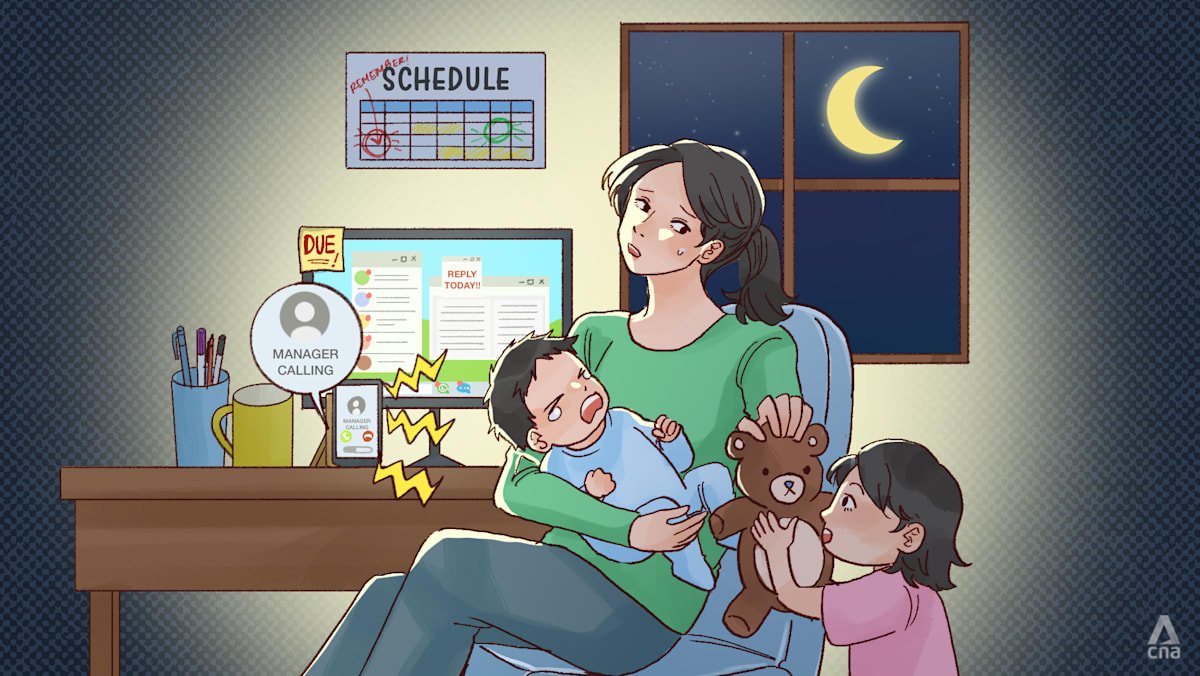
Long hours, in-office requirements, frequent travel and a lack of flexibility are common sticking points for parents working in Singapore. (Illustration: CNA/Clara Ho)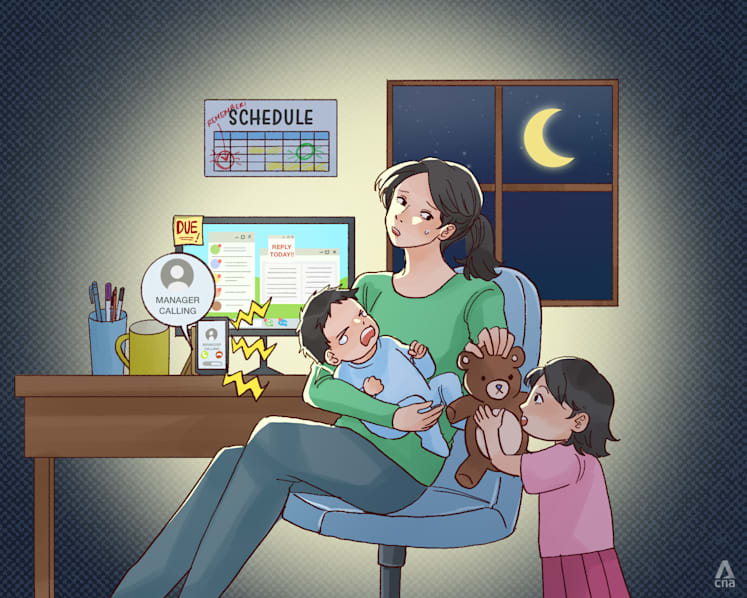
New: You can now listen to articles.

This audio is generated by an AI tool.

Read a summary of this article on FAST.
Get bite-sized news via a new
cards interface. Give it a try.
Click here to return to FAST
Tap here to return to FAST
FAST
SINGAPORE: When Ms M Low’s newborn was fighting for his life in the intensive care unit (ICU) last year, she was still fielding calls and messages from her team despite being on maternity leave.
She asked them to contact her after she left the hospital, and they agreed, but the experience left a bad taste in her mouth.
“My son was in a critical stage in the ICU, and I felt that I should be left alone, because every day I’m worried about my son, every day I’m hearing grim news about my son,” said Ms Low.
Her son died after a month in hospital. But back at work, the persistent cycle of business travel and after-hours drinks went on unchanged.
When Ms Low, 38, became pregnant again, instead of trying to negotiate for a slower pace at work, she simply resigned. “Forget it, let’s take care of this pregnancy,” she recalled her husband saying.
While the recent National Day Rally announcements are helpful, progressive national policies, such as increased childcare leave and higher grants of almost S$70,000 (US$55,000) for each child, do not address the root of the issue for her.
The work culture in Singapore is “intense” and lacks boundaries, she said, adding that it actively prevents couples from starting families safely without having to sacrifice their careers.
On its end, the government has stated that measures announced at the National Day Rally are early moves in its reforms to support parents, and recognises that there is also a need to address workplace culture issues in Singapore.
In his rally speech, Prime Minister Lawrence Wong encouraged employers to do their part.
“Support parents in your organisations and give them confidence to take the leave they are entitled to. Help them settle back into work afterwards. Make sure that becoming a parent never becomes a disadvantage in someone’s career,” he said.
The Marriage and Parenthood Reset Workgroup, which is headed by Minister in the Prime Minister’s Office Indranee Rajah, is set to release a fuller set of recommendations in early 2027 that is expected to tackle workplace culture issues.
Ahead of the rally, Ms Indranee said these issues could not be addressed earlier because more time is needed to balance the interests of employers and employees.
Adding that changing mindsets and attitudes at workplaces is “the much harder part to do”, Ms Indranee said employers, human resource professionals and line managers can shape the experience of employees.

Guess Word
Crack the word, one row at a time

Buzzword
Create words using the given letters

Mini Sudoku
Tiny puzzle, mighty brain teaser

Mini Crossword
Small grid, big challenge

Word Search
Spot as many words as you can


A line manager who is empathetic and happy for you makes it much easier, while a manager who behaves like the employee taking leave is an imposition sends a different signal, she said.
“So, learning how to create better workplace norms and cultures, I think, is a very important part of this.”
EFFECT ON FAMILY PLANNING
For many working parents, the attitudes they observe at work are precisely what stall plans to grow their families.
One mother who declined to be named said she would be open to having a third child, but finds her current workplace unsuitable for such an endeavour.
After a change in management when she was pregnant with her second child, her work hours have become less flexible and her bosses are less understanding.
Her manager, for example, asked her not to take childcare leave at the last minute so often.
“How would I know that my child will be sick?” asked the mother, who works as an operations executive. “It doesn’t make sense for me to plan my leave, as if I know my child will be sick next month.”
She also felt that the company was not fair in their appraisal of her performance when she was pregnant.
During her appraisal, her manager said she was not reliable because she missed a work event, even though he knew that she missed the event because she experienced bleeding during her pregnancy and went to see a doctor.
“I had a hard time towards the end of my pregnancy, and I don’t think they understood,” she said, adding that she sometimes felt guilty for missing work, but wanted to prioritise her health and her child.
“With the flexibility that I used to get from my old management, I think I would have another kid. But with this kind of situation, new management and so many new people around me at work, I don’t think so,” she said.
She is not alone in her hesitation to expand her family because of rigid work hours and intolerant bosses.
Dr Tan Poh Lin, a senior research fellow at the Institute of Policy Studies, said work-life balance and office culture are “critical” factors affecting Singapore’s total fertility rate, which hit a record low of 0.87 last year.
She said couples typically want to be financially stable and hence prioritise career progression.
“In the event that work-life balance is poor and families are forced to choose, many would choose having fewer children,” she said.
Associate Professor Mu Zheng noted that workplace conditions can affect fertility at several stages: whether young adults have the time and energy to form relationships, whether couples feel ready to have their first child, and whether parents feel capable of having another.
“Importantly, workplace pressures may affect fertility not because people no longer value parenthood, but because they perceive it as increasingly difficult to combine being a good parent with being a good employee,” said Assoc Prof Mu, who is from the National University of Singapore’s (NUS) department of sociology and anthropology.
WORKPLACE CHALLENGES FOR PARENTS
Long hours, in-office requirements, frequent travel and a lack of flexibility are common sticking points for parents working in Singapore.
There is also a pervasive expectation that staff remain contactable outside of office hours, several parents told CNA.
Most workplaces and companies in Singapore have a “hustle” culture,” said Mr Daniel Yoong, who runs an HR advisory firm.
“Employees work hard, they’re expected to work hard compared to other countries,” he said, adding that people want to advance their careers and earn more if they want to own a home and raise a family due to the high cost of living here.
“Everyone wants to strive for excellence,” said Ms Nicole Chan, a civil servant and mother of one.
“We want to be excellent in our jobs, and it always requires us to work beyond what is on paper,” she said, adding that her colleagues and friends rarely draw strict boundaries around work.
When she became a parent, she realised she needed to protect her time after office hours – a shift that left her feeling guilty.
Ms Michelle Yan, a centre success manager at co-working space operator Arcc Spaces, described Singapore’s general workplace culture as traditional.
Following the COVID-19 pandemic, many organisations gradually rolled back work-from-home policies, especially small- and medium-size enterprises (SMEs) and local firms, she said.
“Bosses would still prefer to see their employees come into office as a form of their commitment to work, they need to see you around,” she said, adding that this creates friction whenever parents need urgent leave to care for their children.
Meanwhile, those working for larger, multinational companies may need to travel frequently because of Singapore’s role as a business hub, said Ms Maybelline Tan, a regional marketing manager who travels at least twice a month.
They may also need to take part in work calls at night if they are working with colleagues based in Europe or the US, she said.
With work life being so demanding, Ms Tan decided to have pets instead of children.
“I feel very worried and I feel very upset if I have to leave my pets, (what more) if I have actual human kids?” she said.
Ms Sher-Li Torrey, who founded career portal Mums@Work, said she has received several requests from women who are not yet mothers asking if they can become a member of the network.
“They will write and say, because my current work environment does not suit it, I need to leave so that I can have a kid,” she said, adding that some will indicate that their existing job requires them to travel frequently.
In search of a better environment to work and raise their children in, some Singaporeans told CNA they ended up moving abroad to find the right balance.
Ms Irene Cheong, who is in her 50s now, applied for permanent residency in Australia before starting a family. Had she not succeeded in her application, the Singaporean mother of one said she may not have had children at all.
She lived and worked in Australia from the time her son was three, until he was around 10 years old.
She worked so-called “mum hours” that allowed her to send her son to school in the morning, pick him up around 3pm, cook dinner and spend quality time with her family.
This level of work-life integration seems uncommon in Singapore, said Ms Cheong, who works in HR information systems.
Professor of Economics Christine Ho said it is better to consider what constraints families face, rather than to find fault for the falling fertility rate.
“Housing costs, gender norms that leave working mothers doing a double shift at home and at work, competition in education and at work, and a definition of success measured by whose children get the best grades or earn the most – those are constraints, and constraints can be targeted,” she said.
CAN SINGAPORE BE ‘MADE FOR FAMILIES’?
At a policy level, parents and experts who spoke to CNA agreed that strides have been made toward fostering a more supportive workplace.
In recent years, there have been increases to paternity leave and shared parental leave, as well as efforts to encourage flexible work arrangements.
But family-friendly policies may not always translate into changes on the ground.
A 2025 survey of more than 1,500 people found that workers are worried that taking parental leave, requesting for flexible work arrangements or adjusting their schedules for caregiving could signal a lack of commitment and affect their career progression.
The survey, which was conducted by the National Trades Unions Congress (NTUC) Women and Family and the People’s Action Party Women’s Wing, reported that 41 per cent of respondents felt stronger leadership support would make flexible work arrangements more effective.
“That tells us something important,” said NTUC assistant secretary-general Yeo Wan Ling. “Family-friendly policies will only work fully when workers feel safe using them.”
A manager who tells an employee to “take the time you need” sends a very different signal from a manager who approves the leave but makes the worker feel guilty, said Ms Yeo, who is also director of NTUC Women and Family.
“These everyday interactions matter. They shape whether workers believe that having children and progressing in their careers can genuinely coexist,” she said.
For example, Ms Low, who had to handle work while her son was in the ICU, said she found out she was pregnant just four months after starting a new job.
When she shared the news with her boss, he asked her why she did not inform him earlier of her intention to start a family.
A policy can only be as effective as its implementation, said Mr Aslam Sardar, chief executive of the Institute for Human Resource Professionals.
He said manager capability and workplace trust are important because an employee’s experience of a family-friendly policy hinges on how comfortable they feel discussing their needs with their manager.
It also depends on whether their managers focus on outcomes rather than an employee’s physical presence, he said.
“That does not necessarily mean managers are unsupportive. Many managers are themselves balancing business pressures, team capacity and individual needs,” he said, adding that they can be equipped with skills and frameworks to navigate different situations fairly and consistently.
MANAGERS MATTER
Beyond business owners, colleagues who are single or do not intend to have children have also voiced concern about the workload that falls on them when parents take extended leave.
To this, Mr Marcus Lam, honorary treasurer of the Singapore National Employers Federation, said openness between employers and employees will help in tackling operational challenges when a staff member goes away for a longer stretch.


Employers can plan ahead to find a temporary cover, split the work among existing colleagues or defer projects that are not time sensitive.
They can also help to foster relationships between colleagues and initiate conversations, said Mr Lam, adding that it is worse if one colleague makes assumptions because the employer did not communicate well.
“The organisation needs to communicate upfront, or during the assessment, to be able to say okay, I reward you for that, thanks for the extra effort,” he said.
Earlier in the process, the rest of the team can be included in discussions on how to manage both the trade-offs and the benefits collectively, Mr Lam said.
WHAT A SUPPORTIVE WORKPLACE SHOULD LOOK LIKE
For many parents, genuine support ultimately comes down to day-to-day flexibility.
One mother, who declined to be named, recalled working at an international bank where she was scolded for taking leave to bring her child to the doctor, and told that her performance rating was low because she was not working nights and weekends.
One of her colleagues was also reprimanded when she was unable to log in to work systems during her maternity leave, even though the security system had locked her access automatically after a month away from work.
“At least three of us left because we wanted to have another kid, but you definitely can’t have a kid there,” she said.
At her new workplace, she only needs to be in office from 11am to 4pm, and her colleagues are mindful of not contacting her when she is on leave or unwell.
When she expressed hesitation at having another child so soon after starting a new job, her colleagues encouraged her not to hold back
“It’s really very different. You are happier, your kids are happier, then you would want to have another kid,” she said.

Mr Kevin Goh, group head of engagements and programmes at the Centre for Fathering, said the charity cannot pay their employees as much as the private sector, but offers a strong pro-family environment.
In his team, employees do not need to apply for time off if they need to pick up their children or bring their parents for appointments.
“I know that my team works hard already, so I don’t nitpick,” he said, noting that the team does work nights and weekends given the nature of their roles.
He gave an example of someone from his team who was allowed to come late to a staff meeting because he had to pick his son up. The team member even brought his son to the office for the day.
The organisation also rescheduled a work-from-office day when it coincided with early school dismissals for Teachers’ Day.
Mr Yoong, the HR consultant, said extending flexibility across the board would help managers to build a good environment and culture in the team.
That means accommodating workers whether they are parents, married without children, or single.
“If somebody else in the team needs to take time off to go and send their mother to the hospital, or if you feel like working from home today, go ahead,” he said.
Source: CNA/an(nj)
Sign up for our newsletters

Get the CNA app
Stay updated with notifications for breaking news and our best stories
Get WhatsApp alerts
Join our channel for the top reads for the day on your preferred chat app

Get bite-sized news via a new
cards interface. Give it a try.
Click here to return to FAST
Tap here to return to FAST
FAST