


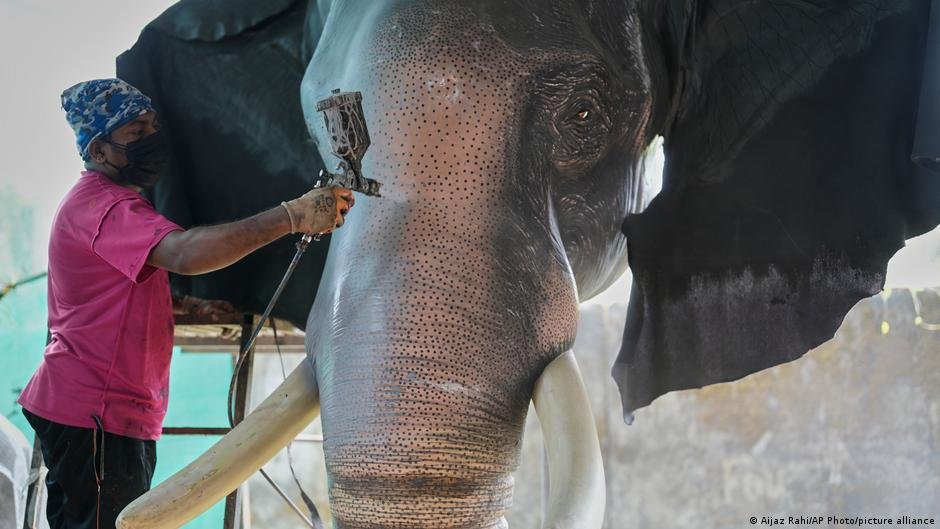
Life-size robotic elephants are increasingly replacing real animals in India’s temples — a change applauded by animal rights activists, but resisted by traditionalists.
Image: Aijaz Rahi/AP Photo/picture alliance
In a small workshop in Chalakudy, southern India, engineers are creating elephants that look deceptively real. Their ears flap, their trunks move and spray water, and their tails sway gently. But the animals are made of fiberglass, iron and rubber. Inventor Prasanth Prakashan wants to replace real temple elephants with his robots — and has sparked a heated debate.
Image: Aijaz Rahi/AP Photo/picture alliance
Prakashan, who holds a mechanical engineering degree, first developed his robots for amusement parks and shopping malls. Working with artists, he perfects every detail — from wrinkles in the skin to veins on the ears. “It was something we had to figure out on our own,” he told The Associated Press. After a 2023 video of his robots went viral on social media, animal rights group PETA took notice.
Image: Aijaz Rahi/AP Photo/picture alliance
PETA and other organizations have now donated about 40 robotic elephants to various temples across India, to replace live animals. Each one costs about $6,000 (about €5,200). “These elephants are forced to stand there for hours in the heat, with large crowds, drums and fireworks,” said Khushboo Gupta, vice president of policy at PETA India. “Any trigger could cause them to go on a rampage.”
Image: Aijaz Rahi/AP Photo/picture alliance
Elephants are inextricable from the temple rituals and festivals in India. But there are risks. Male elephants can become particularly aggressive during a period known as musth — an annual surge in testosterone. In 2024, nine people died after being attacked by elephants at temple festivals in Kerala. Nevertheless, many believers feel live elephants are an integral part of religious ceremonies.
Image: Aijaz Rahi/AP Photo/picture alliance
In India, elephants are considered a symbol of the divine. In Kerala in particular, magnificently decorated elephants attract thousands of visitors during temple festivals. Some animals even become celebrities in their own right. An elephant named Thechikkottukavu Ramachandran has close to 150,000 fans on Facebook.
Image: Aijaz Rahi/AP Photo/picture alliance
This worker is welding metal parts together to build another robotic elephant. But P.S. Easa, a Kerala-based wildlife biologist and elephant expert, does not believe change will come quickly. “You cannot change centuries-old tradition anytime soon,” he told AP. “But who knows? Maybe if these robotic elephants can start walking.”
Image: Aijaz Rahi/AP Photo/picture alliance
The Irinjadapilly Sree Krishna Temple got its first robotic elephant in 2023. Rajkumar Namboothiri, the temple’s head priest, is convinced it was the right decision. “Elephants are tortured and abused. It’s not right,” he said, adding that children can touch the robotic elephant safely — something that would be impossible with a live animal. Many smaller temples are now following this example.
Image: Aijaz Rahi/AP Photo/picture alliance
But not everyone has welcomed the change. K. Mahesh has been renting out his elephant for temple festivals for 25 years. To him, the elephant remains sacred. “If you don’t believe elephants are sacred, what’s the point of a robotic elephant in a temple?” he asked. Many temple administrators also strongly oppose the use of artificial animals in religious ceremonies.
Image: Aijaz Rahi/AP Photo/picture alliance
Because of his robotic elephants, inventor Prasanth Prakashan is now unwelcome at some temple festivals. Nevertheless, he remains committed to his work. “This is my trade. … I’m not out to ruin their tradition,” he said. “But, if we don’t stop treating elephants like commodities, future generations won’t have them.”
Image: Aijaz Rahi/AP Photo/picture alliance9 images1 | 99 imageshttps://p.dw.com/p/5HFFD







