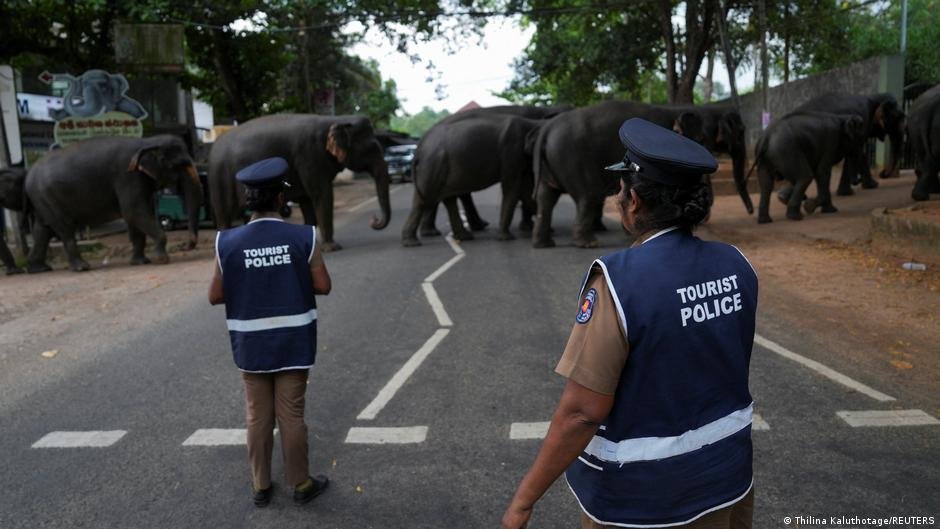
As their habitat shrinks, wild elephants are entering Sri Lankan villages in search of food. More than a hundred people, and many more animals, die in these unpredictable encounters every year.
Image: Thilina Kaluthotage/REUTERS
One victim among many: Villagers surround a young dead elephant in a field in Ambanpola, Sri Lanka. The animal died from an improvised explosive device, which has become one of the most common and cruel causes of death for wild elephants on the island. Around 400 elephants die in Sri Lanka every year from shooting, electrocution, train accidents and poisonous or explosive bait.
Image: Thilina Kaluthotage/REUTERS
The conflict between elephants and humans has been escalating for several years. Gamekeeper Dewagiri Mudiyanselage Thilakaratne Bandara (right) and his wife were attacked by a wild elephant in their yard, and Bandara’s wife lost her leg in the attack. Nevertheless, Bandara told Reuters that he doesn’t feel any hatred for the elephant: “He was hungry because of the activities of us humans.”
Image: Thilina Kaluthotage/REUTERS
Elephants on train tracks are a risk for animals and humans. Since 2019, an average of 138 people have been killed by the mammals in Sri Lanka every year. The elephants are encroaching on human living space because their own is shrinking. The island’s forest area has shrunk from around 70% of the country in the 1920s to around 34% today. And the elephant population is still growing.
Image: Thilina Kaluthotage/REUTERS
Farmers from the village of Galgamuwa, where game warden Bandara lives, have built a tree house to protect their fields from wild elephants. The number of animals has increased by 27% in the last 10 years to an estimated 7,500 elephants. Neighbors often band together to scare away elephants approaching a field or house by shouting and setting off firecrackers.
Image: Thilina Kaluthotage/REUTERS
It doesn’t always work: Elephants have left deep footprints in this rice field. “Twenty years ago we didn’t have this situation,” reports Bandara. At that time there were still large forests in the region. “But they were eventually cleared and then the elephants started moving closer.” A 14-kilometer (8.7-miles) long electric fence is now intended to keep elephants away.
Image: Thilina Kaluthotage/REUTERS
In order to avoid encounters with the animals as much as possible, the residents of Galgamuwa have adapted their everyday lives. School starts later, and villagers finish their work earlier so as not to be out and about in the dark when the elephants are active. Even funerals and weddings are planned to minimize the chance of an elephant encounter.
Image: Thilina Kaluthotage/REUTERS
Despite all the conflicts, the people of Sri Lanka have deep cultural ties to elephants. The animals are an integral part of colorful temple parades, and owning an elephant is considered a status symbol. Elephants are also a mainstay of the island’s $4 billion tourism industry.
Image: Thilina Kaluthotage/REUTERS
A captured elephant is driven to a protection station. Only around 30% of Sri Lankan elephants live in protected areas — this also exacerbates the conflict between humans and animals. Bandara is therefore calling for an end to deforestation to create more space for agriculture. Instead, according to the gamekeeper, the focus should be on reforestation.
Image: Thilina Kaluthotage/REUTERS8 images1 | 88 imageshttps://p.dw.com/p/5OKnC