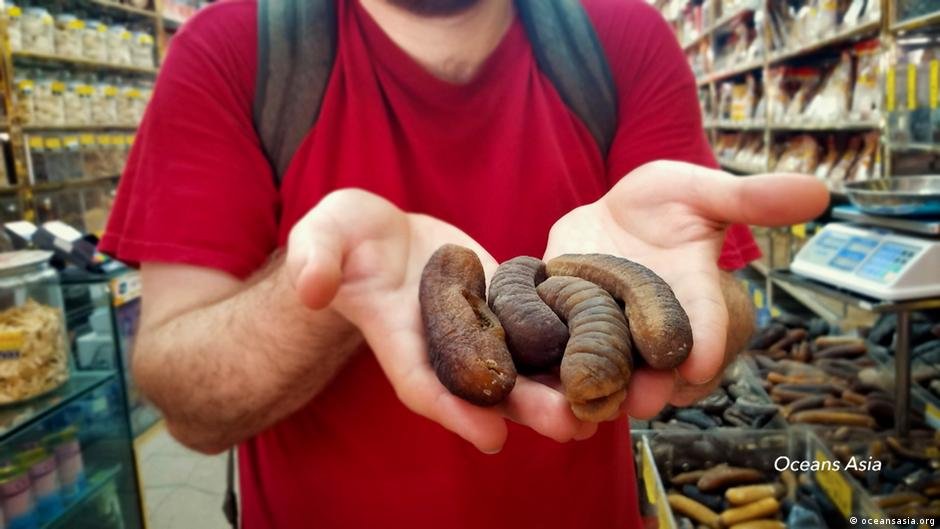
When it comes to smuggling, squishy sea blobs that spend their lives eating and pooping are probably not what comes to mind. But a group of lumpen creatures known as sea cucumbers are at the center of a $200 million (€175 million) black market trade.
Known alternately and misleadingly as sea cucumbers or sand fish, they are actually neither cucumbers nor fish, but echinoderms. In other words, invertebrate marine animals with a skin or a hard covering.
Found in abundance around the Andaman Islands — the easternmost landmass of the Indian territory — local biologist Sangamesh Uday says they are so ecologically important that without them the intertidal zone “wouldn’t be an ecosystem, it would just be broken rocks.”
The 1,500 or so species of sea cucumber around the world are great marine recyclers. They eat organic material including bacteria and microalgae, break it down, and excrete clean oxygenated sand. This keeps vital nutrients like nitrogen and phosphorous in circulation and suppresses coral diseases.
It also boosts ocean alkalinity levels which helps to slow down acidification, which is becoming a huge issue as rising levels of greenhouse gases in the atmosphere cause oceans to warm. In short, it’s hard to overstate the environmental importance of these innocuous looking lumps.
Why are they being smuggled?
To their detriment, sea cucumbers are also considered a delicacy, especially in China and Southeast Asia. Historical records show they were traded between Indonesian fishers and Chinese merchants even 800 years ago.
They are used in soups, served as pickled sides or turned into traditional medicine. And though there is some scientific evidence that the Omega-3 they contain is a useful antioxidant and anti-inflammatory, they’re mostly popular because they’re quite phallic — and therefore considered an aphrodisiac.
Since the 1980s, commercial sea cucumber harvesting has expanded globally, with better access as well as higher incomes and demand in East Asia acting as the main drivers. Though many countries have outlawed the practice, some like Sri Lanka and Madagascar do allow fishing and aquaculture. Of the existing sea cucumber fisheries, 70% have become overexploited globally.
The combination of the increasing demand and legal complexities has drawn the attention of minor and major mafias. Some of the largest Mexican cartels and even the Japanese Yakuza have been reported as diversifying their portfolios by using sea cucumbers and other sea creatures to keep the money flowing.
These illicit groups enter every aspect of the supply chain — from extorting fishermen to the final smuggling of illegally-caught cucumbers across borders.
They exploit weak environmental regulations and a lack of official knowledge around rules and species. Sea cucumbers are sometimes marked as legal fish consignments or smuggled into countries that do allow trade in the species.
Leading expert on sea cucumber crime, Teale Phelps Bondaroff, says awareness is critical in dealing with the issue.
“While many law enforcement officers may be on the lookout for drugs, weapons, or well-known wildlife contraband like ivory, rhino horns, or shark fins, sea cucumbers may slip past,” he tells DW.
Poachers from overseas drawn to the Andaman Islands
The Indian government began regulating sea cucumbers in the 1980s and introduced a blanket ban on fishing them in 2001, when it saw the impact of the illicit trade on local populations.
Since then, India has become the country with the strongest protections for the species. Anyone who catches one faces a seven-year jail term — the same sentence handed down for poaching a tiger or elephant.
As a result, sea cucumbers close to the Andaman Islands have generally thrived. In the ocean around Myanmar, around 50km (30 miles) further north, it’s a different picture. Civil war in the country has severely impacted local livelihoods and local black-market agents are using the instability to offer comparatively higher sums for a boatload of illegally caught sea cucumbers. And as their numbers in local waters dwindle, poachers head south.
It is no easy game, however. They have to dodge the Indian coast guard, navy, police, evade local fishermen and even dense populations of crocodiles.
To view this video please enable JavaScript, and consider upgrading to a web browser that supports HTML5 video
They survive on fish, freediving using hookah pipes to breathe, and spend months rationing their diesel to ensure they have enough to make it back home — evading the Myanmar authorities and pirates looking to try and steal their catch.
Many poachers are caught by the regional Andaman and Nicobar police, who are being specifically trained to comb the mangrove islands to find them. At least 50 people have been arrested in the past year, some as young as 16 and some in their 60s. Several have come back for the second or third time — risking being incarcerated again after completing full sentences.
Is there a way to stop the illegal trade?
Despite the efforts of the Indian authorities, the number of poachers coming in, year after year, has stayed stable.
Bondaroff sees a need to sound the alarm at a global level. Other similar trades, like that of shark fins, have been slowed thanks to increased awareness about its cruelty and impact on the ecosystem — making it less socially acceptable.
“The solution must include educating consumers about the harms of unsustainable and illegal sea cucumber extraction and tackling seafood fraud.”
Other suggestions include India opening up small areas of its waters where sea cucumbers can be legally fished, or introducing community-based aquaculture that is easier to regulate and would also benefit local fishers.
But Bondaroff thinks that tackling the problem also requires cooperation and a deep understanding of the issue.
“This means liaising and information sharing between governments and law enforcement agencies,” he says. “And working together to address the complex financial crimes that enable sea cucumber crime.”
This report was supported by the Pulitzer Center.
Edited by: Tamsin Walker
About The Author