


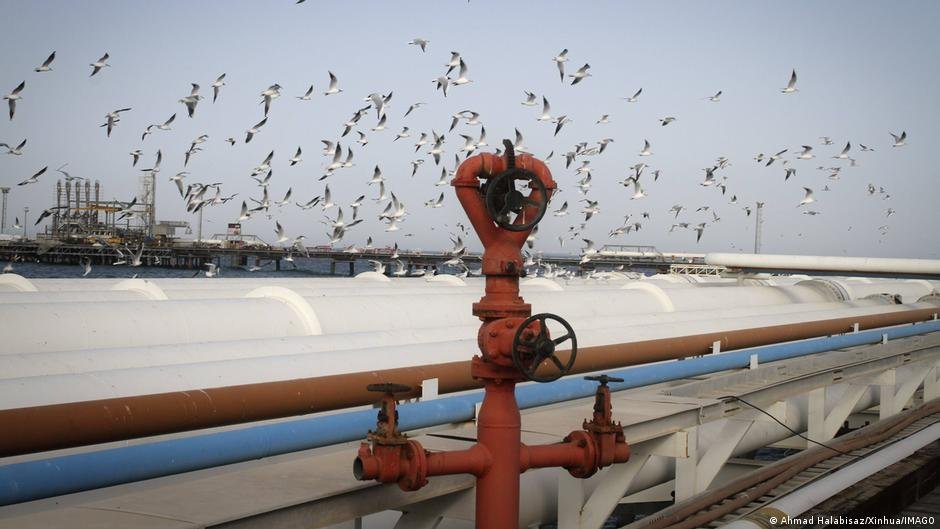
With its toughest sanctions yet, the administration of US President Donald Trump is seeking to force Iran’s leadership into submission.
The measures, dubbed “economic D-Day” sanctions, are intended to achieve what military pressure since February has failed to accomplish.
In addition to targeting Iran’s key sources of revenue and trade, including oil, banking, gold, shipping, aviation and certain technology sectors, US authorities are increasingly focusing on cryptocurrencies.
Digital currencies such as bitcoin, which operate outside the traditional banking system and dollar-based financial networks, are being used by Iran for money transfers, trade transactions and, increasingly, oil-related business.
An opaque network to help Tehran bypass sanctions
Iran also appears to be exploring cryptocurrencies as a way to secure oil shipments passing through the Strait of Hormuz.
According to the Fars News Agency, which is close to Iran’s Revolutionary Guards, the idea was proposed by Babak Zanjani.
The 53-year-old billionaire was released from prison last year and remains one of the most prominent figures in a network that has grown over decades and helped Iran navigate international sanctions.
Individuals within these networks enjoy support and protection from influential figures inside the Islamic Republic. In return, they are believed to share part of their profits with powerful patrons within the system.
“Among these people, Zanjani belongs to an economic elite with innovative ideas and has repeatedly demonstrated his capabilities in the past,” said Behzad Ahmadinia, an Iran-born journalist based in Cyprus who specializes in the oil and energy sector.
“It appears that the regime has decided to overcome internal rivalries and rely on professionals and experts who can work more efficiently than others and take over key positions.”
Selling oil barrels on the black market
Iran can draw on decades of experience in operating under sanctions. The system extends far beyond individual businessmen and includes a vast network of companies, financial channels and personal connections.
Corruption and a lack of transparency are widely regarded as structural problems within Iran’s political and economic system. Transparency International’s Corruption Perceptions Index 2025 gave Iran a score of 23 out of 100 and ranked it 153rd out of 182 countries, indicating a very high perceived level of public-sector corruption.
Zanjani reportedly controlled a business empire of around 60 companies, including entities in Malaysia, Tajikistan, Turkey and the United Arab Emirates.
Many of these firms were later sanctioned by the United States. Through this network, Zanjani began selling billions of barrels of Iranian oil on the black market during the presidency of Mahmoud Ahmadinejad, while also importing a wide range of goods, including aircraft, into Iran.
To view this video please enable JavaScript, and consider upgrading to a web browser that supports HTML5 video
In 2016, however, he became entangled in Iran’s internal power struggles. Authorities accused him of failing to return around $2.6 billion (€2.24 billion) in oil revenues to the Iranian state.
After a highly publicized trial in one of the country’s biggest corruption cases, he was sentenced to death. For years, he disputed claims over the missing funds and negotiated with Iranian authorities.
US gains insight into sanctions evasion routes
A key link in this network was Turkish-Iranian businessman Reza Zarrab. He was arrested in the United States in 2016 while on vacation and accused of money laundering and violating US sanctions on Iran.
Zarrab had built an extensive network in Turkey and possessed detailed knowledge of the financial and trading mechanisms Iran used to bypass sanctions.
Cases such as his gave US authorities valuable insight into how Iranian sanctions evasion networks operate, allowing Washington to target them more effectively. Zarrab later cooperated with US investigators and was released from custody. According to reports, he now lives in the United States under a new identity.
“People like Zarrab or Zanjani are cultivated within the system and maintain connections to different centers of power,” France-based economist Jamshid Assadi told DW.
To view this video please enable JavaScript, and consider upgrading to a web browser that supports HTML5 video
According to reports, Zanjani’s rise began some 30 years ago during his military service, when he worked as a driver for the governor of Iran’s central bank. The position is said to have opened doors to influential circles and provided him with key business contacts. How many billions of dollars flowed through his network and companies, and how much he personally earned from those activities, remains unclear.
In February 2024, Iranian media reported that assets linked to Zanjani had been repatriated from abroad. His wealth, they said, had grown beyond the value of his outstanding liabilities. In 2025, he was released from prison and quickly returned to the business world. Through one of his companies, he signed a multibillion-dollar contract with Iran’s state railway operator.
At the same time, Zanjani has sought to reinvent himself. In an open letter to US business magnate Elon Musk, he offered his company as a bridge for economic cooperation between Iran and the United States. He now presents himself as an entrepreneur, mediator and advocate of dialogue.
After the United States placed Zanjani back on its sanctions list in January 2026, Washington expanded its measures in July to target a broader network of companies and business associates linked to him.
Just one day before the new sanctions were announced, Zanjani opened a cafe and pastry shop in western Tehran and attended a celebratory launch event. The business was shut down by authorities the following day.
To view this video please enable JavaScript, and consider upgrading to a web browser that supports HTML5 video
Can the US cripple Iran’s shadow networks?
The key question, however, is whether the latest US measures can truly reach the networks underpinning Iran’s shadow economy.
According to Assadi, many of the traditional sanctions evasion routes are now well known and increasingly difficult for Tehran to use. The United States has warned numerous countries that their companies, banks and private-sector actors could face penalties if they help Iran bypass restrictions.
At the same time, Iran has spent decades adapting to economic pressure and finding new ways around it. Whether Washington’s latest sanctions will significantly weaken those networks remains uncertain. But the return of Babak Zanjani suggests Tehran is once again turning to the businessmen who helped it weather previous periods of economic isolation.
This article was originally written in German.
Edited by: Srinivas Mazumdaru







