


‘I’ve never been able to call this place home’: Hong Kong fire survivors struggle to rebuild lives a year on
On the first anniversary of Hong Kong’s deadly Tai Po fire, CNA looks at how some displaced residents and schoolchildren are coping with the lasting impact of the tragedy.
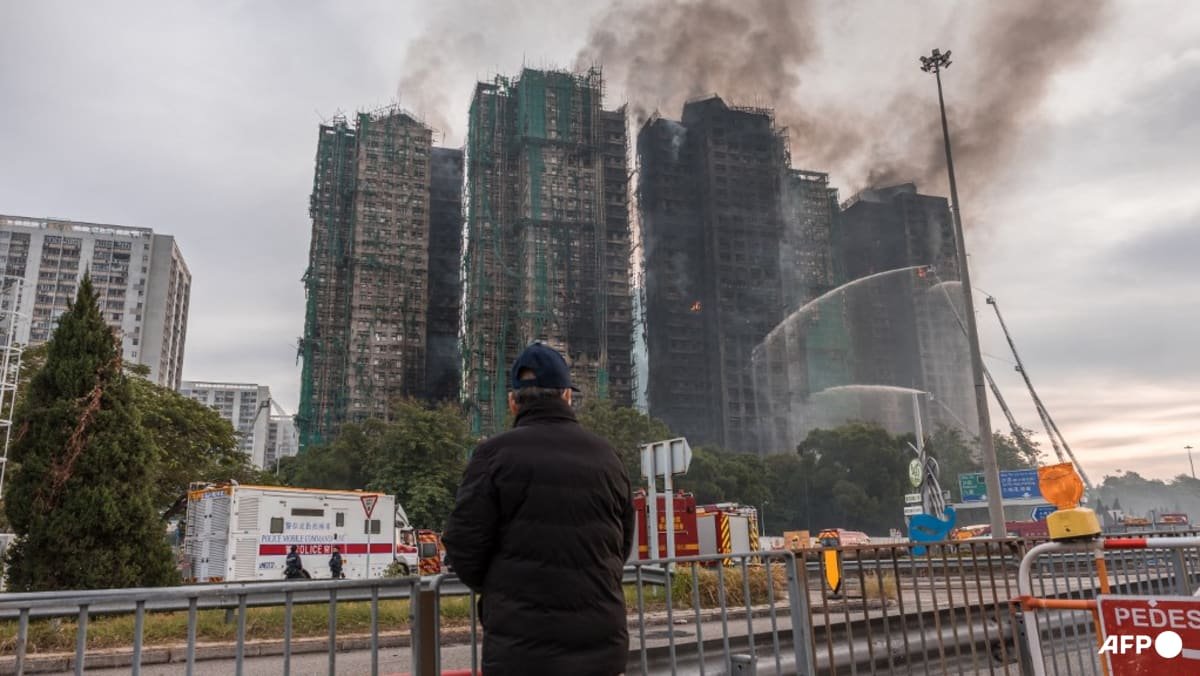
Smoke rises from apartments after a major fire swept through several blocks at the Wang Fuk Court residential estate in Hong Kong’s Tai Po district on Nov 27, 2025. (File photo: AFP/Dale De La Rey)
New: You can now listen to articles.

This audio is generated by an AI tool.

Read a summary of this article on FAST.
Get bite-sized news via a new
cards interface. Give it a try.
Click here to return to FAST
Tap here to return to FAST
FAST
HONG KONG: A year after a deadly fire displaced residents from their homes at the Wang Fuk Court housing estate in Hong Kong’s Tai Po district, many are still living in temporary accommodation.
Among them are Athena Kwong and Marco Chan, both 29, who have been staying in a 12sqm unit in a transitional housing facility, equipped with a bathroom and a small cooking area but with little space for the comforts of everyday life.
“I feel like I’ve only adjusted to going to work and coming back from work here, but I’ve never felt like I belong here. I have never been able to call this place home,” said Kwong.
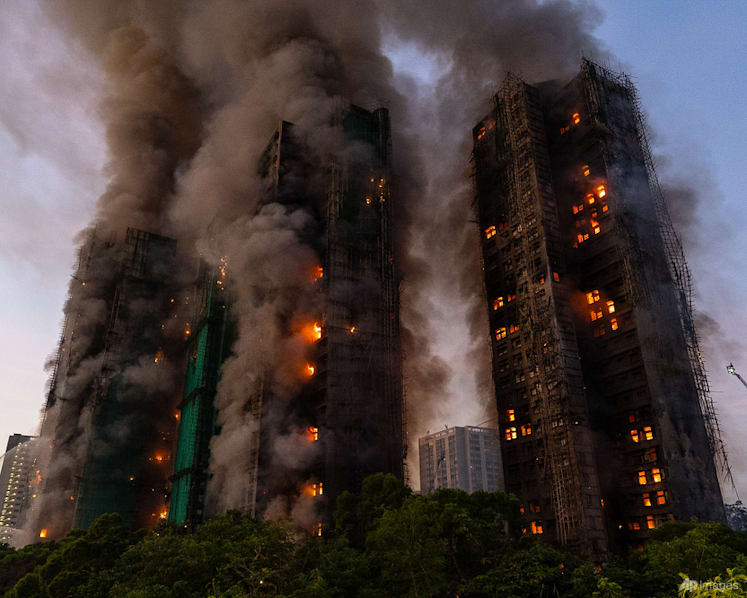
The fire, which broke out on Nov 26, 2025, killed 168 people in Hong Kong’s deadliest blaze in decades.

Guess Word
Crack the word, one row at a time

Buzzword
Create words using the given letters

Mini Sudoku
Tiny puzzle, mighty brain teaser

Mini Crossword
Small grid, big challenge

Word Search
Spot as many words as you can

A year on, the scars of the tragedy remain, with survivors including Kwong and Chan still struggling to rebuild their lives and regain a sense of normalcy.
For many displaced residents, the challenge goes beyond finding a roof over their heads. It is also about finding a place they can once again call home.
A HOME THEY CAN NEVER RETURN TO
Although Kwong and Chan’s apartment was not directly affected by the fire, the couple will never be able to return to the home they designed and decorated together.
The Hong Kong government plans to demolish Wang Fuk Court and has yet to decide what to do with the site afterwards.
The couple have made two trips back to retrieve their belongings, including Kwong’s yangqin, worth about US$10,000, which was partly damaged in the fire. The traditional Chinese music instrument is a hammered dulcimer played with rubber-tipped sticks.
During a visit in May, she played the instrument one last time at their Tai Po apartment, choosing “Cherish Tonight”, a song by the late Hong Kong singer Danny Chan.
“When I got to the unit, the first line that came to my mind was, ‘in love, yet not able to coexist’,” she recalled, referring to the song’s lyrics.
“For me, it was like, I like this house a lot but I can’t continue staying here.”
Months later, playing the same song at her music studio brought different emotions.
“It feels like the dust has settled. I still feel helpless, but I don’t feel as sad as I did that day,” she said.

For now, the couple are waiting for their next home to be ready. They have bought a flat in Fanling, about a 10-minute drive from Tai Po, through the government’s special sales exercise.
But it is not the neighbourhood they had hoped to settle down in.
“I wanted to move back to Tai Po, because I’ve lived there all my life,” said Chan.
The government has offered displaced residents the option of buying new subsidised flats in several locations, including Tai Po, although some of these will not be ready until 2031.
“(The government’s) solution would require us to wait five years. I felt five years was too long,” he said.

Tai Po was where the couple grew up and met, and where both their families lived.
With a new flat secured, they have turned their attention to other plans, including their wedding, which they postponed due to the fire.
Kwong said the ordeal has brought them closer.
“We’ve never argued because of this incident,” she said.
Chen added: “We lived through something so major. To have someone by your side, that burden feels less heavy.”
A SCHOOL FORCED TO START ANEW
The struggle to rebuild a sense of normalcy has also extended to schoolchildren in Tai Po, some of whom are still coping with memories of the disaster.
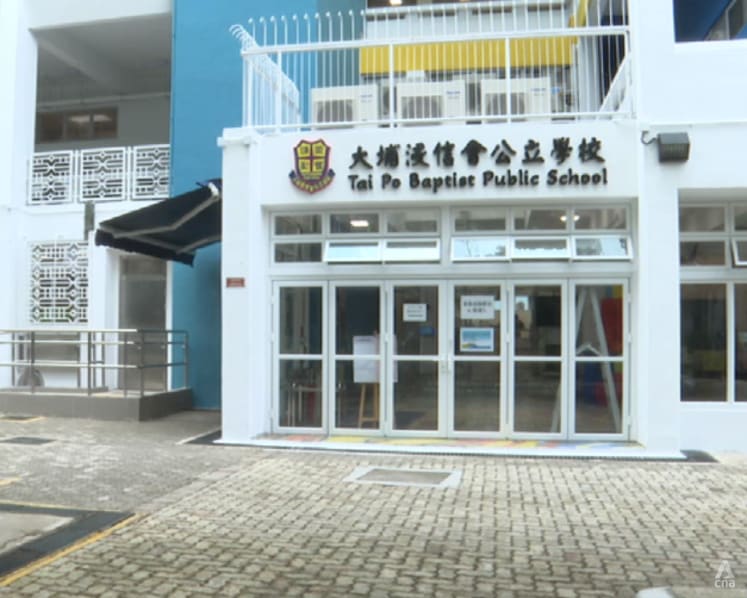
Tai Po Baptist Public School, which stood directly opposite Wang Fuk Court, was spared from the massive fire, but had to vacate its campus after its premises were closed for emergency relief efforts.
For more than six months, students and teachers were split between two temporary sites before moving into a newly renovated campus in the nearby Fu Shin Estate in September.
“Teachers, parents, students, we are all very happy, because we are finally back together again,” said the school’s principal Siu Ting.
“But whether things can return to the way they were, I don’t think so.”
The school has tried to preserve familiar elements from its former campus.
An indoor court was designed to resemble the old one, while four pet reptiles that lived alongside students and teachers were brought over.
“We wanted to tell the students, everything that they left behind at the old campus, their works and their traces, we would cherish them and this is a space that belongs to them,” said Siu.
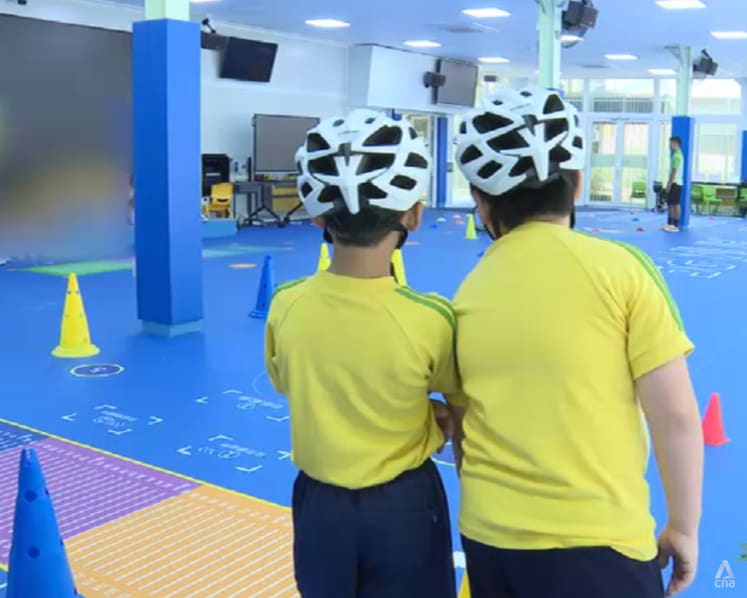
Among the students are 30 children who lived at Wang Fuk Court. All survived the fire, but their daily routines have been affected.
Twin brothers Wong Cheuk Nam and Wong Cheuk Fung, who previously lived at the estate, now face a bus journey of more than 20 minutes to the new campus.
“If Wang Fuk Court didn’t burn down, we wouldn’t have to wake up so early, we can wake up later,” said Wong Cheuk Nam.
HELPING CHILDREN FEEL SAFE AGAIN
For some children, the effects of the fire have been harder to overcome.
Social worker Dawn Leung said students who witnessed the fire could become distressed by everyday sights and sounds that remind them of the traumatic incident.
“They would be very sensitive to sounds, and bright lights that may look like flames, this might be a trigger, because at that time they witnessed the whole scene, sounds, smells and lights,” she said.
“Some bells like the recess bell might be quite loud, and the students would struggle with that.”
Even routine fire drills had to be handled with care, with affected students informed beforehand to avoid triggering distress.
Leung said the school has also had to repeatedly reassure children that their new surroundings are safe.
Many families from Wang Fuk Court with children at the school are still living in transitional housing.
“(Helping) the students adjust is a long-term endeavour, it’s not something easy that we can resolve in a couple of sessions,” said Leung, stressing that recovery would take time.
Source: CNA/oc(dn)
Sign up for our newsletters

Get the CNA app
Stay updated with notifications for breaking news and our best stories
Get WhatsApp alerts
Join our channel for the top reads for the day on your preferred chat app

Get bite-sized news via a new
cards interface. Give it a try.
Click here to return to FAST
Tap here to return to FAST
FAST







