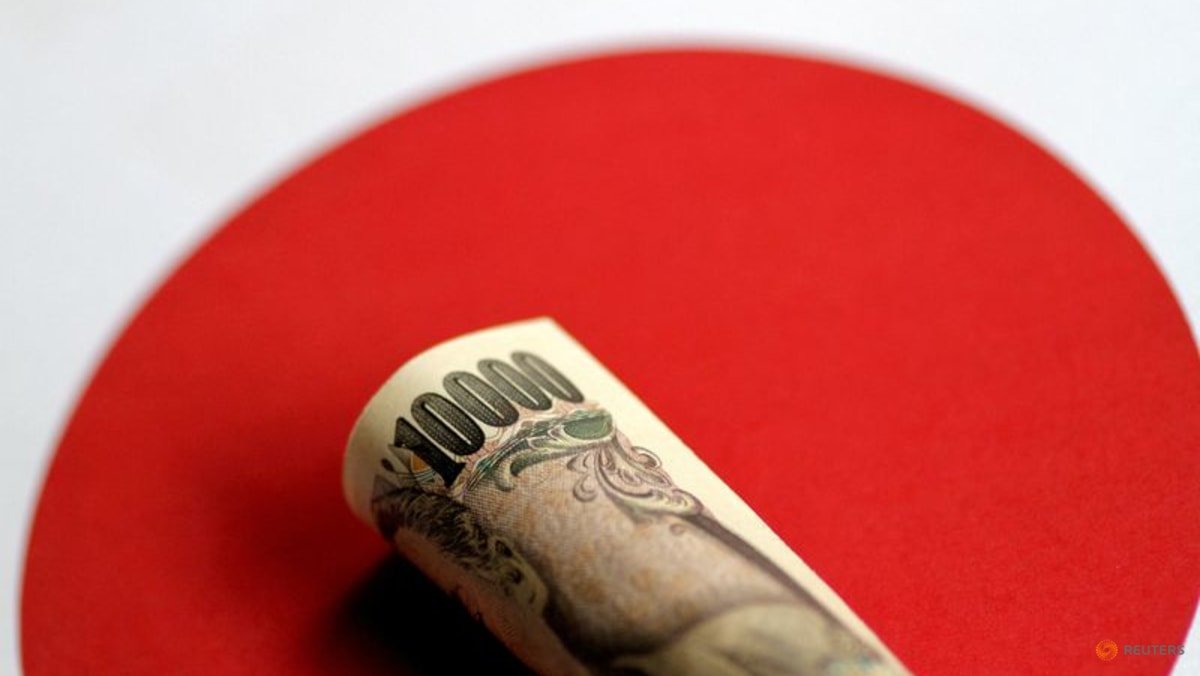
Japan’s benchmark bond yield rises to 3% for first time in 30 years
FILE PHOTO: A Japanese yen note is seen in this illustration photo taken June 1, 2017. REUTERS/Thomas White/Illustration/File Photo
Read a summary of this article on FAST.
Get bite-sized news via a new
cards interface. Give it a try.
Click here to return to FAST
Tap here to return to FAST
FAST
TOKYO, Sept 1 : Japan’s benchmark 10-year bond yield hit 3 per cent on Tuesday for the first time since September 1996, pushed higher by investor concerns about inflation, fiscal health and mounting pressure on the central bank to hike interest rates faster.
With the Middle East crisis stoking inflation fears globally and pressure on the Bank of Japan to accelerate rate hikes, yields have jumped to historic levels across the Japanese government bond curve.
That has accelerated in recent days with domestic media reporting Japan’s ministries and agencies likely made the largest initial budget request on record for next fiscal year.
The 10-year JGB yield, used as a benchmark for mortgages and corporate borrowing, has more than tripled in two years. On the shorter end, the five-year rate is at a record high of 2.265 per cent, and the two-year yield is at a 31-year peak of 1.795 per cent as markets priced in a near certainty the BOJ will raise interest rates at its meeting this month. Yields rise when bond prices fall.

Guess Word
Crack the word, one row at a time

Buzzword
Create words using the given letters

Mini Sudoku
Tiny puzzle, mighty brain teaser

Mini Crossword
Small grid, big challenge

Word Search
Spot as many words as you can
The spike in yields signals investor doubts about Prime Minister Sanae Takaichi’s ability to balance fiscal responsibility with ambitions to ramp up investment in strategic areas such as semiconductors and AI.
“Through the rise in yields so far, the bond market has to some extent been sounding a warning against fiscal expansion,” said Ryutaro Kimura, senior fixed income strategist at BNP Asset Management in Tokyo.
“From the bond market’s perspective, I think there is now something of a sense of resignation — tinged with helplessness — about rising interest rates.”
Inflationary pressures and the yen, languishing near a four-decade low, have exerted pressure on the BOJ to speed up rate hikes. The central bank has faced criticism at home and abroad that it was “behind the curve” in normalising monetary policy, which includes a gradual drawdown of its massive JGB holdings.
Japan’s bond selloff has drawn attention because the country’s heavy debt burden makes it especially vulnerable to rising borrowing costs.
The government assumed a 3 per cent long-term interest rate to calculate debt-servicing costs in Japan’s fiscal 2026 budget, and a move above that level would add further strain to the country’s finances.
Japanese finance minister Satsuki Katayama declined to comment when asked by reporters about the benchmark yield approaching 3 per cent after the first day of the Group of 20 finance leaders meeting.
She said she explained in the meeting Japan’s commitment to fiscal discipline by steadily reducing the debt burden, reforming the budget process and funding consumption tax relief without issuing additional deficit-financing bonds.
Takaichi has pushed an investment-led growth path targeting strategic industries since taking office in October. That spending, along with planned tax cuts, has stoked concerns that Japan could worsen its precarious financial position, with debt exceeding 200 per cent of gross domestic product.
Japan is not alone in seeing stress in its bond market. With no end in sight for the U.S.-Iran conflict and elevated oil prices, bond yields across the United States, Germany and France jumped to multi-year highs of late on rising expectations for inflation and central bank tightening.
The 10-year JGB yield rose to 3 per cent almost immediately after trading restarted in the afternoon session, but results of an auction of the notes released shortly after that showed robust demand, helping anchor the yield. It stood at 2.995 per cent as of 0533 GMT.
“With 3 per cent being a psychological threshold, it may draw out a certain amount of demand,” said BNP Asset Management’s Kimura.
“The auction itself saw a high level of bids, so for the time being we could see yields move sideways around this level.”
Source: Reuters
Sign up for our newsletters

Get the CNA app
Stay updated with notifications for breaking news and our best stories
Get WhatsApp alerts
Join our channel for the top reads for the day on your preferred chat app

Get bite-sized news via a new
cards interface. Give it a try.
Click here to return to FAST
Tap here to return to FAST
FAST
About The Author