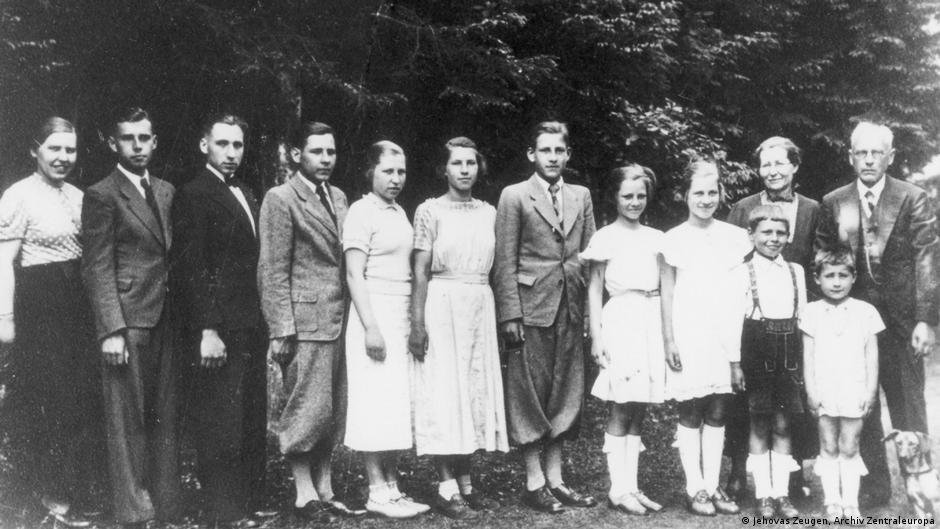
Germany’s Federal Court of Justice (BGH) has ruled in favor of the Jehovah’s Witnesses in a dispute over a unique archive that meticulously documents the persecution of its adherents in photographs, letters, reports from the Gestapo secret police, arrest warrants and death sentences.
The religious community of Jehovah’s Witnesses was one of the groups persecuted by the Nazi regime during the Holocaust. From 1933 to 1945, around 15,000 Jehovah’s Witnesses were persecuted across Nazi-occupied Europe. Around 4,500 were sent to concentration camps where they were forced to wear purple triangles. Over 1,800 were murdered.
Annemarie Kusserow, herself a victim of Nazi persecution who died in 2005, bequeathed her private archive to a branch of the Jehovah’s Witnesses in Germany. However, in 2009, one of her brothers sold the more than 1,000 documents to the Bundeswehr Military History Museum in Dresden and gave assurances that he was the rightful owner. The Jehovah’s Witnesses have since been locked in a years-long legal battle with the German state for the return of the archive.
“To learn that here was a family that was persecuted by the Nazis and you have a clearly expressed will of Annemarie Kusserow who herself was persecuted, suffered, was imprisoned, and she clearly states what should happen with this archive that she collected meticulously, and morally it is so clear where this archive should be,” said Sebastian Stock, a spokesperson for the Jehovah’s Witnesses in Germany.
Targets of ‘blood and soil’ ideology
The Jehovah’s Witnesses are an outgrowth of the International Bible Student movement founded in the US in the 1870s. Many of their missionaries traveled to Europe. By 1933, over 25,000 Jehovah’s Witnesses were living in the German Reich, and the eastern German state of Saxony was home to Europe’s largest community. Both the Protestant and Catholic Churches in Germany opposed the group, known as the International Bible Students and the Earnest Bible Students, and from 1931, as the Jehovah’s Witnesses.
Before the Nazis came to power in 1933, the Bible Students were targeted by the German ethno-nationalist “völkisch” movement that emerged in the late 19th century, and which viewed the German people as a “racially pure” community tied to the land as part of the so-called “blood and soil” ideology. Baseless propaganda was spread that “World Jewry” or an international Jewish conspiracy financed the Jehovah’s Witnesses.
Born in the western German town of Bochum in 1913, Annemarie Kusserow was the eldest of 11 children who, along with their parents, would all be imprisoned by the Nazi regime. In 1931, the family moved to the nearby town of Bad Lippspringe where Kusserow’s father encouraged her to document their systematic persecution.
The Nazis issued a nationwide ban on the Bible Students in 1935 after several German states, Prussia and Bavaria among them, had already imposed regional restrictions. Its members were dismissed from the civil service, lost their jobs and pensions, and were subjected to waves of mass arrests.
To find work, Kusserow moved to Berlin where she was able to visit her younger brother Wolfgang who was in prison for his refusal to join the military. She was arrested in Berlin on October 25, 1944, and was sentenced to four years for discussing her faith and for being in possession of the group’s literature. Her brother Karl-Heinz Kusserow was imprisoned in Dachau concentration camp and died at the age of 28 in 1946 as a result of his treatment there.
Conscientious objectors executed
The Nazis targeted Jehovah’s Witnesses because they were unwilling to swear allegiance to the Nazi state and Adolf Hitler. They believe that their primary allegiance is to God and not any government or human leader. Jehovah’s Witnesses refused to give the Hitler salute, would not become members of any Nazi organizations or institutions, and refused to join the military based on their religious pacifism. They were the single largest unified group that refused military service in the Third Reich.
Nearly 300 young men were executed by the Nazis for refusing to fight, including two of Annemarie’s brothers. Kusserow’s younger brother Wilhelm was executed by firing squad in 1940. “At age 25, imagine this young man who stood there and who gave his life for his conviction not to kill others,” said Stock. In 1942, their 20-year-old sibling Wolfgang was executed by guillotine.
To view this video please enable JavaScript, and consider upgrading to a web browser that supports HTML5 video
The executions of conscientious objectors are one reason why the right to refuse military service is now enshrined in Germany’s Basic Law. “My brothers died for refusing to participate in military service. I don’t find it proper that this inheritance is stored, of all places, in a military museum,” Paul-Gerhard Kusserow, the youngest sibling, told the New York Times in 2022.
The Federal Court of Justice in Karlsruhe ruled on June 26 that Annemarie’s brother Hans-Werner had taken possession of the archive without authorization. It also ruled that in the case of a “singular, historical significant archive,” the state cannot simply rely on the reassurances of a seller and has a duty to investigate. The Higher Regional Court in Cologne will now determine whether Annemarie was the sole owner of the documents, how she lost possession of them, and whether sufficient questions were asked of her brother’s right to sell the archive.
New memorial to persecuted Jehovah’s Witnesses
The ruling came just two days after a new memorial to the Jehovah’s Witnesses who were persecuted and murdered by the Nazis was unveiled in Berlin. The nearly five-meter-high bronze stele stands in the capital’s Tiergarten park where groups of Jehovah’s Witnesses would meet to organize resistance activities. Members were arrested by the Gestapo at the park’s goldfish pond in 1936.
The new memorial in Berlin has, however, prompted criticism. Prominent historian Tim B. Müller wrote an opinion piece for the Frankfurter Allgemeine newspaper. He argues that the Jehovah’s Witnesses persecuted by the Nazis have no legitimate representation today. The Bible Student movement was marked by various schisms and, according to Müller, there is no straightforward continuity between those persecuted by the Nazis and later Jehovah’s Witnesses. Müller writes that the memorial presents a “one-sided narrative” where “well-organized voices drown out historical plurality, and some of the victims are not represented.”
Author Stefanie de Velasco has also criticized the memorial. She has written at length about her upbringing in the Jehovah’s Witnesses, which she describes as a “totalitarian” sect. “The Jehovah’s Witnesses were victims of the Nazis; I don’t doubt that. But I would have preferred a memorial that focused on the individuality of the victims and their involuntary suffering — not on their heroic steadfastness,” she wrote in Der Spiegel news magazine.
Concentration camp survivors persecuted in GDR
The persecution of the Jehovah’s Witnesses did not end with World War II in 1945. It continued in Soviet-occupied Germany and intensified in the German Democratic Republic (1949-1990). Jehovah’s Witnesses in Soviet-occupied Germany were initially able to carry out church services. Those who had been imprisoned or held in Nazi concentration camps were also given official papers recognizing them as victims of fascism.
“That changed by around 1947 and then a ban was introduced in 1950 on the religious community in the GDR. The official status of victims of fascism was then revoked,” historian Falk Bersch told DW. “I’ve even come across cases where the time spent in Nazi concentration camps was counted by the GDR authorities as a prior criminal offense.”
A total of 6,740 Jehovah’s Witnesses were imprisoned in the Soviet occupation zone and later in the GDR. Sixty-five died in custody, around half of whom had spent time in Nazi camps. “We know of over 600 men and women who were persecuted by both the Nazi and the GDR regimes. Around 400 were in concentration camps or imprisoned under both regimes,” Bersch said.
Edited by Rina Goldenberg