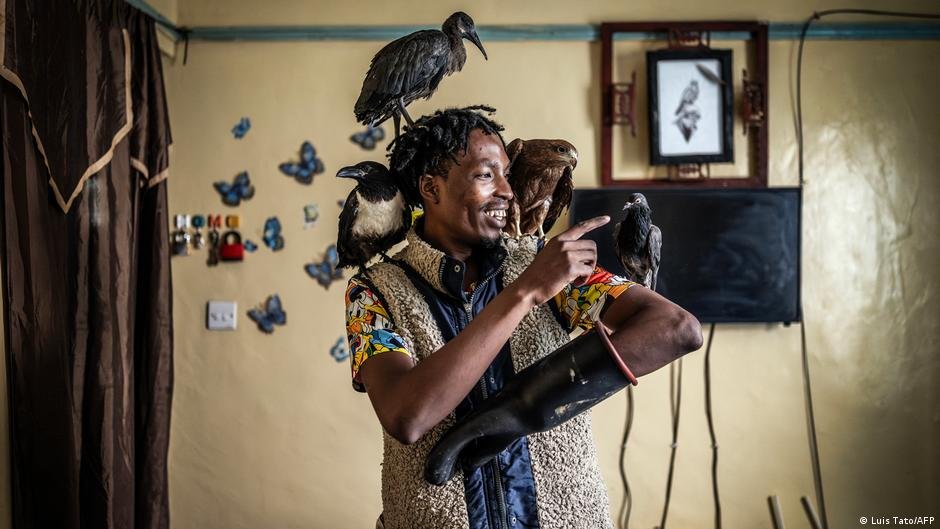
Rodgers Oloo Magutha once lived on the streets; today, the Nairboi ‘Birdman’ is an internet star. He delights millions with rescued wild birds — but the local authorities view his actions with skepticism.
Image: Luis Tato/AFP
For years, Rodgers Oloo Magutha, 28, who lives in the Kayole neighborhood of the Kenyan capital, struggled to get by as a homeless person on the streets. Amid trash, hunger, and hopelessness, his relationship with injured wild birds gave him a new lease of life. He says that his encounter with a weakened kite led to an extraordinary friendship. Today, everyone calls him the “Birdman” of Nairobi.
Image: Luis Tato/AFP
It is not uncommon for fans to ask Birdman for a selfie. In 2024, a single photo changed his life. While protests rocked Nairobi, he calmly walked through the streets with a kite perched on his head. The photo went viral around the world. He now has tens of thousands of followers on TikTok and Instagram. His videos show his unusual life alongside storks, crows, ibises, and owls.
Image: Luis Tato/AFP
This is how Magutha sums up his rise from homeless street kid to internet star: “I’m one of a kind in this country. Anything is possible.” For many of his fans, “Birdman” is much more than an internet phenomenon.
Image: Luis Tato/AFP
Birds follow Birdman willingly through the streets of Nairobi. They sit on his shoulders, circle above him or land on his head. Magutha is convinced that trust is built through care:
“We can show people that anything is possible and that humans and nature can coexist.”
Image: Luis Tato/AFP
Despite his fame, Magutha continues to earn a living by collecting scrap metal and recyclables. His long-term dream is to create a sanctuary for injured birds and homeless children. He says they both need protection, care, and a second chance and his goal is to bring people and animals together under one roof.
Image: Luis Tato/AFP
“I love saving birds,” says Magutha. He has already taken in and cared for more than 20 injured birds. He does not see them as pets but as temporary charges. “I give them a safe place. When they’re ready, I set them free again.” His small apartment has thus become a refuge for injured wild birds. For many children in the neighborhood, he is a role model.
Image: Luis Tato/AFP
Not everyone views his work positively. After a video showed Magutha eating from a plate alongside his birds, authorities issued a warning about possible diseases. The Kenya Medical Research Institute said that there was a risk of infection from close contact with wild animals. Magutha, however, considers these concerns to be exaggerated.
Image: Luis Tato/AFP
“We ate and slept together on the street — nothing ever happened to me,” Magutha says. Instead of criticism, he would like recognition for his work, which he describes as nature conservation in action. With his videos, he wants to entertain people and, at the same time, raise awareness about wildlife protection. For him, education and compassion go hand in hand.
Image: Luis Tato/AFP8 images1 | 88 imageshttps://p.dw.com/p/5H9iQ