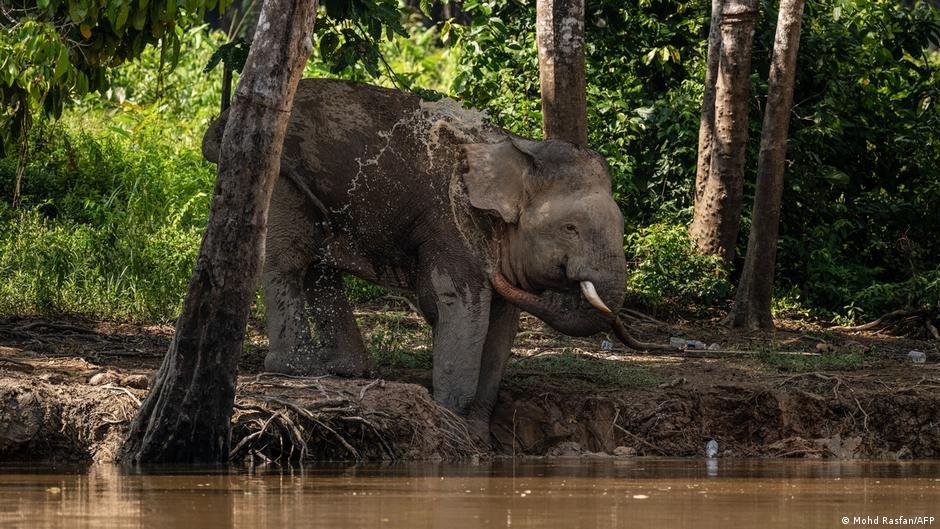
Only about 1,000 Borneo elephants remain in the wild today. Conservationists are using GPS tracking technology and public awarness campaigns to help ensure the species’ survival.
Image: Mohd Rasfan/AFP
These elephants live in the lush Borneo jungle of Malaysia and tend to move in small herds. They are a critically endangered species, whose habitat is being encroached upon by oil palm plantations and human settlements. Human-elephant conflict is increasing.
Image: Mohd Rasfan/AFP
Conflicts are more likely if elephants wander into human settlements or plantations. Many residents reacted with fear and frustration when a herd of 20 elephants recently moved through three villages and several plantations.
Image: Mohd Rasfan/AFP
The conservationist Farina Orthman has been researching Borneo’s pygmy elephants for years and is committed to their protection. A special program has been put in place to improve coexistence between elephants, plantation owners and locals, and to reduce conflicts. To this end, some elephants have been fitted with GPS collars so that the movement of herds can be more closely monitored.
Image: Mohd Rasfan/AFP
The program developed by Orthmann aims to create safe corridors for the roughly 160 elephants that live near the Kinabatangan River as well as to build up local support for elephant conservation. The animal welfare group Seratu Aatai visits schools to raise awareness and works with local wildlife rangers, who help to guide the elephants out of villages and back to their natural habitat if need be.
Image: Mohd Rasfan/AFP
Team members sedate the elephants lightly before equipping them with GPS collars and taking blood samples. They have to be quick as the sedative wears off after about 30 minutes.
Image: Mohd Rasfan/AFP
Over the past 40 years, Bornean elephants have lost more than 60% of their habitat to deforestation and the expansion of oil palm plantations. But representatives of the palm oil industry say that plantation owners who are committed to nature conservation and species protection receive too little recognition and financial support.
Image: Mohd Rasfan/AFP
Despite the challenges, Orthmann remains optimistic about the future. She says that locals used to use the Malay word “halau,” which means “to chase away” or “drive out,” when talking about elephants. But now they are beginning to understand that eléphants can be guided safely out of populated areas instead of chased away with violence.
Image: Mohd Rasfan/AFP7 images1 | 77 imageshttps://p.dw.com/p/5N5Du