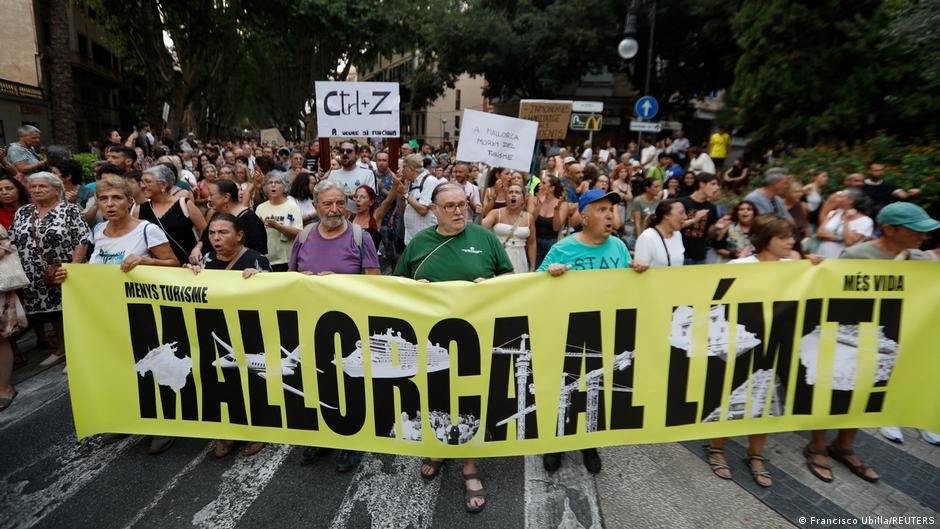
On Sunday, tens of thousands protested against mass tourism in Palma. They demanded fewer visitors, affordable housing and better protection of Mallorca’s environment. The demonstration ended in clashes with police.
Image: Francisco Ubilla/REUTERS
Early Sunday evening, the Plaza de Espana in Palma, Mallorca, filled up. Under the slogan “Mallorca at its limit,” tens of thousands of Mallorcans headed toward the cathedral. The police estimated there were around 25,000 protesters, organizers said that number was 70,000. Their message: The largest of the Balearic Islands should no longer cater solely to the needs of the tourism industry.
Image: Clara Margais/dpa/picture alliance
Hand-painted signs bore messages such as “Tourist, go home!” and “We’re at capacity.” Families, neighborhood groups and environmental organizations marched together through the city center. The demonstration was deliberately set during peak tourist season. And: Regional elections are coming up next year — the goal was for politicians to clearly feel the growing discontent among the population.
Image: Clara Margais/dpa/picture alliance
As in previous years, the protest was organized by the platform “Menys Turisme, Més Vida” (Less Tourism, More Life). The organizers are calling for limits on the number of visitors and vacation rentals. Many locals are seeing their living spaces rented out to vacationers, driving up prices. Those earning an average income can barely afford an apartment anymore.
Image: Clara Margais/dpa/picture alliance
“Mallorca Overbooked” — the protesters’ anger is not directed at individual vacationers, but at a business model that, in their view, has lost its balance. In 2025, the Balearic Islands surpassed the 19 million annual visitors mark for the first time — a new record. In addition to a housing shortage, this also causes more traffic jams, waste and noise, and harms the environment.
Image: Clara Margais/dpa/picture alliance
A woman is holding a sign that reads “Not for sale!” Mallorca depends on tourism, but it also suffers from its consequences. The protesters are therefore not calling for a complete halt, but rather for clear limits.
Image: Clara Margais/dpa/picture alliance
After the demonstration ended, the situation escalated. A total of eight people were injured during police operations. Two protesters were taken to the hospital with minor injuries and were discharged that same night. Six others were treated by first responders at the scene. One protester was taken into custody.
Image: Francisco Ubilla/REUTERS
As the streets emptied out, the key question remained: What now? The protest was not the first of its kind. So far, however, the regional government has rejected calls to reduce tourist numbers, citing the threat of job losses. The issue is sure to play a major role in the 2027 regional elections.
Image: Francisco Ubilla/REUTERS7 images1 | 77 imageshttps://p.dw.com/p/5Hpma