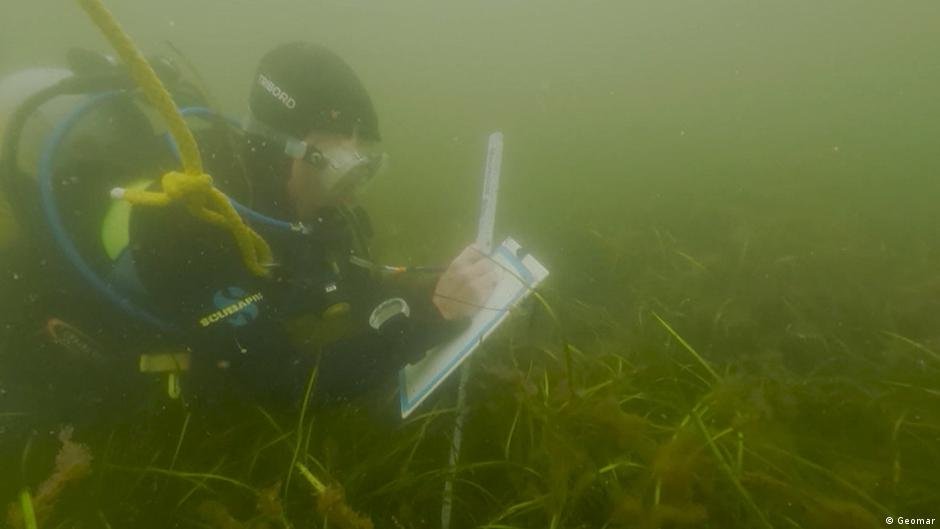
Half a dozen divers are navigating the cold waters of the Baltic Sea off the coast of Dahme, a small beach town in northern Germany. Keeping the roots intact, conservationists carefully lift shoots from a donor meadow of seagrass and place them in a bag.
They only take a few shoots from each spot, which will be planted where the conservationists hope to regrow another meadow. They’ve already picked out a prime area for the young plants, which need sandy sediment, shelter from waves and currents and sufficient light and oxygen to thrive.
The scientists see the work as critical. Myriam Spicka, who heads the NGO Seagrass Conservation, says she has “seen the changes” in the more than 30 years she’s been diving. And she is not the only one who has witnessed the destruction.
To view this video please enable JavaScript, and consider upgrading to a web browser that supports HTML5 video
Scientists estimate that around 60% of the Baltic coast’s seagrass meadows have disappeared.
“That’s the bad news,” said marine ecologist Thorsten Reusch from the GEOMAR Helmholtz Center for Ocean Research Kiel . “The good news is that the decline has stopped.”
Why should we care about seagrass?
Underwater seagrass meadows feed and shelter fish, crabs, shellfish and many other species. They improve water quality and slow waves, helping protect shores from erosion. And they store carbon in the seabed about 30 to 50 times faster than forests.
Around 70 species of seagrass can be found along the coasts of more than 150 countries. Some grow just below the surface, others at depths of 60 meters or almost 200 feet.
To view this video please enable JavaScript, and consider upgrading to a web browser that supports HTML5 video
“Some countries have far more seagrass, particularly in the Indo-Pacific,” said Reusch. “There, it can play a major role in their carbon balance.”
But the value of seagrass goes beyond carbon storage. Its meadows in the Baltic are among the sea’s most valuable habitats. They shelter wildlife, stabilize the seabed and act as natural filters by trapping particles and nutrients.
How can seagrass be replanted on a larger scale?
Planting individual seagrass shoots is painstaking work so people like Reinhard Helbig are trying to make it easier.
Through ZosteraTec, the start-up he co-founded, he helps restore marine habitats, including seagrass meadows damaged by offshore activity, such as wind farm construction. His work begins on the beach.
“Stormy weather helps us. Waves and currents wash seagrass out of the seabed. A day or two later, it washes up here, still fresh,” he said.
The collected shoots are grown and multiplied in ZosteraTec’s aquaculture. Several months later, the marine saplings are laid on a plant support. A specially developed machine binds the planted strands with biodegradable thread. The resulting lengths can be laid on the seabed with less diving work.
“We plant here on land to cut down on underwater work. That means fewer dives, and we can do the painstaking work on shore,” Helbig said.
Could planting seeds be a solution?
Researchers at the Geomar Helmholtz Center in Kiel are also testing new ways to restore seagrass across larger areas, including using seeds.
Marine ecologist Esther Thomsen reaches into an aquarium tank and pulls out a flowerpot containing seagrass.
“Ten percent of the plants in our meadows produce seeds. You can clearly see the seeds sitting inside the seed pod,” she said.
“The big advantage of restoring meadows from seed is greater genetic diversity. And in the future, we should be able to sow seeds over much larger areas,” explained Thomsen.
Reusch from Geomar said they currently “think the most promising way to grow meadows that can withstand climate change is to plant individual shoots as a foundation, then sow seeds between them to increase genetic diversity.”
It takes time to see results
Whether a planting mission is successful is revealed months or even years later.
Thomsen and her colleagues are visiting the first seagrass meadow planted in Germany’s Baltic waters in 2021. The divers count shoots, check how densely they grow and record how the meadow has developed.
They then compare it with the donor meadow that supplied the plants. Only that comparison reveals whether the new crop has merely survived or is beginning to function more like a natural one.
“We’ve just checked the seagrass meadow, and it’s really dense. We counted lots of shoots per square,” Thomsen said. “It’s looking really good.”
This article is based on a Global Us video report.
To view this video please enable JavaScript, and consider upgrading to a web browser that supports HTML5 video
Edited by: Tamsin Walker