Mercury spacecraft BepiColombo ‘on track’ despite glitch, ESA says
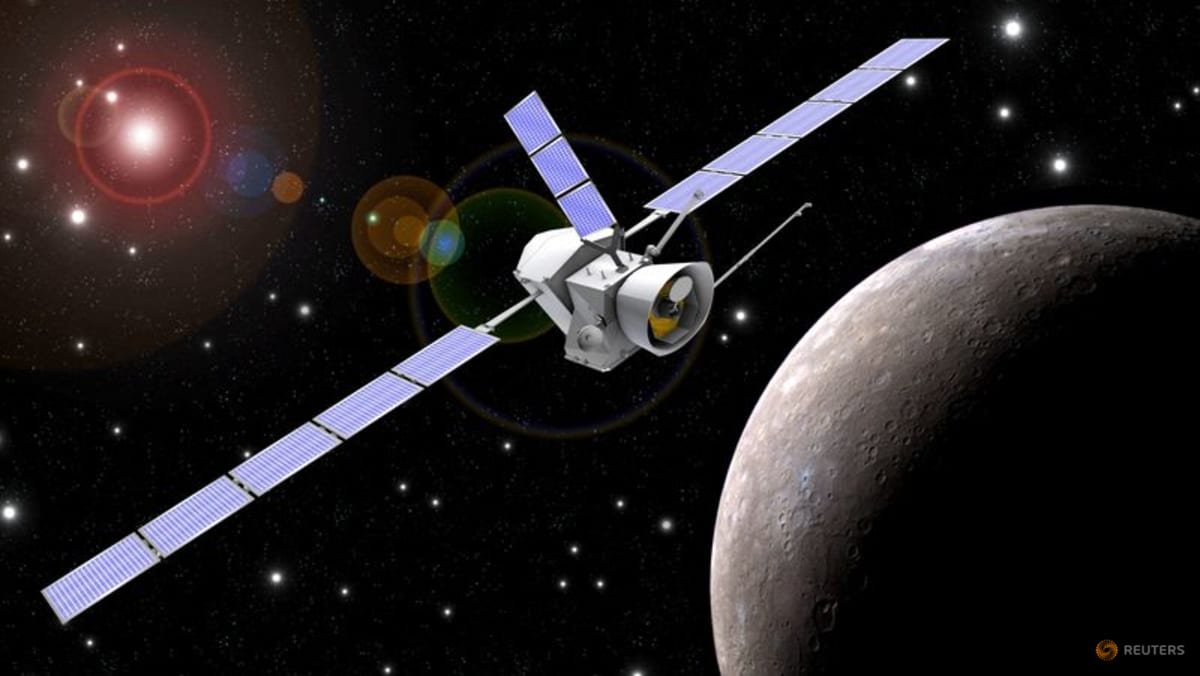
An artist’s impression of the BepiColombo Mercury Composite Spacecraft arriving at Mercury in this image released on August 30, 2010. European Space Agency/Handout via REUTERS
Read a summary of this article on FAST.
Get bite-sized news via a new
cards interface. Give it a try.
Click here to return to FAST
Tap here to return to FAST
FAST
Nov 23 : The European Space Agency said on Monday the BepiColombo European-Japanese mission to explore Mercury is “on track” and the spacecraft is safe despite a glitch that occurred when it began orbiting the solar system’s smallest and innermost planet.
ESA confirmed on Saturday that BepiColombo had entered orbit above Mercury after an eight-year journey from Earth, but then disclosed on Sunday that the thrusters used to position the spacecraft properly above the planet had fired for a shorter amount of time than planned.
In a statement on Monday, the space agency said that “BepiColombo is safe and in a stable orbit around Mercury.”
The robotic spacecraft is a composite of ESA’s Mercury Planetary Orbiter and Japan Aerospace Exploration Agency’s Mercury Magnetospheric Orbiter. They have different scientific objectives and are due to separate in the coming weeks.

Guess Word
Crack the word, one row at a time

Buzzword
Create words using the given letters

Mini Sudoku
Tiny puzzle, mighty brain teaser

Mini Crossword
Small grid, big challenge

Word Search
Spot as many words as you can
In its statement on Monday, ESA said the mission is “on track for the separation of its two science orbiters” on December 9 as previously planned.
The agency said teams at its European Space Operations Centre worked with lead spacecraft manufacturer Airbus and others to investigate the thruster issue, which “has been traced to a software glitch.”
ESA said that as BepiColombo passed 395 miles (635 km) above Mercury’s surface, its thrusters began firing as planned.
This burn was expected to last 37 minutes, slowing the spacecraft enough to secure its orbit, but the maneuver instead was “autonomously interrupted and the spacecraft had entered safe mode, a protective state designed to keep the spacecraft safe by ceasing all non-essential activities when it encounters unexpected conditions,” ESA said.
ESA said mission control determined that because the burn had ended prematurely, the spacecraft achieved around 77 per cent of the total planned velocity change. ESA said more thruster burns are scheduled for the months ahead to modify BepiColombo’s orbit.
ESA has said routine science operations are slated to commence in April.
The mission control team is located in Darmstadt, Germany.
Mercury, only slightly larger than Earth’s moon, is the least explored of the four planets in the inner solar system, with BepiColombo only the third spacecraft to visit the planet and just the second to orbit it.
The mission will seek to answer questions about Mercury such as why it has a magnetic field, why ice exists in the polar craters of a sun-scorched planet, and what is the nature of enigmatic depressions called “hollows” on its surface.
BepiColombo was launched in 2018.
Source: Reuters
Sign up for our newsletters

Get the CNA app
Stay updated with notifications for breaking news and our best stories
Get WhatsApp alerts
Join our channel for the top reads for the day on your preferred chat app

Get bite-sized news via a new
cards interface. Give it a try.
Click here to return to FAST
Tap here to return to FAST
FAST