NASA rover detects ultrafine dust particles on Mars
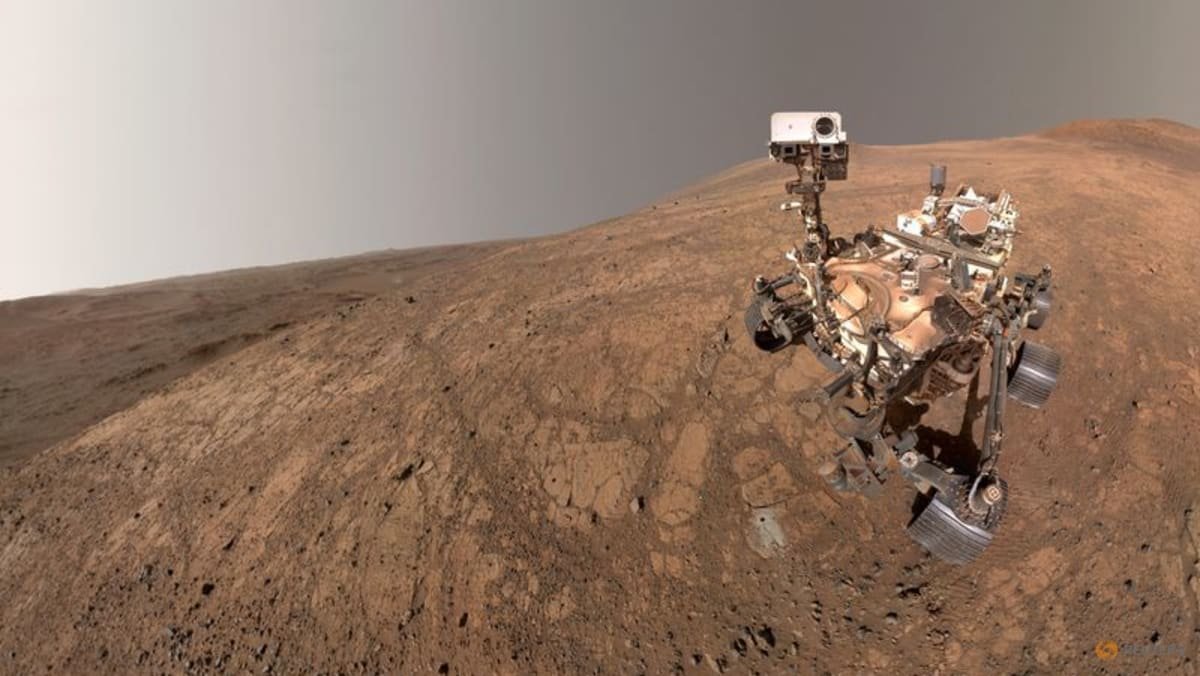
FILE PHOTO: NASA’s Perseverance rover took this selfie inside Jezero Crater in its northern hemisphere of Mars on May 10, 2025. NASA/JPL-Caltech/MSSS/Handout via REUTERS/File Photo
Read a summary of this article on FAST.
Get bite-sized news via a new
cards interface. Give it a try.
Click here to return to FAST
Tap here to return to FAST
FAST
WASHINGTON, Oct 28 : Mars is a dusty place. Dust is circulated by everyday winds, whirlwinds called dust devils and larger dust storms raging at local, regional and global scales. Dust is a factor that must be addressed in any human mission to Mars, and new data from a NASA rover is revealing just how much of a challenge it may present.
NASA’s Perseverance rover, operating in and around an area called Jezero Crater in the Martian northern hemisphere since landing in 2021, has detected the finest particles of dust to date on Earth’s planetary neighbor. It documented ultrafine particles as small as around 100 nanometers wide, about 500 times thinner than a human hair.
“A smaller particle size does not necessarily make dust more dangerous, but smaller particles do have a higher potential to penetrate deeper into the human body and are harder for the body to clear,” said planetary scientist Scott VanBommel of Washington University in St. Louis, a member of the Perseverance science team and lead author of a study describing the findings in the journal Proceedings of the National Academy of Sciences.
“Like any substance, toxicity depends on dose and duration. Martian dust contains silica, iron compounds and chlorine compounds such as perchlorate, which are known to be harmful at high enough doses on Earth,” VanBommel said.

Guess Word
Crack the word, one row at a time

Buzzword
Create words using the given letters

Mini Sudoku
Tiny puzzle, mighty brain teaser

Mini Crossword
Small grid, big challenge

Word Search
Spot as many words as you can
Perseverance measured dust particles that stuck to rover hardware including spacesuit materials carried aboard the six-wheeled robotic vehicle with the intent to observe how they hold up in the planet’s harsh environment.
Previous measurements resolved Martian dust particles down to about 3 micrometers in diameter. But Perseverance’s Planetary Instrument for X-ray Lithochemistry, or PIXL, documented two categories of particles even smaller. Along with the ultrafine particles, there was a category of fine particles of less than 2.5 micrometers in diameter, or 30 times thinner than a strand of hair.
Such tiny particles could be small enough to penetrate an astronaut’s lungs, enter the bloodstream and potentially damage vital organs. Another concern is that the Martian environment and dust’s physical properties could degrade spacesuit and habitat materials over time.
With this in mind, Perseverance carries samples of possible spacesuit materials such as the manufactured fiber Vectran and the protective coating Teflon, each about three-quarters of an inch (20 mm) square.
“We don’t have evidence that the dust damaged the spacesuit materials, just that the materials tended to interact with dust differently,” VanBommel said. “Vectran appeared to hold larger dust particles, with the greatest prevalence on the underside of its weave. The Teflon sample held less dust, but the dust it held was finer, reflecting differences in how electrostatic properties can preferentially adhere particles of different sizes to each material.”
ASTRONAUTS ON MARS
NASA is looking to send astronauts to Mars as early as the 2030s.
“These findings will help inform the design of future human support systems for crewed Mars missions, including the choice of suit and habitat materials and cleaning methods that work at sub-micron particle sizes. They also add to the guidelines and protocols NASA has established for toxicological risk,” VanBommel said.
“How much dust reaches a habitat will depend largely on how suits and airlocks are designed, and that work is ongoing. NASA is currently studying suitports — docking stations for spacesuits — and dual-chamber airlocks, as well as other concepts, to keep dust out of living areas,” VanBommel said.
NASA has experience with the effects of dust from the Apollo astronaut moon landings from 1969 to 1972. Lunar dust degraded outer spacesuit layers, damaged seals and scratched visors. It also may have been associated with symptoms resembling hay fever among some astronauts.
But Mars dust differs from lunar dust.
“On the moon, dust is generated largely by surface impacts, including by micrometeorites. With no atmosphere or wind to wear them down, lunar particles stay sharp and angular. Most of the concern about lunar dust comes from its shape, whereas for Martian dust its chemistry and particle size are the primary concerns,” VanBommel said.
Mars dust arises primarily from the planet’s fine-grained basaltic rocks. Weathering of the particles makes them less abrasive.
“The active wind environment mixes it globally, giving it a rather uniform composition. That same environment rounds the particles and gradually breaks them into smaller particles through collisions,” VanBommel said.
Perseverance’s focus has been on searching for signs of ancient Martian microbial life. But NASA also has used it to prepare for human missions.
“The results from this study do not mean Mars is too dangerous for humans. Mars dust is a hazard that has to be designed for, in the same way radiation and distance from Earth are,” VanBommel said.
Source: Reuters
Sign up for our newsletters

Get the CNA app
Stay updated with notifications for breaking news and our best stories
Get WhatsApp alerts
Join our channel for the top reads for the day on your preferred chat app

Get bite-sized news via a new
cards interface. Give it a try.
Click here to return to FAST
Tap here to return to FAST
FAST