NEA expands surveillance camera scheme with town councils to tackle high-rise littering
Under the partnership, town councils identify high-rise littering hotspots, while NEA deploys cameras and investigates offences.
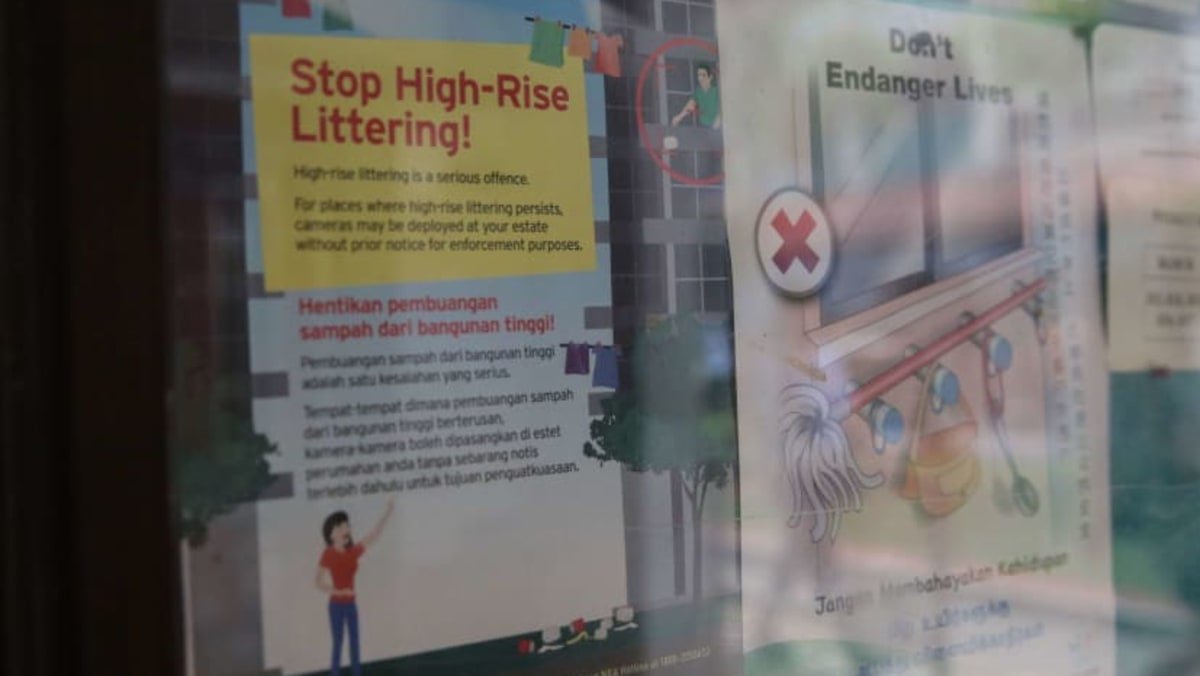
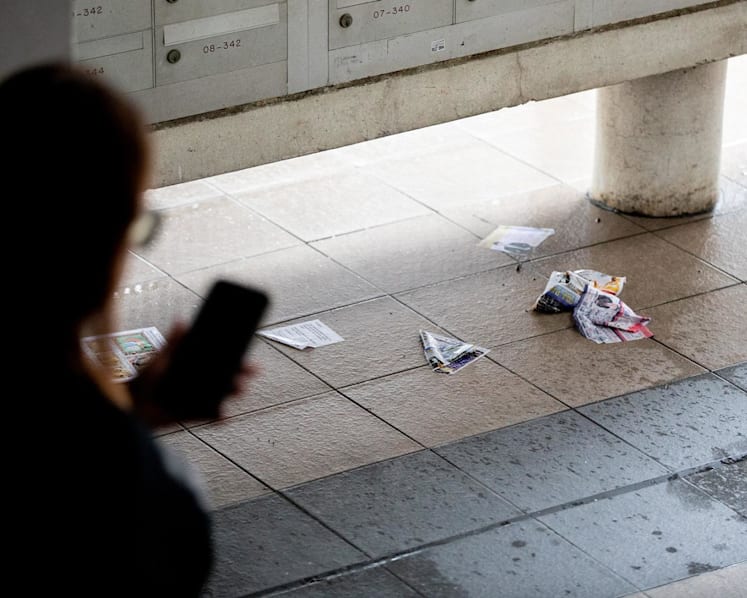
A poster advising against high-rise littering seen on the notice board of a housing estate.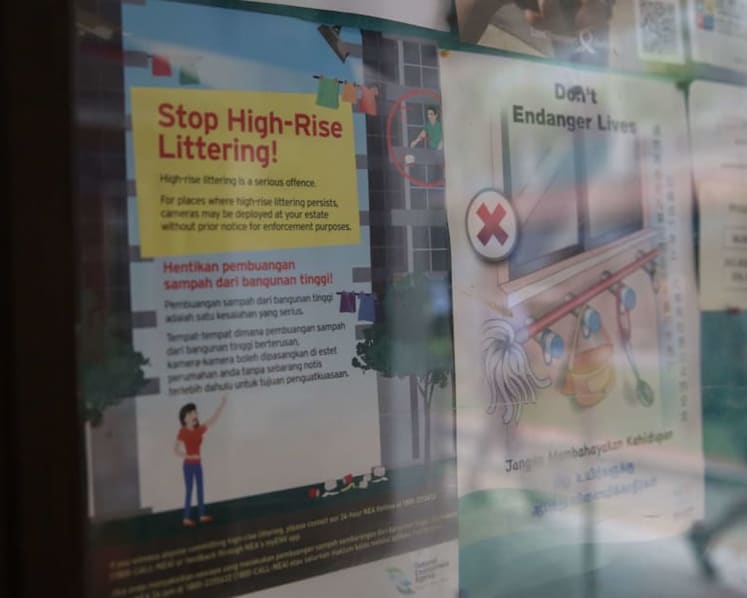
New: You can now listen to articles.

This audio is generated by an AI tool.

Read a summary of this article on FAST.
Get bite-sized news via a new
cards interface. Give it a try.
Click here to return to FAST
Tap here to return to FAST
FAST
SINGAPORE: Town councils can now request up to three surveillance camera deployments a month to tackle high-rise littering, up from two under a pilot scheme, said the National Environment Agency (NEA) on Thursday (Nov 19).
The expansion follows what NEA described as “encouraging results” from a six-month pilot launched in October 2025.
The trial recorded a catch rate of 34 per cent, compared with 26 per cent for the agency’s camera deployments islandwide over the same period.
NEA previously said all 19 town councils participated in the pilot, with 73 camera deployments carried out between October 2025 and April 2026.

Guess Word
Crack the word, one row at a time

Buzzword
Create words using the given letters

Mini Sudoku
Tiny puzzle, mighty brain teaser

Mini Crossword
Small grid, big challenge

Word Search
Spot as many words as you can
Under the partnership, town councils identify locations based on ground observations and estate-level intelligence, with NEA deploying the cameras and investigating detected offences.
“This allows for more targeted and timely intervention at high-rise littering hotspots,” the agency said.
At Telok Blangah Drive, a surveillance camera deployed at a location identified by Tanjong Pagar Town Council captured a high-rise littering offence, allowing NEA to identify the source unit.
Following investigations, the offender was prosecuted and convicted on Oct 20 and fined S$700 (US$540).
High-rise littering feedback cases have averaged about 28,600 cases a year since 2023, NEA said in September.
In 2025, the agency carried out about 2,200 camera deployments and took about 500 enforcement actions for high-rise littering offences.
GROUND LITTERING
Separately, NEA issued about 2,300 fines for ground littering offences in the third quarter of the year.
The number of fines was unchanged from the second quarter but down from about 3,100 in the first quarter.
The agency conducted 114 enforcement blitzes at cleanliness hotspots and issued about 90 Corrective Work Orders (CWOs).
At Kranji MRT station, litter counts fell by 90 per cent between July and September following targeted enforcement, surveillance and ground engagement under the Cleaner Neighbourhood initiative.
Cleanliness hotspots are identified using litter counts, public feedback and observations on the ground.
RAT ACTIVITY
The average number of rat burrows detected per two-month surveillance cycle rose from about 3,400 in the first half of 2026 to about 4,000 across the July-August and September-October cycles.
Most of the burrows were found in public housing estates, followed by grass verges along roadsides and industrial estates.
Between July and September, NEA and the Singapore Food Agency (SFA) jointly took about 210 enforcement actions against premises owners for rat-related lapses.
About 110 of the actions in the third quarter were for poor refuse management. Other lapses included poor housekeeping, defects in refuse-handling facilities and the presence of places where rats could shelter.
At Kreta Ayer Road, New Bridge Road and Smith Street, refuse management lapses fell 81 per cent over five months following targeted efforts under the Cleaner Neighbourhood initiative.
These included engaging businesses and market stallholders on proper refuse management, working with town councils to reduce visible waste and deploying surveillance cameras.
“Sustained housekeeping and proper refuse management are essential to suppressing rat activity, as populations can rebound quickly where food sources and harbourage remain available,” said NEA.
The agency added that it would continue working with stakeholders and taking enforcement action where necessary to address rat activity and maintain public cleanliness.
Members of the public can report public health offences through the OneService app.
Source: CNA/dc(sz)
Sign up for our newsletters

Get the CNA app
Stay updated with notifications for breaking news and our best stories
Get WhatsApp alerts
Join our channel for the top reads for the day on your preferred chat app

Get bite-sized news via a new
cards interface. Give it a try.
Click here to return to FAST
Tap here to return to FAST
FAST