Once excluded from PE, now a national athlete: Meet Singapore’s only female national wheelchair rugby player
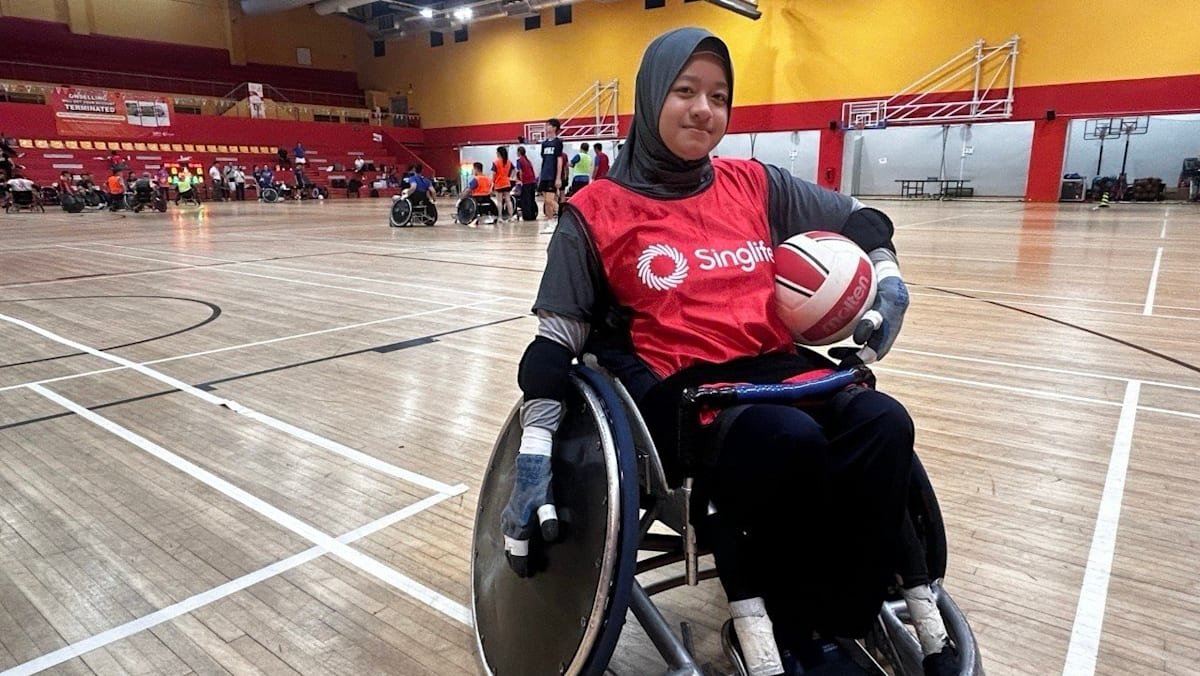
Nur Sabrina Suhaimi needs a cane and brace to walk short distances because of a rare genetic neurological disorder that weakens her muscles over time. In a rugby wheelchair, she flies across the court, crashing into opponents in a sport once known as murderball.
Diagnosed with Charcot-Marie-Tooth disease, a rare neurological disorder that causes progressive muscle weakness, Nur Sabrina Suhaimi competes for Singapore in wheelchair rugby. (Photo: Annie Tan)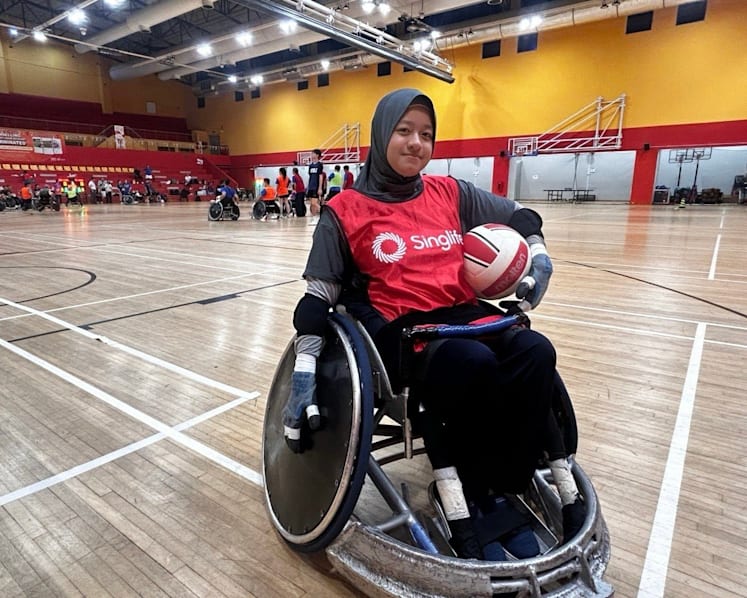
New: You can now listen to articles.

This audio is generated by an AI tool.

Read a summary of this article on FAST.
Get bite-sized news via a new
cards interface. Give it a try.
Click here to return to FAST
Tap here to return to FAST
FAST
It used to be called murderball because of how physical the sport is. Most people know it as wheelchair rugby.
Each team has four players and, throughout the game, you will hear the resounding clang of wheelchair against wheelchair, metal against metal, as players fight to get a ball across the goal line.
These collisions are an integral part of the game, said 25-year-old Nur Sabrina Suhaimi.
“It’s like bumper cars – exhilarating. It is a game where you can unleash your madness in a legal way,” she laughed.
Hearing the young Singaporean para athlete talk, you might forget that she has Charcot-Marie-Tooth disease, a rare genetic neurological disorder that damages peripheral nerves. It causes progressive muscle weakness and loss of sensation, usually beginning in the feet and legs, and can later affect the hands and arms.
Sabrina’s fingers curl inwards and she is unable to fully straighten them, making it hard for her to grip items, open a mineral water bottle or button shirts.
She needs a walking cane, as well as braces known as ankle-foot orthoses on both legs to walk short distances.
But when she’s on a purpose-built rugby wheelchair, she flies across the court.
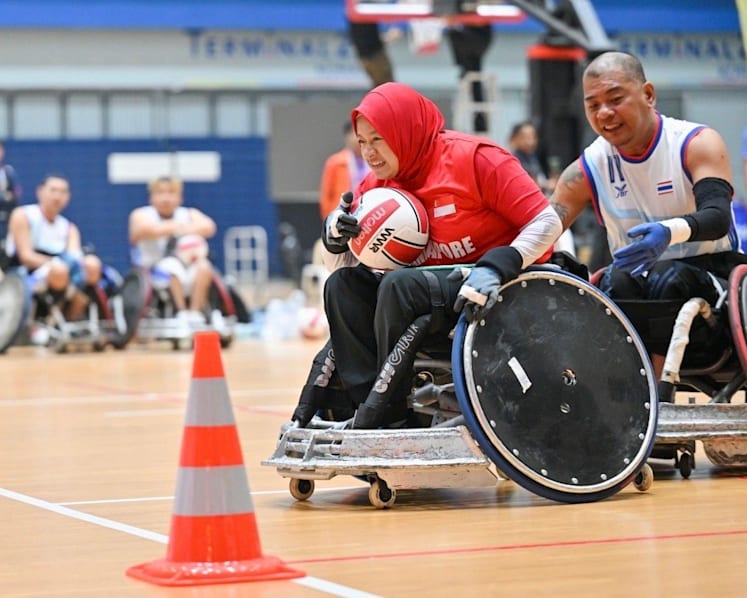
As Singapore’s only female national wheelchair rugby player, Sabrina said the men were initially gentler on her simply because of her gender. That was until they saw her fire.
“Recently, we had a tournament, and I kept banging into my opponent. He told me that I own this court,” she laughed.
THE GIRL NO ONE THOUGHT COULD PLAY SPORTS
Colleagues and friends are always surprised that Sabrina plays this hard-hitting sport. Off the court, she is a gentle soul with the most infectious laugh.
Growing up, she was the smallest kid in every class, and not in the least bit athletic.
At five, she began walking noticeably slower than her peers. Then, as she progressively lost function in both ankles, she developed foot drop, making it difficult for her to lift the front of her feet when walking.
When she was eight, her mother took her to the doctor, but they could not figure out what was wrong.
Gradually, in secondary school, climbing steps got more difficult and her mobility declined. For her safety, her physiotherapist advised her not to participate in physical education classes.
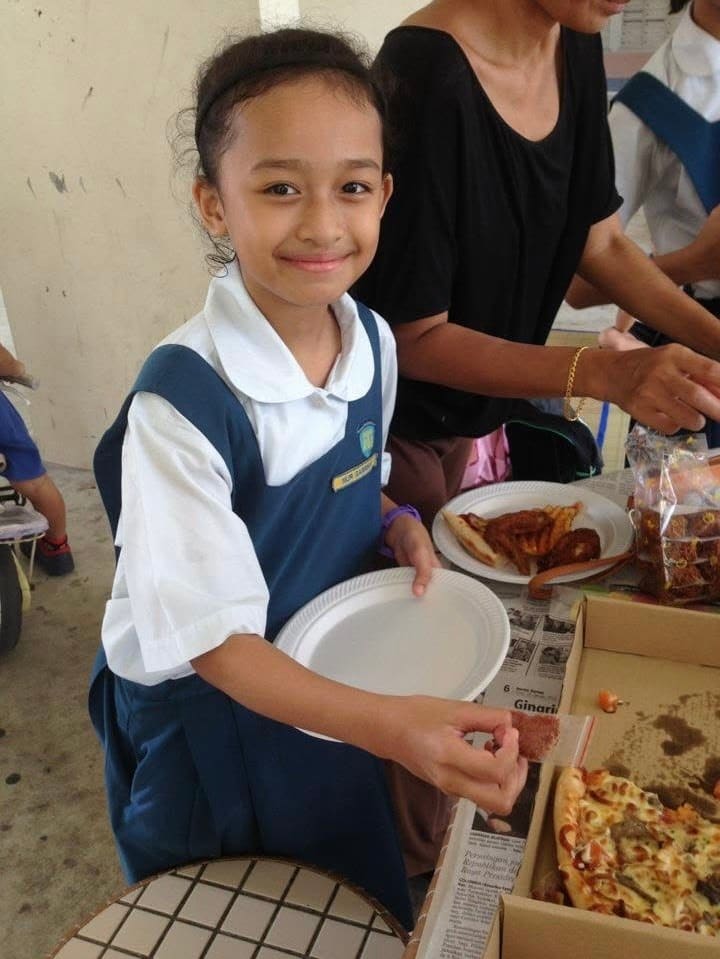
“I thought I couldn’t do sports anymore, and that made me feel like I was different from others,” she told CNA Women.
It was only after her condition progressed to her hands and she could not flex her fingers that doctors conducted more specific tests and diagnosed her with Charcot-Marie-Tooth disease. She was 16 by then.
After years without an explanation, the diagnosis gave Sabrina a better understanding of her condition.
“There’s currently no cure for this. But as my muscles progressively get weaker, staying active can help me maintain my strength and mobility,” she said.
However, in May 2024, Sabrina suffered a bad fall. While stepping out of her house to get into her mobility scooter, she missed a step and fractured her ankle. The injury left her wheelchair-bound for a year.
“That was the lowest point of my life. I couldn’t do a lot of things. I couldn’t even go to the toilet on my own, and had to keep asking my mum for help,” she said.
“I had heard of other people with my condition losing the ability to walk and I was worried this would happen to me.”
The graphic designer had also been retrenched from her job at a creative agency a few months before the fall.
“I felt like I was just a burden to my mum,” said Sabrina. “I did not want my mum to have to worry about taking care of me when she got older.”
Little did Sabrina expect the injury to lead to a new passion and pride.
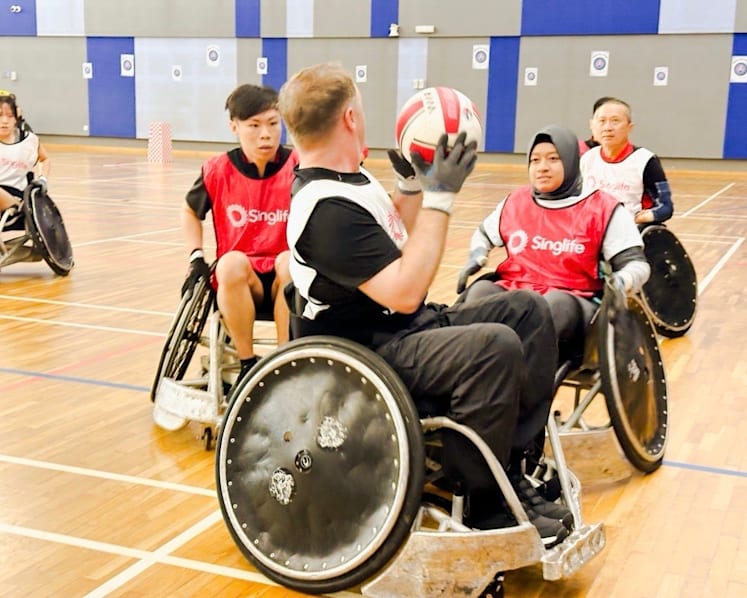
To get on her feet again, Sabrina joined an inclusive swimming class. One of her swimming coaches, who happened to be a former wheelchair rugby coach, introduced her to the game.
THE WHEELCHAIR BECAME HER SUPERPOWER
That’s how Sabrina went from being excluded from PE class to becoming a national athlete for Singapore, playing offence.
Wheelchair Rugby Association Singapore (WRAS) has around 27 members, including athletes with spinal cord injuries, muscular dystrophy, neurological conditions and amputations. The Paralympic version is played by athletes with impairments affecting both their upper and lower limbs.
Competitive players receive classification points according to their functional abilities, and they use custom-built lightweight wheelchairs designed for speed, agility and hard collisions.
High pointers usually dribble, pass or carry the ball and score, while the mid and low pointers block opponents to clear a path for them. Sabrina is classified as a high pointer because she has more functional abilities.
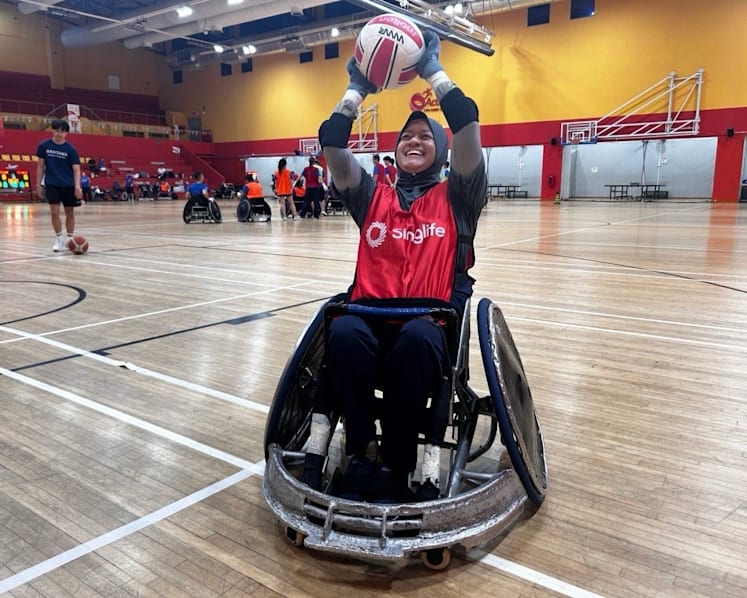
Because collisions are part of the game, falls are common.
Having just recovered from her own fall, Sabrina was apprehensive at first. But the wheelchair rugby community helped her overcome her fears.
“The moment someone falls, all the caregivers, coach and teammates will clap to give them support,” she said. Team staff members and match officials are trained to help them back up safely, and players also learn to protect their head and neck when they fall.
If the players aren’t injured, the game continues “like nothing happened”, she said. “Because of this, it feels like a fall is nothing that serious.”
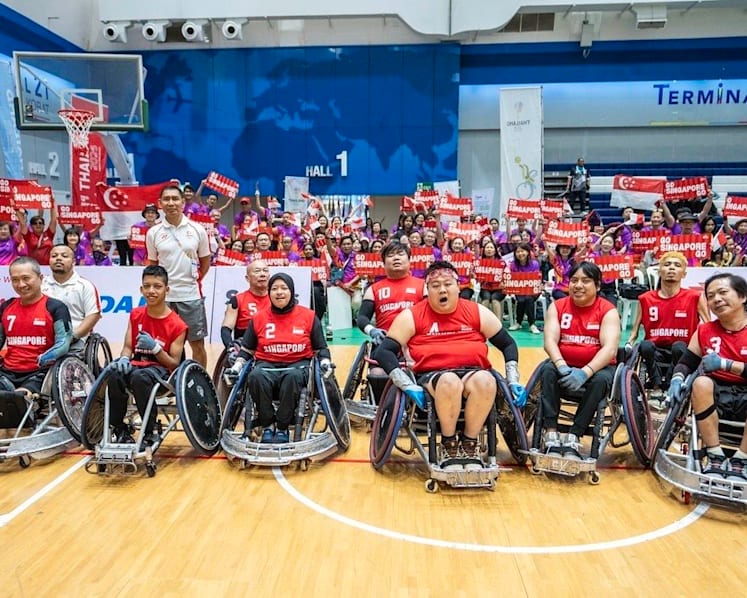
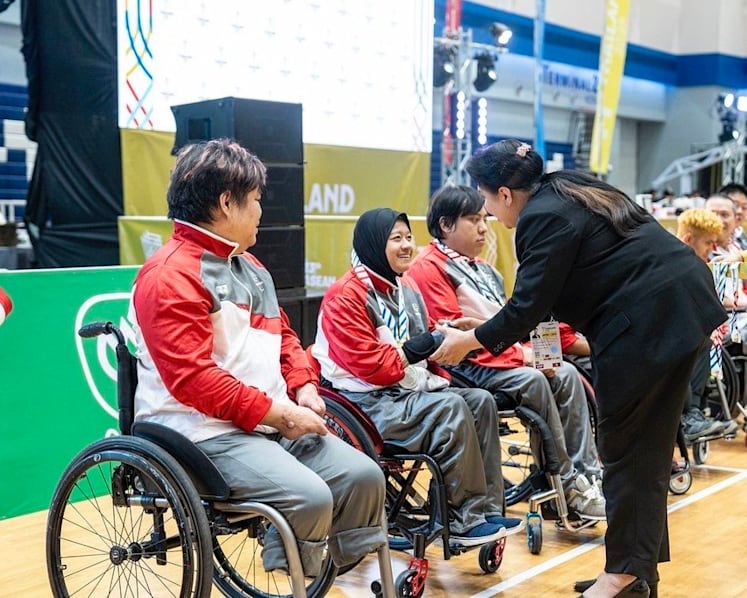
Initially, Sabrina joined wheelchair rugby mainly to get out of the house, especially since she had lost her job. But two months after starting the sport, in May 2026, she landed a new graphic design job.
By then, she had begun to love wheelchair rugby. So, she continued to train three times a week, working on strength, conditioning, developmental skills and technical drills.
She quickly made the national team and was one of 10 wheelchair rugby players to represent Singapore at the 13th ASEAN Para Games in Thailand in January 2026. Singapore played multiple matches against Thailand, and ultimately finished second.
In June this year, Sabrina participated in the four-day World Wheelchair Rugby Super Week, jointly organised by the WRAS and World Wheelchair Rugby, with sponsorship from financial services company Singlife.
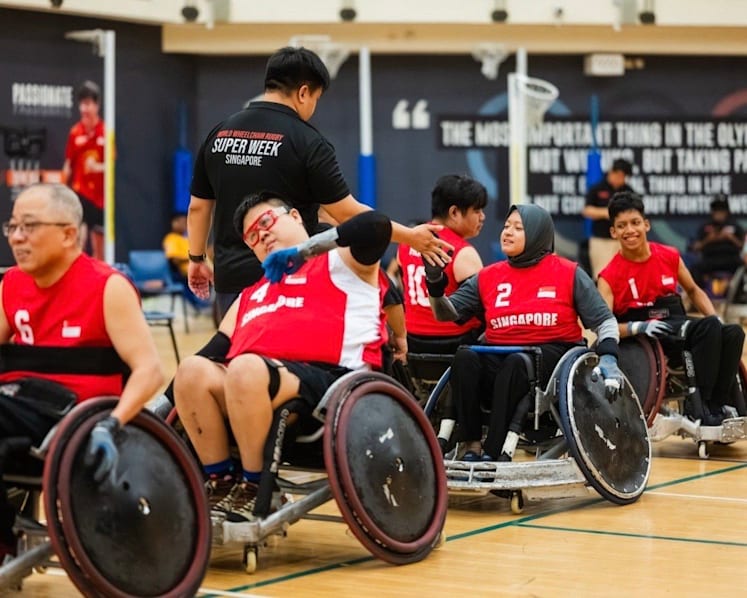
Athletes from countries such as Singapore, Malaysia, Indonesia and Thailand received intensive and individualised coaching from international coaches.
“Competing alongside elite athletes who have played for years yet remain hungry to improve reminded me to keep growing and to be better than the person I was yesterday,” said Sabrina.
PROUD TO USE A WHEELCHAIR
The Singapore national team is now working towards taking part in the 2027 WWR Asia-Oceania Championship and hopes to represent Singapore at the 2029 ASEAN Para Games, which will be held in the country.
Sabrina also hopes for increased awareness and funding for WRAS so the sport can grow.
“I hope more people will know about wheelchair rugby, and see that even though we are all in wheelchairs, we can still play hard and fight for our goals.
“Everyone is different, but we are all just living our best life, and giving our best to life,” she said.
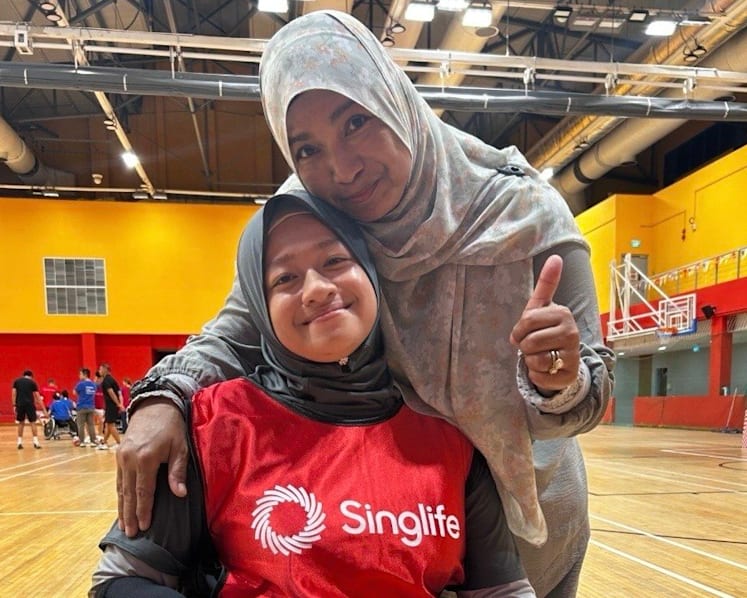
In 2025, Sabrina switched from her mobility scooter to a manual lightweight sports wheelchair. Wheelchair rugby not only gave her confidence to manoeuvre it, but also completely changed her relationship with the wheelchair.
“I used to be shy to tell people I’m in a wheelchair. But now, it is something I am proud to say,” she said. “I have a wheelchair, and I’m a rugby player.”
Sabrina admitted that she worries about her disease progression.
“It’s neuromuscular. Besides affecting my mobility, it also affects my nerves and could affect my eyesight or voice as I get older,” she said.
She cannot predict how her body will change, but Sabrina is determined to continue doing whatever she can to the best of her abilities, she said.
“In 10 years, I still see myself as someone trying her best. If I’m not able to compete in wheelchair rugby anymore, I’m still going to give my best to whatever else I’m doing,” she said.
CNA Women is a section on CNA Lifestyle that seeks to inform, empower and inspire the modern woman. If you have women-related news, issues and ideas to share with us, email CNAWomen [at] mediacorp.com.sg.
Source: CNA/pc
RECOMMENDED
Get bite-sized news via a new
cards interface. Give it a try.
Click here to return to FAST
Tap here to return to FAST
FAST
About The Author