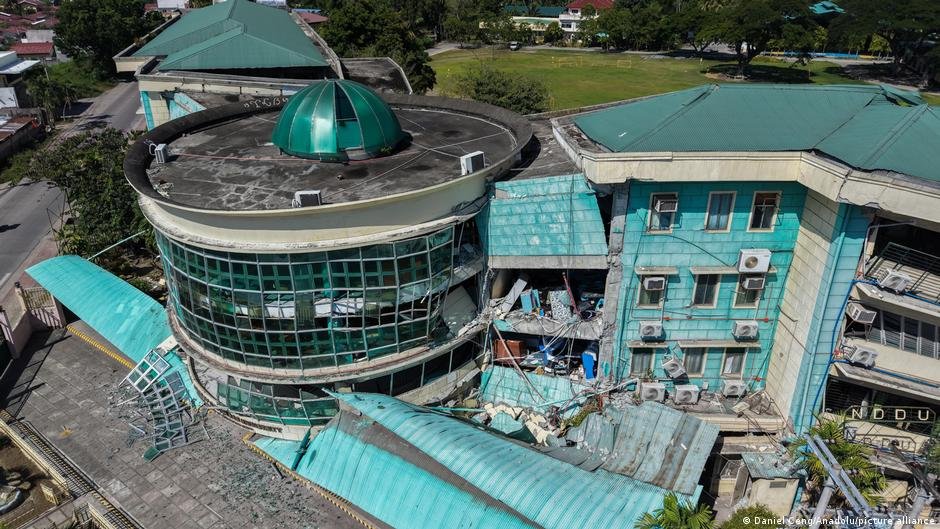
Rescuers continued their search of damaged and collapsed buildings in General Santos city and the surrounding area on Tuesday, a day after the strongest earthquake to hit the Philippines this year killed 37 people and displaced around 20,000.
The Office of Civil Defense said only four people were still considered missing on official records in the southern provinces of Mindanao, but it said that several collapsed and heavily damaged buildings still required thorough searches for possible survivors or casualties.
President Ferdinand Marcos Jr. deployed top defense-mitigation officials from Manila to help oversee search and rescue operations. They were also charged with helping distribute food and construction materials to quake victims and assessing damage to bridges, roads and other infrastructure.
What happened during the quake?
Authorities on Tuesday increased the confirmed death toll to 37, saying that nearly 500 people were injured. More than 20,000 were displaced, at least temporarily, with most fleeing to emergency shelters.
Monday’s magnitude 7.8 quake briefly triggered a tsunami warning, forcing many people to leave coastal homes, although ultimately only small waves of up to 1.4 meters (4.6 feet) above tide level hit the shoreline.
Smaller waves were registered as far away as Indonesia, Palau and southern Japan.
The epicenter was just off the southern coast of Mindanao, the country’s second-most populous island, near the port of General Santos city.
Where were the deaths recorded?
In General Santos, a port city of around 700,000 people known as the tuna capital of the Philippines, at least 13 people were killed in collapsed buildings or as a result of falling debris.
Slightly to the south, even nearer the epicenter in the mountainside town of Glan, a landslide buried several houses. Rafaelito Alejandro of the Office of Civil Defense said that most of the 18 people killed in Sarangani province died as a result of this landslide.
Officials said other deaths were reported in the southern provinces of South Cotabato and Davao Occidental, as well as on Balut Island just off Mindanao’s southeastern coast.
What damage was done to buildings?
Initial assessments from the government found that around 2,000 houses and 117 government buildings and facilities were damaged across several provinces.
General Santos’ international airport remained shut, forcing the cancellation of 63 domestic flights, except for those bringing in humanitarian assistance.
The quake had struck on the first day back at school after two months of summer holidays. Many of the injured were young students.
Authorities said that around 6,000 public school buildings required checks before they could reopen, since buildings that sustained cracks could be at risk from aftershocks.
“We cannot force the immediate reopening of schools because we have to ensure the integrity of buildings,” Alejandro said.
The US Geological Survey on Tuesday tracked more than a dozen aftershocks in the area of Monday’s quake, several of them above magnitude 5 in their own right. They were even more frequent and larger in the immediate aftermath of the quake on Monday.
How prone is the area to quakes?
The Philippines is often hit by earthquakes and volcanic eruptions due to its location on the Pacific “Ring of Fire,” an arc of seismic faults around the ocean.
Monday’s quake was the largest on record in 50 years, according to Teresito Bacolcol, the director of the Philippine Institute of Volcanology and Seismology.
Movement in the same undersea Cotabato Trench triggered a magnitude 8.1 earthquake on August 17, 1976. Some 8,000 people died, many in much larger tsunamis of up to 8 or 10 meters that engulfed several coastal towns.
A 1990 earthquake that also had a magnitude of 7.8 led to more than 1,000 deaths, thousands of injuries and extensive damages in northern provinces and cities.
Don’t let the algorithm hide the news. If you rely on our team for trusted reporting, please take a moment to select us as your Preferred Source on Google by clicking here and hitting the “star” or “preferred” button, so you’ll always see our verified news first.
Edited by: Sean Sinico