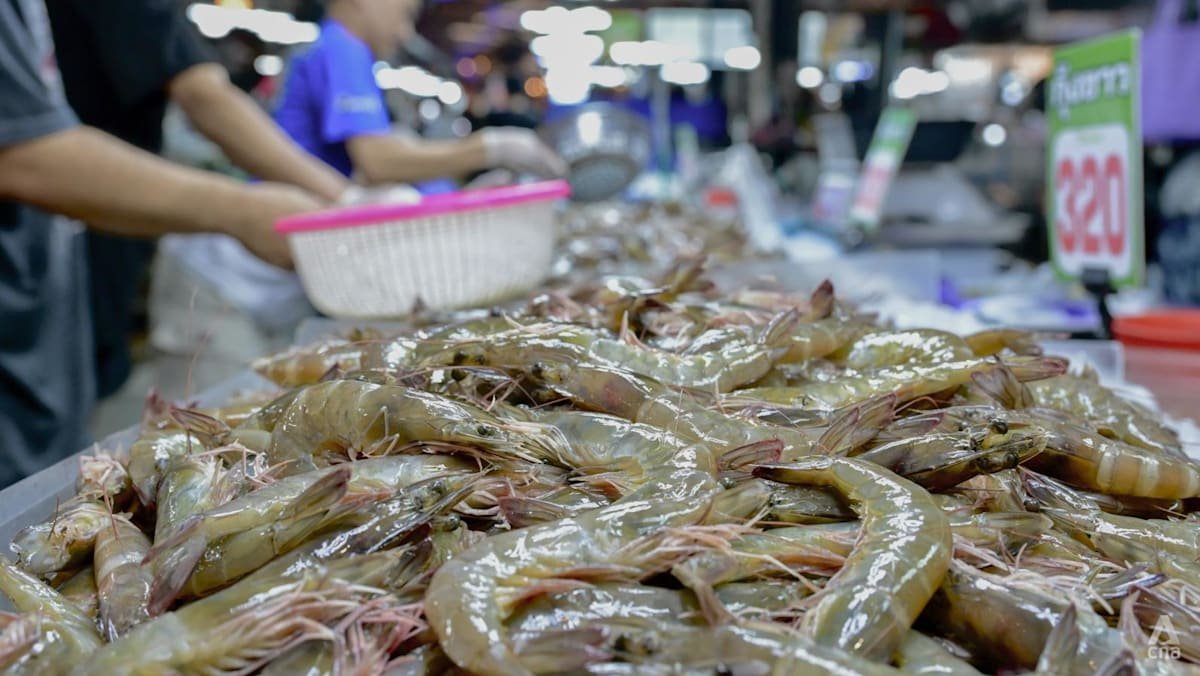
‘Protectionist instincts’: Seafood traders caught in Thai-Malaysia row over shrimp, seabass exports
A seafood trade dispute between Thailand and Malaysia has created uncertainty for Thai farmers and Malaysian sellers.
Local shrimp for sale at Thonburi Market, outside Bangkok, on Jun 10, 2026. (Photo: CNA/Jarupat Karaunyaprasit)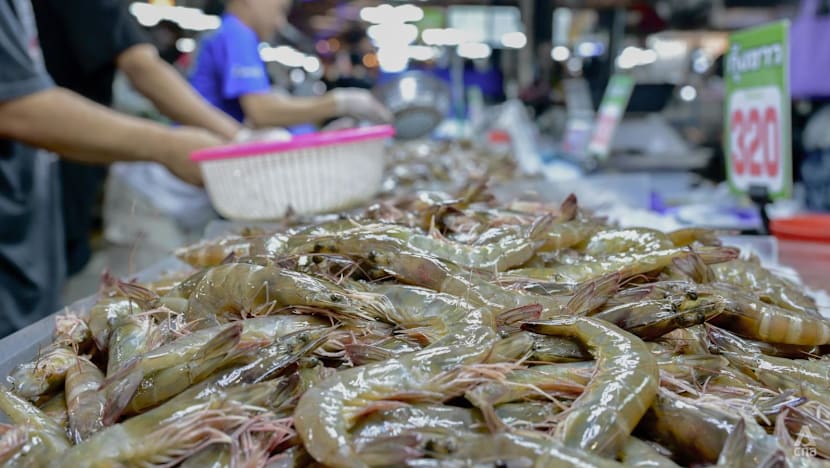
New: You can now listen to articles.

This audio is generated by an AI tool.


Read a summary of this article on FAST.
Get bite-sized news via a new
cards interface. Give it a try.
Click here to return to FAST
Tap here to return to FAST
FAST
BANGKOK/KUALA LUMPUR: Shrimp exporters and farmers in southern Thailand are grappling with uncertainty as Malaysian customers postpone or suspend orders in the wake of a seafood spat between the two countries that began last month.
Some seafood sellers in Malaysia have, meanwhile, seen business slow down as the supply of Thai prawns and shrimp, which are typically cheaper than local shrimp, is halted.
The spat began last month, when Bangkok restricted the import of Malaysian sea bass after concerns about chemical residues in the fish.
Malaysia responded by introducing a temporary ban on Jun 1 on the import of five varieties of prawns and shrimp from Thailand – brown tiger, banana and giant tiger prawns as well as whiteleg and blue shrimp – over food-safety controls.

Guess Word
Crack the word, one row at a time

Buzzword
Create words using the given letters

Mini Sudoku
Tiny puzzle, mighty brain teaser

Mini Crossword
Small grid, big challenge

Word Search
Spot as many words as you can
Its Ministry of Agriculture and Food Security also said last month that it would require an extra Certificate of Analysis for Thai sea bass.
With Thai Agriculture and Cooperatives Minister Suriya Juangroongruangkit scheduled to visit Malaysia on Wednesday (Jun 17) for policy-level talks aimed at ending the dispute, industry players in both countries said they are hopeful.
The dispute had earlier escalated, with Thai Prime Minister Anutin Charnvirakul on Jun 2 ordering urgent talks with Malaysia to resolve an issue threatening to hurt Thai farmer livelihoods.
Thai Deputy Prime Minister and Commerce Minister Suphajee Suthumpun then said on Jun 10 that Thailand would consider raising the matter at a regional level or at the World Trade Organization if bilateral negotiations do not produce a resolution.


But ahead of Suriya’s visit, Malaysian Deputy Agriculture and Food Security Minister Chan Foong Hin struck an optimistic tone, telling CNA on Jun 12 he appreciates the “readiness expressed by the Thai government to engage in discussions on this matter”.
“Engagement between the relevant agencies of both countries is ongoing, and we are encouraged by the positive developments in recent days,” he said.
Analysts told CNA that while Thailand’s aquaculture sector is advanced, it needs to innovate and adapt to better shield against such market access shocks.
And while the current dispute may eventually be resolved, there is a larger need for Southeast Asian governments to think about collective food supply resilience instead of defaulting to protectionist measures whenever tensions arise, the analysts added.
“The suspension is a significant concern for Thailand’s shrimp industry,” Ekapoj Yodpinit, president of Thai Shrimp Association, told CNA.
EXPORT DISRUPTION COULD AFFECT LOCAL PRICES
The current saga with its neighbour has piled new pressure on a Thai industry already struggling with rising costs, disease risks and regional competition.
Malaysia imports an estimated 6,000 to 8,000 tonnes of Thai shrimp annually, around 5 per cent of Thailand’s total shrimp exports.
“The most immediate impact has been uncertainty surrounding orders,” said Ploypapus Wiriyathadasak, who is involved in the procurement, grading and export of shrimp in Songkhla province. Malaysia is a regular export market due to its proximity and steady demand from across the border.
“As a result, we have had to adjust our production and shipment plans and look for alternative markets to absorb volumes that would normally be exported to Malaysia.”
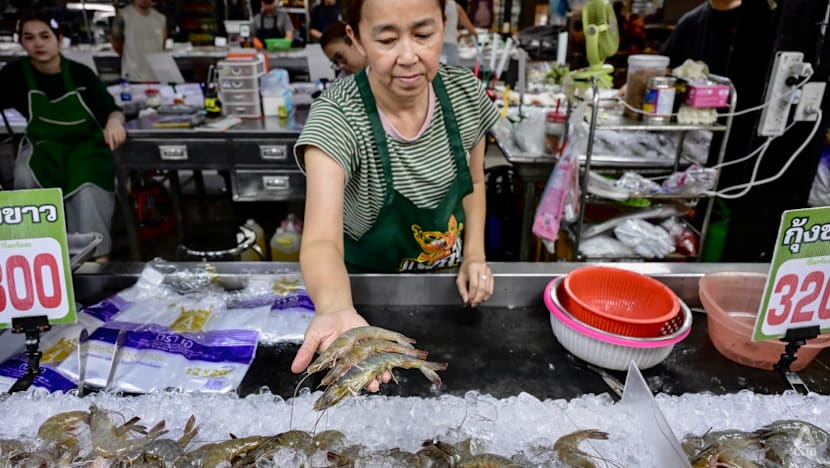
With some customers postponing or suspending orders while waiting for greater clarity on the situation, storage and inventory costs have gone up, she said.
Replacing Malaysian buyers was not simple because other destinations have different product specifications, regulations and buyer requirements.
“Our biggest concern is the potential loss of customers and market share. If buyers switch to suppliers from other countries, it may be difficult to win them back,” she said.
The impact of the shrimp restrictions has yet to be fully felt in markets further north in Thailand.
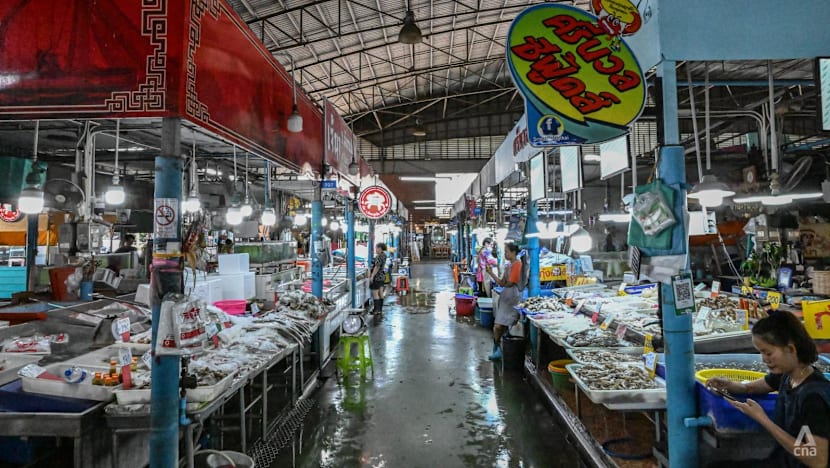
At Thalay Thai Market outside Bangkok, the seafood trade looked routine on a recent weekday morning. Sellers arranged fresh fish, crabs, river prawns and shrimp over beds of ice, as they waited for customers.
But some of them are watching prices nervously. If shrimp that would normally go to Malaysia is redirected into Thailand’s domestic market, they say the increase in supply could put pressure on prices, impacting their profits.
“If shrimp that can no longer be exported to Malaysia is redirected to the domestic market, shrimp prices will certainly decline. There is little we can do about it,” said Rungnapha Sophasri, a seafood seller at the market, in Samut Sakhon province.
But Ekapoj from the Thai shrimp association said any price reduction is unlikely to be dramatic or sustained, as storage, processing and distribution costs remain significant, and efforts are already underway to export to alternative markets.
If the suspension continues for several weeks or months, he said he was concerned about oversupply in the domestic market, downward pressure on farm-gate prices and the potential loss of export customers.
Any disruption affects not only exporters, but also farmers, collectors, processors and logistics operators throughout the supply chain, particularly those that rely heavily on the Malaysian market, he said.
The Thai government in a statement acknowledged the shrimp issue is tied to its tighter inspections on Malaysian sea bass imports.
On Jun 11, it said it was reviewing those procedures and working to speed up testing from around 15 days to about seven days while maintaining food safety and consumer protection standards.
In the meantime, the government said it would monitor prices and address any impact on shrimp farmers.
A FRAGILE INDUSTRY IN THAILAND
Thailand’s shrimp sector has shrunk dramatically from its peak. Production reached about 640,000 tonnes in 2010, before disease outbreaks sent output plunging. In 2026, the Thai Shrimp Association expects production of between 120,000 and 140,000 tonnes.
It has been facing multiple challenges including high feed costs, rising energy prices, labour costs and increasing competition from other shrimp-producing countries, said Ploypapus, the Thai seafood exporter.
The industry was badly impacted by Early Mortality Syndrome in the early 2010s and never fully rebuilt to its previous scale.
Disease and unstable weather, connected to worsening climate change, have continued to hit the sector in the years since, while competitors like Ecuador, India, Vietnam and Indonesia have increased their share of exports.
“Losing access to a market at this time adds further pressure on the sector,” Ploypapus said.

Thailand’s aquaculture sector has strong expertise, established farming systems and an experienced processing industry, said Supawadee Poompuang, a professor in the Department of Aquaculture at Kasetsart University in Bangkok.
But given its ongoing challenges, long-term resilience will depend on genetics, disease prevention, biosecurity, farm management, data-driven farming and climate-resilient systems, she said.
“The industry has made significant progress over the years, but maintaining competitiveness will require continued innovation and adaptation,” she added.
Since the latest border-trade disruption, the Thai Department of Fisheries has been tasked with compiling proposals to strengthen the shrimp industry across the supply chain.
It said it was preparing measures to reduce production costs, promote the adoption of technology and clean energy in aquaculture and encourage domestic shrimp consumption.
The Fisheries Department had also submitted a full clarification on its shrimp policies to its Malaysian counterpart and received a “positive response”, Suriya, the Thai agriculture minister, said on Jun 5 after discussions with Malaysia over the shrimp export restrictions were postponed then.
MALAYSIA’S SHRIMP SUPPLY STABLE, BUT SELLERS HIT
But in a sign of the complexities involved, Malaysia’s Fisheries Department said on Jun 8 it had not received answers on safety worries about shrimp from Thailand – a pre-condition before deciding on its next moves.
“Once we receive the response, we will assess whether it meets Malaysia’s biosecurity requirements,” said the department’s director-general Adnan Hussain, as quoted by Malaysian news agency Bernama.
Malaysia’s temporary restriction had followed Thailand’s decision to impose restrictions and conduct full inspections on Malaysian sea bass exports, Adnan said.
“Our sea bass exports are also subjected to restrictions and comprehensive inspections by Thailand. As such, we are applying similar biosecurity measures,” he added.
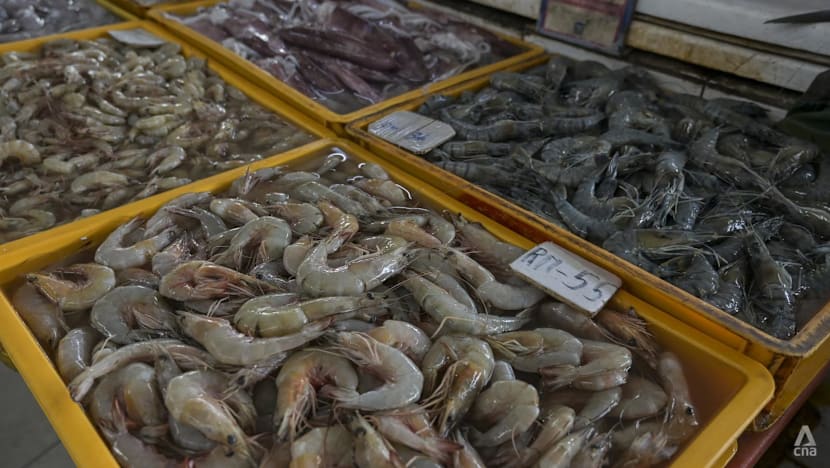
The spat has impacted Malaysian seafood sellers.
At a wet market in Klang, Selangor, sellers told CNA on Jun 11 that the ban has prevented cheaper Thai shrimp from coming in, and that the higher prices of local shrimp are turning customers away.
One of them, Mohamed Usman, said he usually sells Thai shrimp for RM26 (US$6.42) to RM28 per kilogram, compared with RM32 per kilogram for local shrimp.
“My boss has not brought in Thai shrimp for one to two weeks; I don’t know why,” he said. “There’s less variety in what is being sold now.”
Another seller, who only gave his name as Hing, said local shrimp is slightly more expensive and harder to sell.
“Business is a bit slower. When the price is higher, people don’t want to buy,” he said.
Fellow vendor Nur Mohamed, however, acknowledged that Thai shrimp was “slightly lower in quality” than local shrimp.
“Thai shrimp used to come in by the tonne and drive prices down,” he said. “We can’t do anything (about the government restrictions). We are not the ones making the policy decisions.”
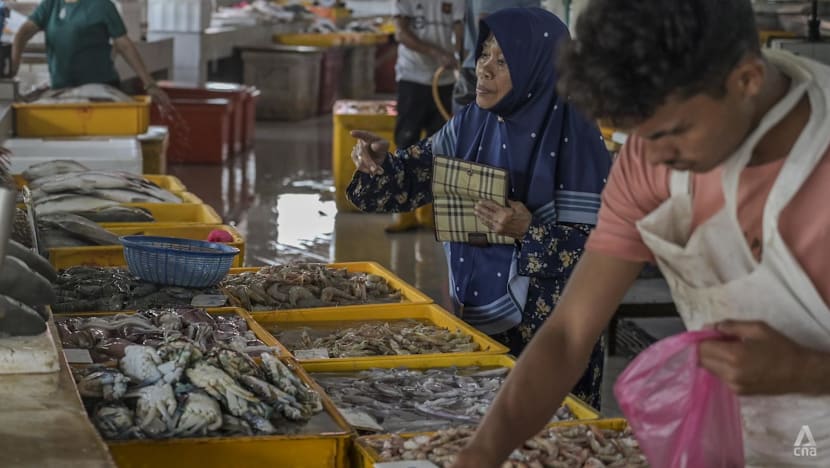
Adnan, the Fisheries Department chief, said on Jun 13 the supply of fresh local shrimp nationwide remains stable.
The department has tightened biosecurity controls at all national entry points to prevent the risk of aquaculture diseases such as Early Mortality Syndrome and White Spot Syndrome Virus, he said, according to Bernama.
Enforcement measures help ensure aquaculture products in the local market remain safe, of high quality and compliant with established standards, he added.
Adib Zalkapli, managing director at Malaysia-based geopolitical consultancy Viewfinder Global Affairs, said the dispute “should not have escalated to where it is today”.
“If there are genuine food safety concerns involving both sea bass and shrimp traded between the two countries, they should be addressed urgently and transparently by the relevant authorities,” he told CNA.
In the current global climate, it is easy for countries to fall back on “protectionist instincts”, Adib said, calling for the region to rethink its broader approach to food trade notwithstanding the food safety concerns involved.
“Without a broader shift in how (Southeast Asian) countries view food supply chains and cross-border food trade, similar disputes are likely to recur in the future,” he added.
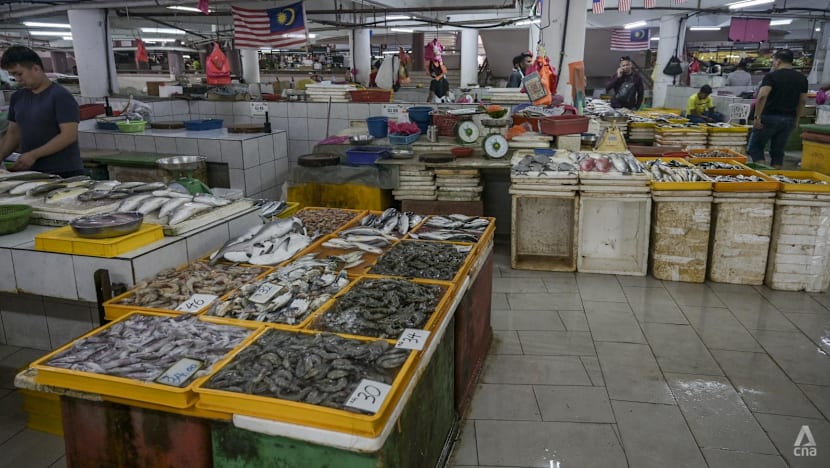
Malaysia deputy agriculture minister Chan said Malaysia and Thailand are longstanding partners in agricultural trade.
“I am confident that through constructive dialogue and cooperation, we will be able to resolve this matter in a mutually beneficial manner,” he told CNA.
Ekapoj from the Thai shrimp association said the shrimp industry wants both governments to resolve the issue through scientific evidence and mutually recognised standards.
“What we need most urgently is direct engagement between the Thai and Malaysian governments at both the political and technical levels,” he said.
“We also need clear communication with industry stakeholders and support measures to help manage excess supply if the disruption continues.”
Additional reporting by Jarupat Karunyaprasit and Fadza Ishak


Source: CNA/hz
Sign up for our newsletters

Get the CNA app
Stay updated with notifications for breaking news and our best stories
Get WhatsApp alerts
Join our channel for the top reads for the day on your preferred chat app

Get bite-sized news via a new
cards interface. Give it a try.
Click here to return to FAST
Tap here to return to FAST
FAST
About The Author