Extreme heat is taking a toll on the glaciers of the Swiss Alps. Experts warn that melting is starting earlier and becoming more severe, with far-reaching consequences for the environment and water supply.
Image: Fabrice Coffrini/AFP
The heat settles over the Swiss Alps like a magnifying glass. On the Rhone Glacier, the last of the winter snow is disappearing unusually early. The so-called “Glacier Loss Day” marks the beginning of a critical phase: From that point on, it is no longer the snow reserves that are melting, but glacial ice that is decades or even centuries old. For researchers, this is an alarming sign.
Image: Fabrice Coffrini/AFP
Matthias Huss is measuring ice melt on the Rhone Glacier. This year, Swiss glaciers will reach “Glacier Loss Day” as early as June 29. Only in the record-breaking year of 2022 did this turning point occur even earlier. “This is a truly alarming situation,” warns glaciologist Huss. The glaciers still have three hot summer months ahead of them — and every day costs them precious ice.
Image: Jean-Christophe Bott/KEYSTONE/picture alliance
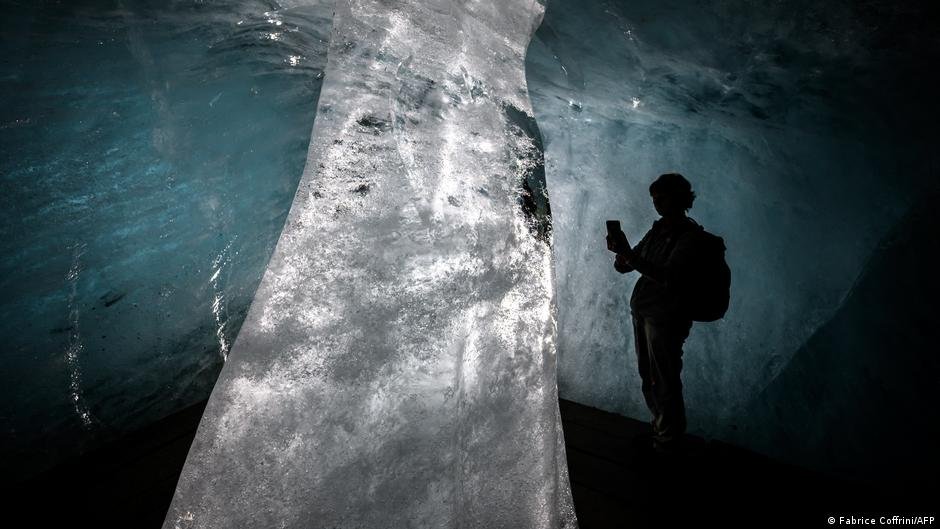
Tourists observe the shrinking ice cave of the Rhône Glacier. Two heat waves, little snow in winter, and Saharan dust are all accelerating the melting at a massive rate. On the Rhône Glacier alone, one meter of ice disappears within a few days. Glaciologist Huss describes the condition as “very poor.” The glaciers are losing more mass than they can replenish in winter.
Image: Fabrice Coffrini/AFP
The consequences are visible to the naked eye. Harry Block, a German tourist, has been visiting the Rhone Glacier for about 50 years. At the sight of the shrinking ice fields, he struggles to hold back his tears. “I could cry. You can see climate change right here.” In place of the once-mighty ice walls, only bare rocks and scree remain.
Image: Fabrice Coffrini/AFP
Visitors take photos of the shrinking glacier tongue of the Rhone Glacier. The glaciers still feed large rivers such as the Rhine and the Rhone with their meltwater. This can only continue as long as there is enough ice. In just 24 years, Swiss glaciers have lost about 38% of their volume. And over the past 50 years, about 1,200 smaller glaciers have disappeared completely.
Image: Fabrice Coffrini/AFP
From a bird’s-eye view, the extent of the melting at the Rhone Glacier becomes apparent. Researchers expect enormous ice losses by 2026. Matthias Huss warns: “If global warming continues, only small remnants of ice will remain by the year 2100.” Conservationists are calling for stronger protection of the glaciers. It is still possible to halt the melting.
Image: Jean-Christophe Bott/KEYSTONE/picture alliance6 images1 | 66 imageshttps://p.dw.com/p/5Hxx4
About The Author