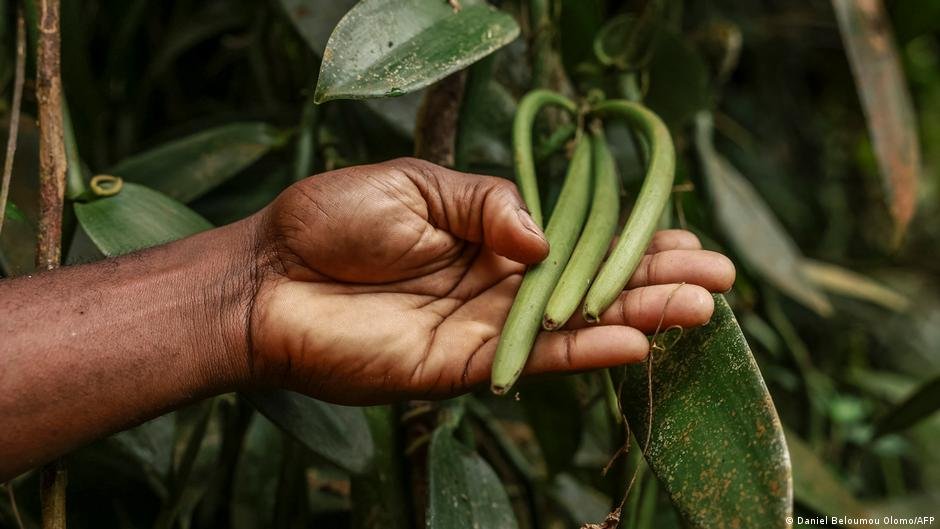
Sao Tome is known for its cocoa. But now, on this island off the coast of Central Africa, another luxury product is making a comeback: vanilla, the second most expensive spice in the world.
Image: Daniel Beloumou Olomo/AFP
Ifrasio de Barros Rompao is a farmer on Sao Tome, the larger of the two main islands of the island nation of Sao Tome and Principe. While his mother grew cocoa, he has turned to vanilla and invested in the cultivation of the green pods. “Vanilla, in terms of money, for me, is essential,” he says. On his property in Abade, in the center of the island, the vanilla plants grow on a wooded hillside.
Image: Daniel Beloumou Olomo/AFP
To boost his income, the farmer recently began growing vanilla. On Sao Tome, which is best known for its cocoa, the spice is currently making a comeback. “I have a big family at home, and with this crop I manage to provide for our needs,” he says. After saffron, natural vanilla is the second most expensive spice in the world.
Image: Daniel Beloumou Olomo/AFP
The Portuguese-speaking island nation, once known as the chocolate islands, was the world’s largest cocoa producer in the early 20th century. Vanilla, introduced in 1876, played virtually no role for a long time. Sugarcane, cocoa and coffee took precedence. But in light of fluctuating cocoa prices and aging plantations, Sao Tome is now turning to vanilla to diversify its economy.
Image: Daniel Beloumou Olomo/AFP
“Only saffron commands higher prices than vanilla, which adds an extra income for farmers,” Juliette Dohar, co-founder of L’Atelier Vanilha, told the AFP news agency. The project, launched seven years ago, promotes high-quality vanilla production on Sao Tome. The organization buys the spice from about 50 farmers, processes them locally, and exports them to Europe.
Image: Daniel Beloumou Olomo/AFP
Producing vanilla is a labor-intensive process: it can take three to four years before the first bloom. After harvest, the pods undergo a lengthy processing procedure. “We’re in a very humid environment, so we need to remove part of the moisture from the pod fairly quickly,” explains Francesco Mai, co-founder of L’Atelier Vanilha.
Image: Daniel Beloumou Olomo/AFP
After harvest, the green vanilla beans are first dried in the sun. They are then processed indoors over the course of several months. During this process, they are treated with hot water, fermented, massaged, and aged. The beans change color from green to dark brown and gradually develop their characteristic aroma.
Image: Daniel Beloumou Olomo/AFP
“At full production, we’re at around 300 kilos. These are very small volumes, but the goal is to achieve high quality,” says Dohar. The company caters to an exclusive market: delicatessens and Michelin-starred restaurants in France, Switzerland, and Belgium. Madagascar and Indonesia, the world’s largest vanilla producers, together produce about 3,000 metric tons per year.
Image: Daniel Beloumou Olomo/AFP
Processing vanilla requires patience and meticulous handwork. Farmers and local workers collaborate closely in this process. Vanilla cultivation on Sao Tome is still in its infancy. Yet in Europe’s top restaurants, the spice is already prized for its exceptional aroma.
Image: Daniel Beloumou Olomo/AFP8 images1 | 88 imageshttps://p.dw.com/p/5Oj7I