


Scientists spot evidence of two huge companion stars that blew up
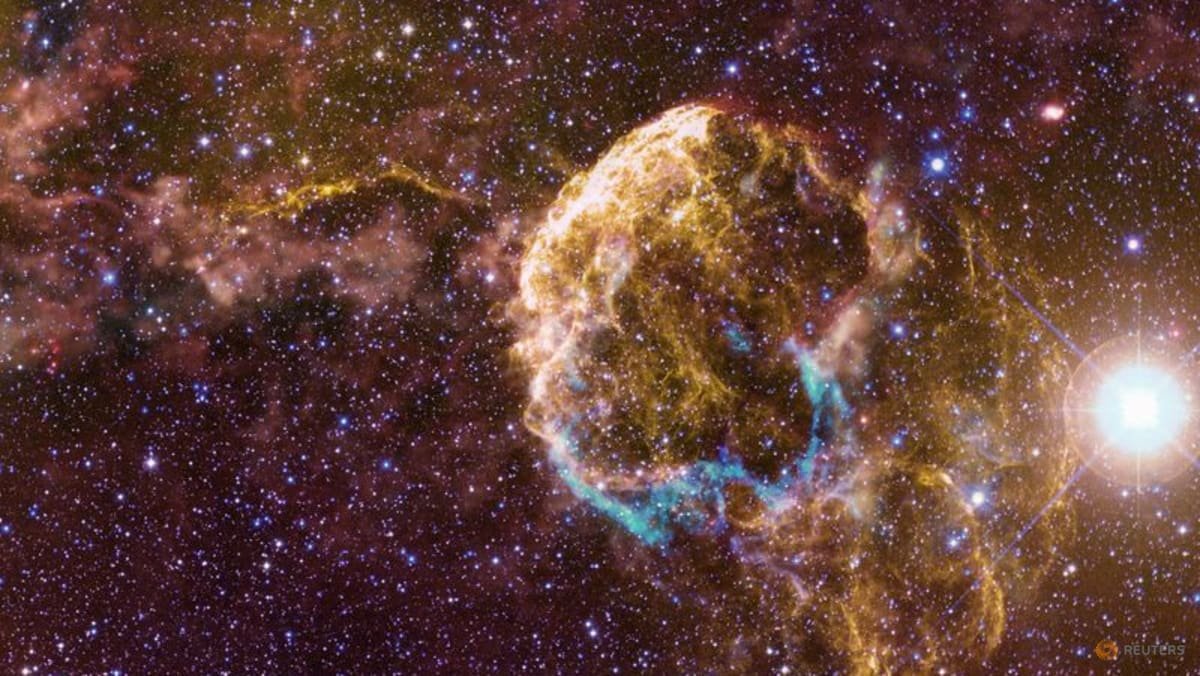
This multiwavelength scene shows the Jellyfish Nebula supernova remnant (right), the interstellar cloud it is interacting with, and a distinctive curving filament to its upper left. The filament, which is shown here both in optical and ultraviolet (UV) light, is the visible part of an overlapping supernova remnant, G189.6+3.3, that is more prominent in radio and X-rays. The brilliant star at far right is Propus. The image was released on June 17, 2026. NASA Goddard Space Flight Center and M. Michailidis et al. 2026; optical: DSS; infrared: NASA/WISE/JPL-Caltech/UCLA; ultraviolet: NASA/Swift/Handout via REUTERS
Read a summary of this article on FAST.
Get bite-sized news via a new
cards interface. Give it a try.
Click here to return to FAST
Tap here to return to FAST
FAST
WASHINGTON, July 21 : Unlike our sun, most of the largest stars in the cosmos are not solo acts, but rather are born together with another star in what is called a binary system, destined to spend their lives gravitationally bound in a cosmic marriage. But not even the best marriage — on Earth or in space — lasts forever.
Scientists now for the first time have discovered evidence of two such massive stars from a binary system that both ran out of fuel and exploded violently within a relatively short time, each leaving behind a telltale cloud of glowing gas called a nebula. Such stellar explosions are called supernovas.
One of these two nebulas is among the best known in our Milky Way galaxy, called the Jellyfish Nebula for its superficial resemblance to the tentacled sea creature.
Guided by more than 16 years of observations by NASA’s Fermi Gamma-ray Space Telescope, the researchers found evidence of a second nebula relatively nearby that has now helped put the Jellyfish Nebula in its proper context as part of a dual calamity.

Guess Word
Crack the word, one row at a time

Buzzword
Create words using the given letters

Mini Sudoku
Tiny puzzle, mighty brain teaser

Mini Crossword
Small grid, big challenge

Word Search
Spot as many words as you can
They believe that the Jellyfish Nebula, formally called IC 443, was produced when a star roughly 15 to 25 times more massive than the sun exploded at the end of its life cycle. They believe the other nebula, formally called G189.6+3.3, was produced by the explosion of the binary companion star, which had been at least 20 times more massive than the sun.
During their lifetimes, both stars are believed to have been at least tens of thousands of times more luminous than the sun. After the explosions, both may have been reduced to dense stellar leftovers called neutron stars.
Both are located about 6,000 light-years from Earth in the constellation Gemini. A light-year is the distance light travels in a year, 5.9 trillion miles (9.5 trillion km).
‘A RARE OPPORTUNITY’
The discovery may offer insight into binary systems composed of massive stars.
“This system provides a rare opportunity to reconstruct the complete evolutionary history of a massive binary — from the birth and interaction of two massive stars, through both supernova explosions, to the remnants they left behind,” said Miltiadis Michailidis, a postdoctoral fellow in Stanford University’s physics department and lead author of the study published on Tuesday in the journal Nature Communications.
“Although most massive stars are born in binary systems, no pair in which both stars have exploded as supernovae and left behind observable remnants has previously been identified,” Michailidis said.
Some massive stars are even born into stellar systems composed of three or more stars.
The two nebulas are expanding structures of hot gas, accelerated particles and shocked interstellar material left behind by the supernovas.
Massive stars live like some rock stars — born brilliant, party hard, die young. They live for several million years — a far cry from the lifespan of roughly 10 billion years expected for the sun.
“Systems like this one can provide direct observational constraints on how the evolution of massive stars is modified by the presence of a binary companion — one of the major outstanding questions in stellar astrophysics,” Michailidis said. “Until now, our understanding of these final evolutionary stages has relied almost entirely on theoretical models and numerical simulations.”
The star associated with the newly identified nebula is the one that blew up first, and the explosion sent its partner reeling. The researchers estimated that about 20,000 to 110,000 years elapsed between the two explosions.
“The first explosion disrupted the binary, and the surviving companion continued moving through space until it also exploded,” Michailidis said.
The two stars once orbited each other very closely — perhaps just a few multiples of the distance between Earth and the sun — but the centers of the two supernovas are now separated by 30 to 50 light-years.
When the binary system was intact, the stars were so close that a phenomenon called mass transfer, with material flowing from one star to its companion, may have occurred.
Michailidis said it is unclear whether the explosion of the first star directly triggered the explosion of its companion.
“By the time the first supernova occurred, the second star may already have been close to the end of its life,” Michailidis said.
Source: Reuters
Sign up for our newsletters

Get the CNA app
Stay updated with notifications for breaking news and our best stories
Get WhatsApp alerts
Join our channel for the top reads for the day on your preferred chat app

Get bite-sized news via a new
cards interface. Give it a try.
Click here to return to FAST
Tap here to return to FAST
FAST
About The Author







