


Singapore closes car loan loophole by extending financing curbs to individually owned private-hire cars
The new restrictions come amid concerns that some buyers may have been taking advantage of an exemption meant for commercial vehicles, despite having no intention of providing private-hire services.
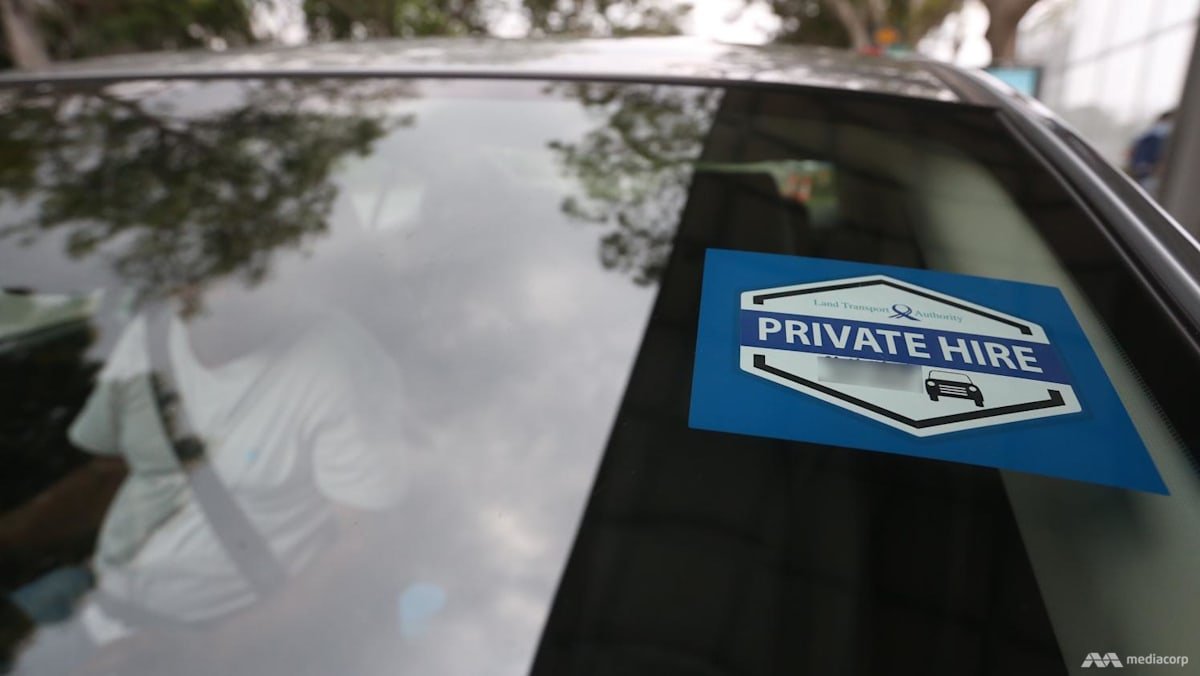
A decal displayed on a private-hire car. (File photo: TODAY/Ooi Boon Keong)
New: You can now listen to articles.

This audio is generated by an AI tool.

Read a summary of this article on FAST.
Get bite-sized news via a new
cards interface. Give it a try.
Click here to return to FAST
Tap here to return to FAST
FAST
SINGAPORE: Individuals buying vehicles registered as private-hire cars (PHCs) will be subject to the same loan restrictions as private car buyers from Friday (Oct 30), closing a potential loophole that some motorists may have used to secure more generous financing terms.
The move comes amid concerns that some buyers may have been taking advantage of an exemption meant for commercial vehicles, despite having no intention of providing private-hire services.
In a media release on Thursday, authorities said there had been a recent surge in registrations of individually owned self-drive PHCs, with about 500 such vehicles registered each month.
This “suggests that some may be doing so primarily to access more permissive financing terms”, the Ministry of Transport, Monetary Authority of Singapore, Ministry of Energy, Trade and Industry and Ministry of Law said in a joint media release.

Guess Word
Crack the word, one row at a time

Buzzword
Create words using the given letters

Mini Sudoku
Tiny puzzle, mighty brain teaser

Mini Crossword
Small grid, big challenge

Word Search
Spot as many words as you can
Under the new rules, individuals purchasing PHCs with an open market value (OMV) of S$20,000 (US$15,600) or less will be allowed to borrow up to 70 per cent of the vehicle’s purchase price.
For vehicles with an OMV exceeding S$20,000, the maximum loan-to-value ratio will be 60 per cent.
The purchase price includes relevant taxes and the cost of the certificate of entitlement (COE), where applicable.
Loan tenures will also be capped at seven years.
These restrictions already apply to ordinary private car purchases but have not applied to PHCs, which were previously exempted on the basis that they were used for commercial purposes.
The exemption was originally intended to recognise the commercial use of PHCs, which, unlike taxis, are private cars that can also be used to provide private-hire services.
However, the authorities noted that the PHC industry had evolved over the years, with the fleet having grown and stabilised.
“More recently, there have been more instances of individual buyers of private cars using this exemption who have no intent to offer PHC services,” the authorities said.
“To ensure that PHC purchases cannot be used to circumvent financing restrictions that apply to private car buyers, individual buyers of PHCs will now be subject to the same financing restrictions as private car buyers,” they added.
“This will also ensure that new PHC drivers exercise the same financial prudence as other private car buyers.”
The new financing restrictions will apply to individuals, including sole proprietors, obtaining motor vehicle loans from financial institutions and licensed or exempt moneylenders.
They will also cover hire-purchase and conditional sale agreements.
The rules will apply to purchases where sales agreements are signed on or after Oct 30.
Where there is no sales agreement, the restrictions will apply if the COE is obtained on or after that date.
Commercial vehicles, business-owned PHCs and motorcycles will remain exempt from the financing restrictions.
Ride-hailing giant Grab said on Thursday it supported the new restrictions.
“Industry-wide standards are an important safeguard to help protect drivers’ long-term livelihoods,” it said.

COE CONSIDERATIONS
The government said it had separately considered other measures, including creating a dedicated COE category for private-hire and car-leasing companies.
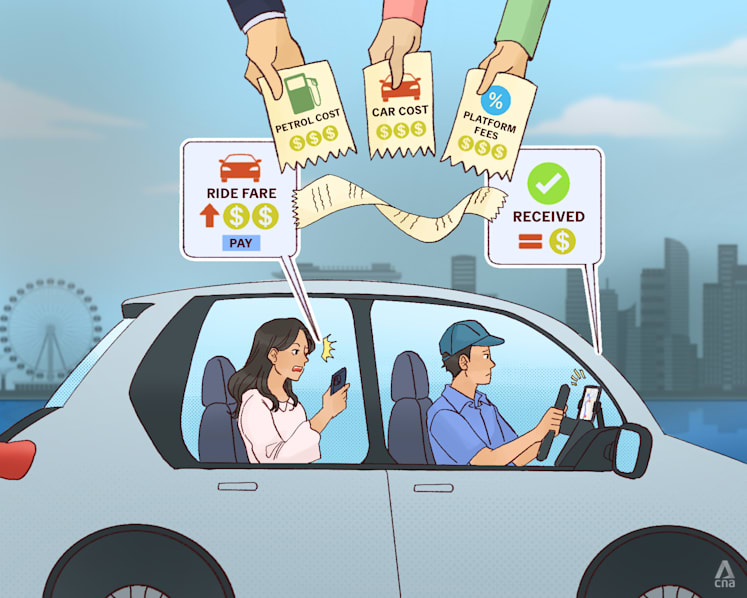
“However, this will likely result in higher rentals for PHC drivers and higher fares for PHC users, thus disadvantaging those who do not own a car or cannot drive,” the authorities said.
“It will also require more prescriptive rules on PHC drivers and cars, thus reducing the flexibility to meet the commuting demand of PHC users.”
In response to media queries on Thursday, the Land Transport Authority said creating a separate COE category for PHCs would not increase the overall supply of COEs, but would instead reduce the quota available to other car buyers.
“Setting aside too few COEs could constrain the supply of PHCs and lead to higher fares for commuters,” it noted.
On the other hand, setting aside too many COEs to PHCs could reduce the quota available to individual car buyers and drive up premiums further.
“Creating a separate PHC category would therefore introduce additional trade-offs without necessarily lowering COE premiums for individual car buyers,” LTA said.
LTA agency also said it does not intend to prohibit motor dealers from bidding for COEs on behalf of buyers, noting that many motorists value the convenience and services offered by dealers.
Instead, LTA said it was working to give individuals “greater choice and control” over the bidding process.
This includes working towards allowing individuals to submit initial COE bids online and exploring requirements for dealers to publish car prices both with and without COE.
“These measures would make it easier for buyers who prefer to bid for COEs themselves, while providing greater price transparency so they can better compare prices across dealers and make informed decisions,” LTA said.
OTHER MEASURES
On suggestions to introduce a surcharge for second and subsequent cars, LTA said such a move was unlikely to have a significant impact on COE premiums.
While a surcharge could discourage multiple-car ownership and free up more COEs for first-time or single-car owners, the authority noted that multiple-car ownership had been declining.
In 2025, about 13 per cent of car-owning households owned more than one car.
“While a surcharge could moderate demand from households seeking to own multiple cars, and distribute the quota across a broader pool of households, multiple-car owners are not a key driver of demand in today’s COE market,” LTA said.
“A surcharge on multiple-car ownership is unlikely to have a significant impact on COE prices.”
Such a policy would also be difficult to administer fairly or effectively, LTA said.
“For example, some households include several generations living together, while others may require more than one vehicle because of caregiving responsibilities.”
Authorities said the government would continue to monitor market developments and could take further steps to ensure that financing restrictions were applied consistently across different arrangements, including in-house loans.
It would also work closely with platform operators to implement the measures effectively and consistently.
“We advise all prospective car buyers to borrow within their means and avoid unregulated financing schemes,” the authorities said.
Source: CNA/co(gs)
Sign up for our newsletters

Get the CNA app
Stay updated with notifications for breaking news and our best stories
Get WhatsApp alerts
Join our channel for the top reads for the day on your preferred chat app

Get bite-sized news via a new
cards interface. Give it a try.
Click here to return to FAST
Tap here to return to FAST
FAST







