Singapore proposes harsher penalties for dangerous driving causing grievous hurt, lower drink-driving limits
The maximum jail term for offenders convicted of dangerous driving causing grievous hurt will be increased, if amendments to Singapore’s traffic laws are passed.
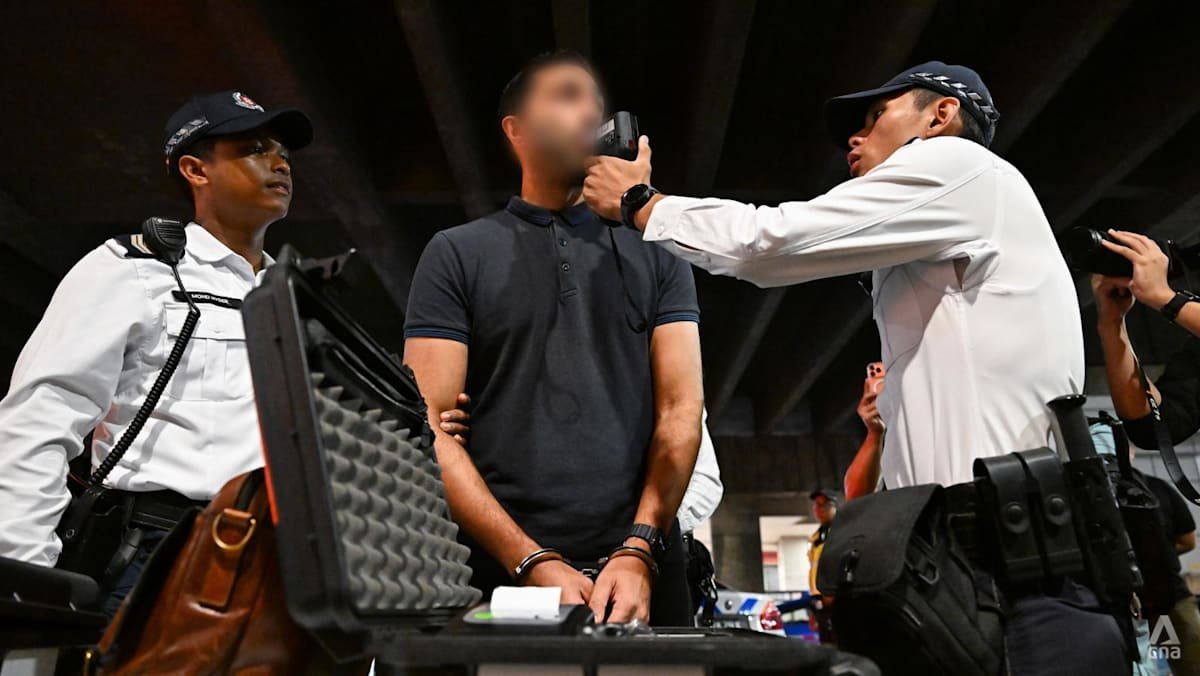
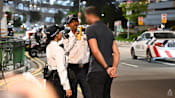
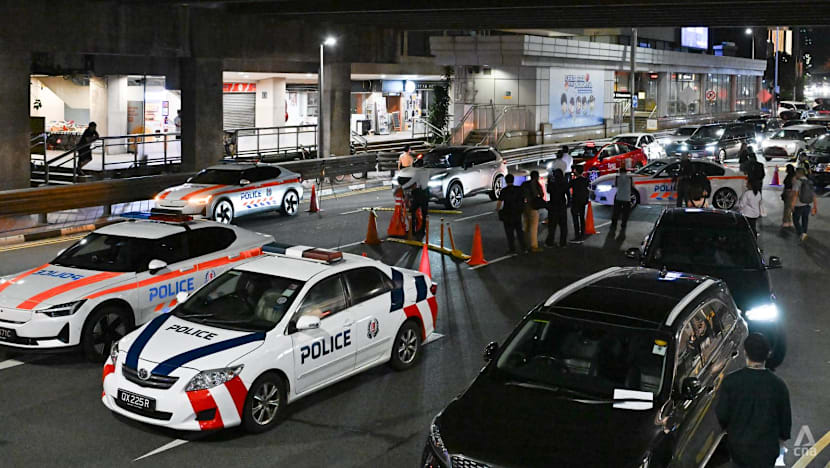
A man taking a breath test using the new handheld breath evidential analyser being trialled by the traffic police during an enforcement operation against drink driving, along Upper Cross Street near Chinatown on Sep 20, 2025. (Photo: CNA/Tan Wen Lin)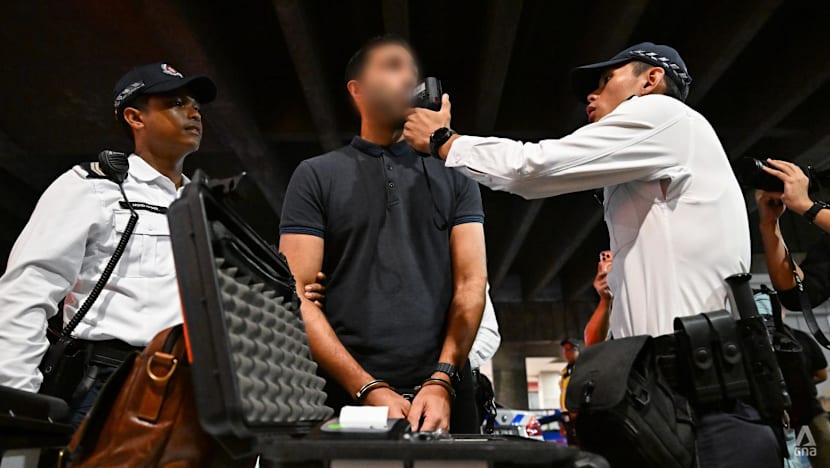
New: You can now listen to articles.

This audio is generated by an AI tool.

Read a summary of this article on FAST.
Get bite-sized news via a new
cards interface. Give it a try.
Click here to return to FAST
Tap here to return to FAST
FAST
SINGAPORE: Singapore is looking to impose stiffer penalties for dangerous driving causing grievous hurt, with the maximum jail term for offenders increasing if amendments to traffic laws are passed.
Senior Minister of State for Home Affairs Sim Ann tabled the Road Traffic (Miscellaneous Amendments) Bill in parliament on Tuesday (Jul 7), which proposed several changes to the law.
Besides harsher penalties for dangerous or careless driving, the Bill includes lowering the prescribed alcohol limits for drink-driving.
The number of road fatalities and injuries rose in 2025, continuing what the Singapore police said was a “persistent upward trend”.

Guess Word
Crack the word, one row at a time

Buzzword
Create words using the given letters

Mini Sudoku
Tiny puzzle, mighty brain teaser

Mini Crossword
Small grid, big challenge

Word Search
Spot as many words as you can
Between 2021 and 2025, traffic fatalities increased by about 24 per cent while traffic violations rose by about 38 per cent.
“Our roads are becoming less safe … To arrest this trend, we will be tightening enforcement and penalties for traffic offences,” the Ministry of Home Affairs (MHA) said in a press release.
HARSHER PENALTIES
The Bill introduces a new offence of purposeful endangerment using a vehicle and causing death or grievous hurt.
“A vehicle can become a dangerous weapon if misused. Where a driver deliberately endangers another person using a vehicle and causes death, he must face consequences that are proportionate to his culpability and harm,” said MHA.
However, the driver cannot be convicted for murder or culpable homicide unless it can be proven beyond reasonable doubt that he intended to kill or knew that the act was likely to cause death.
Such an offender is likely to be charged currently with dangerous driving causing death. The maximum jail term is eight years for first-time offenders.
“There should be increased deterrence and graver consequences for such conduct,” MHA said.
It added that the new offence includes grievous hurt as whether the victim dies is not within the offender’s control.
The ministry also gave several examples of purposeful endangerment.
A car driver drives closely behind a motorcyclist and presses his car horn several times. This endangers the motorcyclist’s personal safety, and the car driver does so for the purpose of endangering the motorcyclist’s personal safety.
The car driver then loses control of the car and collides with the back of the motorcycle, causing the motorcyclist to crash and die. This makes the car driver guilty of an offence of purpose endangerment.
Offenders may face a mandatory jail term of up to 15 years, and may be caned or fined.
They will also be subject to lifetime disqualification unless the court determines that there are special reasons not to do so, said MHA. In that case, the offenders will face mandatory disqualification of at least 10 years.
The court will also have the power to order that the vehicle used in the incident be forfeited.
MHA also noted that some forms of grievous hurt can result in “profound and catastrophic consequences”, such as traumatic brain injuries, that can leave victims permanently bedbound.
Under the Bill, the maximum penalties for careless driving and dangerous driving causing grievous hurt may be increased, bringing them closer to the penalties for causing deaths.
Careless driving refers to driving without due care and attention or without reasonable consideration for other road users, while dangerous driving is when a person drives in a manner that is objectively dangerous and shows disregard for the safety of others.
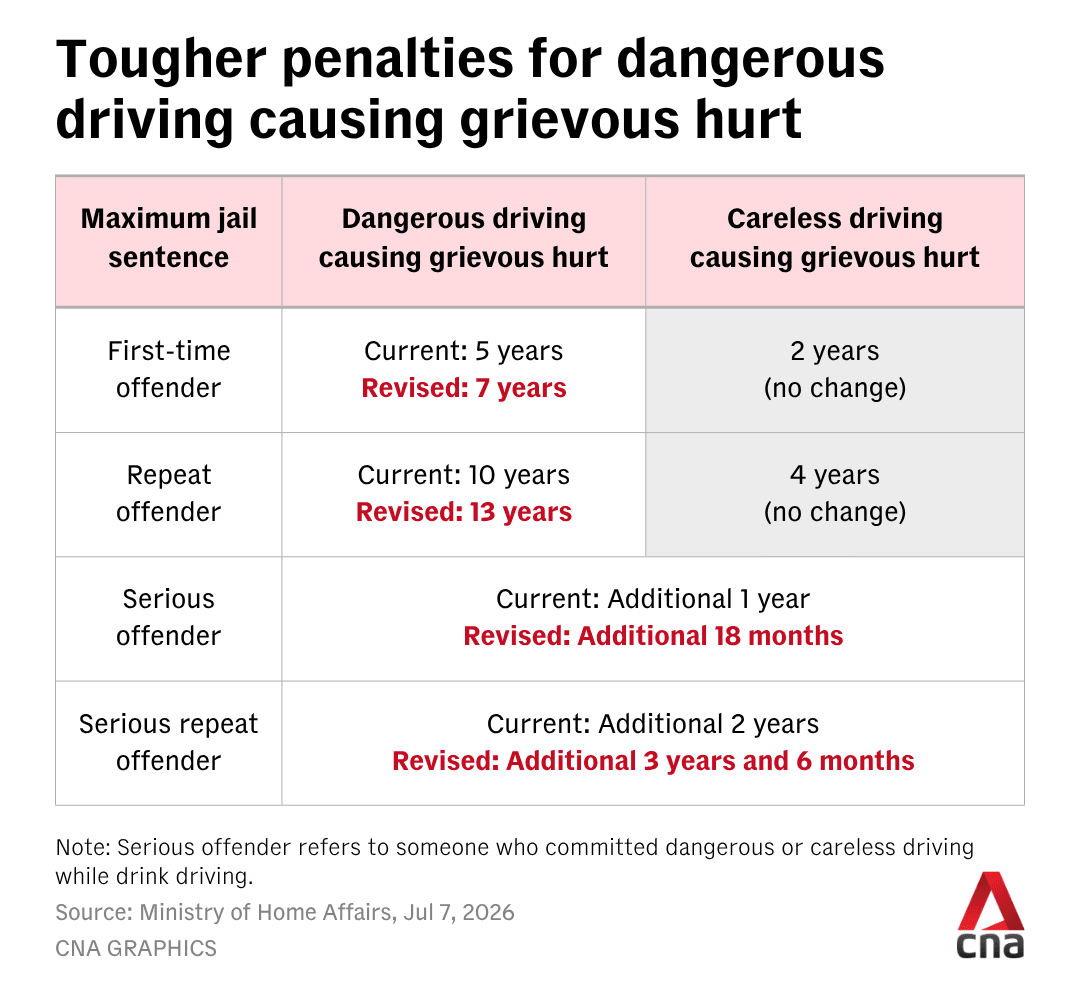
Currently, a first-time offender convicted of dangerous driving causing grievous hurt faces a maximum jail term of five years. Under the proposed changes, this will be increased to seven years.
For repeat offenders, the maximum jail term will increase from 10 years to 13 years.
The maximum penalties will remain unchanged for careless driving causing grievous hurt – up to two years’ jail for first-time offenders and up to four years for repeat offenders.
In cases involving a serious offender – someone convicted of dangerous or careless driving causing hurt while drink driving – he or she will currently be handed an additional year of jail. This will be revised to an extra 18 months if the amendments are passed.
A serious repeat offender may be given an extra three years and six months’ jail – up from an additional two years.
TIGHTENING DRINK- AND DRUG-DRIVING RULES
The proposed amendments include lowering the drink-driving limits, which were first announced during the ministry’s budget debate in February.
The current limit of 35 micrograms of alcohol per 100ml of breath will be lowered to 15 micrograms of alcohol per 100ml of breath. Likewise, the limits for blood tests will be reduced from 80 milligrams of alcohol per 100ml to 30 milligrams of alcohol per 100ml.
These tightened alcohol limits bring Singapore in line with other jurisdictions such as Taiwan, Japan and South Korea.
“There is no ‘safe’ number of alcohol drinks before driving; the effect of alcohol on a person varies depending on factors including a person’s gender, age, health, and body composition,” said MHA.
“We strongly advise drivers not to drink at all if they plan to drive, as this is the safest approach not to run afoul of the revised limits.
“That said, as a general illustration, the tightened limits are equivalent to approximately 1.5 standard drinks for males and not more than one standard drink for females, consumed three hours before driving.”
One drink refers to a 330ml can of beer with 5 per cent alcohol, or a 125ml glass of wine with 12 per cent alcohol, or a 40ml shot of liquor with 40 per cent alcohol.
The ministry said: “Drink driving is a highly culpable offence. No one accidentally drinks and drives. Offenders deliberately choose to do so, placing themselves and others at risk of traffic accidents.”
MHA will also work with the sentencing advisory panel to consider developing guidelines to recommend jail time for first-time drink-driving offenders who drive with very high blood alcohol levels.
The Bill introduces a new offence of driving with the presence of controlled drugs, intoxicating substances or psychoactive substances detected in a driver’s blood specimen.
Currently, enforcement action can be taken only upon proving that the driver was unfit to drive and was incapable of having proper control of his or her vehicle.
Under the proposed law, drivers found with these substances – as defined under the Misuse of Drugs Act, Intoxicating Substances Act and Tobacco and Vaporisers Control Act – in their blood while driving will be liable for an offence, regardless of the quantity of such substances detected or whether there was any observed impairment in driving.
However, a driver will not be liable for this offence if he or she had taken the drugs based on a legal prescription for medical reasons, and did not know that consuming them might impair driving.
“For clarity, drivers who consume any form of drugs, including medication, and who are impaired and incapable of having proper control of the vehicle will remain liable under the existing law,” said MHA.
BREATH AND BLOOD TESTS
Other proposed changes also include amending the traffic police’s breath test process to use a portable handheld breath evidential analyser to provide results immediately at the scene that can be used as evidence in legal proceedings.
The traffic police began piloting the new device last September as part of efforts to combat drink driving.
At present, traffic police officers carry out a preliminary breath test at the scene before administering another breath test at police lock-up that can be used as evidence.
The time difference between the two tests can result in a lower alcohol reading than the actual level at the time of driving, MHA said.
Under the Road Traffic Act, a blood specimen can be taken from a patient in hospital if a registered medical practitioner in charge of the patient’s care gives explicit authorisation – verbal or written – after assessment that doing so will not affect the patient’s proper care or treatment.
The Bill replaces the requirement for the doctor to explicitly authorise the taking of blood.
If passed, the new law will require the registered medical practitioner or nurse taking the specimen – and any other person who is giving instruction or overseeing the taking of the blood specimen – to each be satisfied that taking the specimen does not endanger the patient.
This aligns the Road Traffic Act with other legislation, where the legal safeguard focuses on patient safety rather than a separate authorisation procedure, said MHA.
ENFORCEMENT
The Bill will also make it clear that the disqualification period of an offender who is jailed will only begin after he or she is released from prison, even if the person is jailed for an unrelated offence.
The traffic police process hundreds of thousands of traffic violations every year, which are largely detected by cameras.
Currently, officers are required by law to manually review every photo or video to determine if an offence has been committed, as well as identify the vehicle registration number. They then issue a notice to the vehicle owner to provide the driver’s particulars within 14 days.
The Bill amends the law to enable the traffic police to introduce an automated decision-making system to assess whether an offence has been committed, and to automatically issue such a notice to the vehicle owner.
“The system will only be used to process technical violations that can be objectively verified from photographic or video evidence, such as speeding and red-light violations, and which do not require proof of a person’s mental element,” said MHA.
If the vehicle or the offence was wrongly identified by the system, owners may apply for the notice to be revoked. The traffic police will manually review such appeals.
Source: CNA/ng(mi)
Sign up for our newsletters

Get the CNA app
Stay updated with notifications for breaking news and our best stories
Get WhatsApp alerts
Join our channel for the top reads for the day on your preferred chat app

Get bite-sized news via a new
cards interface. Give it a try.
Click here to return to FAST
Tap here to return to FAST
FAST
About The Author