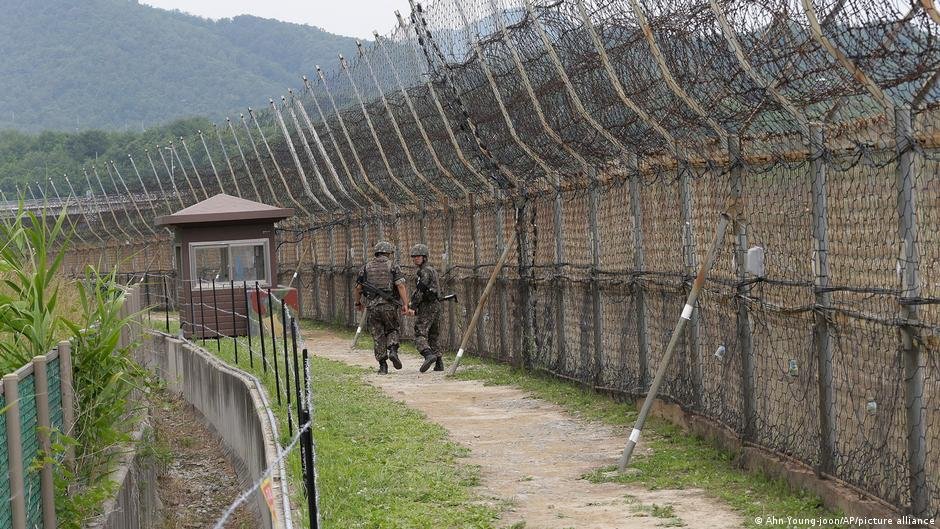
Emboldened by its security and economic alliance with Moscow and flush with cash after sending troops and military equipment to support Russia’s invasion of Ukraine, North Korea is testing boundaries closer to home.
In a meeting in late June with the United Nations Command, South Korea’s Defense Ministry expressed concern about activity by North Korean engineers at a number of locations along the length of the 238-kilometer-long (148 miles) Demilitarized Zone (DMZ), which has divided the Korean Peninsula since an armistice brought the 1950-53 Korean War to an uneasy conclusion.
There have been countless clashes and incursions over the DMZ in the decades since, with North Korean invasion tunnels detected deep underground, defectors risking their lives to cross minefields and barbed wire entanglements to reach freedom in the South, as well as the occasional exchange of gunfire.
To view this video please enable JavaScript, and consider upgrading to a web browser that supports HTML5 video
Is North Korea pushing limits in the DMZ?
Choo Jae-woo, a professor of foreign policy at Kyung Hee University in Seoul, believes the North is now probing to see how far it can push before it meets resistance.
“They are testing the limits,” he told DW. “They know they have the support of both Russia and China in all their endeavors — military, economic, geopolitical — and Pyongyang feels that now is the time to see how far it can go.”
“We see this elsewhere, in the way the North is building advanced new warships, and it would not surprise me if we start to see similar testing of the NLL [the Northern Limit Line] in the West Sea,” he said.
The NLL is the sea border off the west coast of the peninsula that North Korea disputes and has seen a number of deadly clashes, most recently in 2010 when North Korea fired around 170 artillery rounds at the island of Yeonpyeong, killing four South Koreans and injuring 19.
Experts say the North stepped up its probing of what the UN Command finds acceptable on the DMZ around April 2024, months after Kim Jong Un announced that he was redefining ties with South Korea.
Instead of a stated aim of reconciliation and reunification, Pyongyang now sees relations as being between “two hostile countries and two belligerents at war.”
North Korean engineering troops have erected new fences, constructed anti-tank berms and ditches, dug trenches, built new military roads for greater access, cleared land and laid new minefields.
The work has been carried out on the North’s side of the military demarcation line (MDL), but it has crept ever closer to that marker, which is the exact half-way point in the 4-kilometer-wide DMZ.
To view this video please enable JavaScript, and consider upgrading to a web browser that supports HTML5 video
Closing in on the military demarcation line
In some areas, the South Korean military said, the work has been carried out less than 100 meters (around 330 feet) from the MDL, which Seoul says is a breach of the armistice.
Adding additional military capabilities so close to the half-way point effectively neutralizes the DMZ’s function as a buffer zone, South Korean Defense Ministry spokesperson Chung Binna said during a press conference on June 25.
Dan Pinkston, a professor of international relations at the Seoul campus of Troy University, believes Pyongyang has learned from China’s incremental absorption of territory at the extreme fringes of its own borders — such as the atolls of the South China Sea — and the lack of a coordinated international pushback against the landgrabs.
“This is a revisionist power that is dissatisfied with global governance and is looking to take advantage in any way it can,” Pinkston told DW.
“They are cooperating with Moscow in the Russian Far East in trade and in obtaining advanced military equipment and getting dual-use technology from China,” he pointed out.
And with the clear support of both Moscow and Beijing, Kim Jong Un “believes he can push the envelope,” Pinkston said.
The expert underscored, however, that the North’s actions to date fall short of violation of the 1953 Armistice Agreement.
To view this video please enable JavaScript, and consider upgrading to a web browser that supports HTML5 video
What’s the UN Command’s take on the situation?
In a statement issued to DW, the UN Command said it continues to monitor and assess activities within the DMZ to ensure compliance with the 1953 agreement.
“Activities within the DMZ must be understood in their full context and are assessed based on the specific facts, circumstances and applicable provisions of the Armistice Agreement and subsequent agreements,” it said.
“Construction, fortification and other defensive measures do not automatically constitute Armistice Agreement violations,” it added.
“When appropriate, UNC addresses Armistice-related concerns through established mechanisms and remains committed to preserving peace and stability on the Korean Peninsula.”
In a fact sheet published on June 23, the UN Command stated that constructing roads and fences is permitted under the terms of the armistice, as long as they remain north of the MDL.
Laying mines is also permitted, it said, pointing out that South Korean troops also carry out vegetation-clearing projects. It added that there have been no indications of the North bringing “heavy weapons or drone capabilities” into the DMZ, which would be a breach of the agreement.
The UN Command also noted that it is still investigating reports that North Korean fences do cross the MDL and that mines have been laid on the South Korean side of the line.
“Emplacing mines south of the MDL ceases to be defensive and is an automatic violation,” it said. “Any confirmed crossings will trigger immediate armistice violation protocols.”
To view this video please enable JavaScript, and consider upgrading to a web browser that supports HTML5 video
South to carefully monitor developments
Choo believes the changes the North has announced to its constitution with regard to South Korea are driving its actions.
“The new constitution redefines the concept of the nation’s boundaries and territories,” he said. “They now see the MDL — the exact half-way point inside the DMZ — as their southern border and they are taking steps to extend their control over that land to the very limits. They no longer see the DMZ as a buffer zone, they want to control it as their territory.”
Pinkston said the confirmed reports to date of North Korean activities would not be breaches of the agreement, but the work being carried out by Pyongyang’s troops warrants careful monitoring.
“Barbed-wire fences, minefields, anti-tank barriers are all defensive measures, but the nature of warfare has changed dramatically in the last couple of years and the South will be observing very carefully to make sure these do not develop into violations,” he said.
Edited by: Srinivas Mazumdaru
About The Author