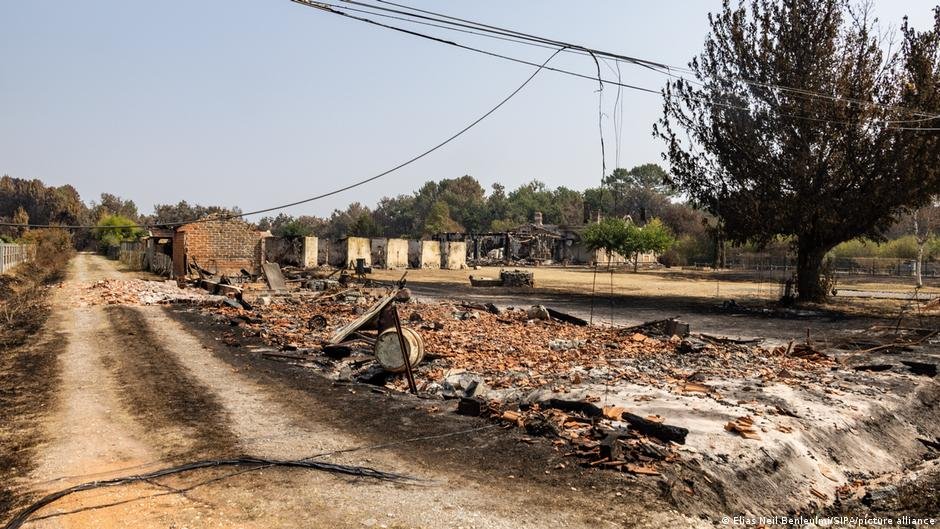
As Spain battled its largest wildfire on record and France struggled to contain a blaze four times the size of Paris, scientists warned that extreme wildfires were becoming more frequent worldwide.
To view this video please enable JavaScript, and consider upgrading to a web browser that supports HTML5 video
Evacuees allowed to return in Spain
Spain started lifting evacuation orders for various places in the Avila province on Wednesday, having taken similar steps in the Madrid province on Tuesday.
Interior Minister Francisco Martin Aguirre announced progressively reduced restrictions for a variety of places after conditions overnight allowed firefighters to make gains, saying tens of thousands had been able to return home.
Sanchez: ‘Next 12 hours will be very important’
“Today, I believe we are closer to that final objective” of “defeating the fire,” Prime Minister Pedro Sanchez told reporters in televised comments at a command center in the town of Navalarnero near the fire zone.
“Things are progressing favorably, with the greatest of caution,” he said, predicting that “the next 12 hours will be very imporant — they will be decisive for consolidating the work that has been done.”
For a week, Spain has been fighting two large fires that had at times come close to merging into a single blaze in wooded hills west of Madrid.
However, authorities remain on alert, with highs consistently above 35 degrees Celsius (95 degrees Fahrenheit) forecast every day in the Madrid area this week.
Heat warnings across most of France, including fire flashpoint Gironde
On France’s southwestern Atlantic coast, temperatures and winds picked up once more on Wednesday, threatening to fan the flames.
Temperature warnings were in place for most of the country, with the most severe on the eastern border and in the southwestern areas hardest hit by fires, including the Gironde region. The Meteo France weather service forecast highs of 40 Celsius in the Bordeaux area in the afternoon.
French authorities have been forced to relocate around 220,000 people in total amid the fires, many of them from holiday resorts on the coast — like Lacanau and Grand Cohot on Tuesday.
More than 2,200 firefighters and over 20 aircraft remained mobilized, backed by crews from across France and European partners.
“We strike quickly and strike hard at any new smoke emissions,” Gironde fire commander Matthieu Jomain said.
The Gironde wildfire has burned an area four times the size of Paris, and resisted the firefighting efforts of a dozen countries.
Climate change exacerbating wildfires
Scientists say climate change is fueling hotter, drier summers that are intensifying wildfires across Europe. The warmer temperatures are also extending fire seasons and making these blazes harder to control, straining the resources of European nations.
Currently, the European Union only coordinates the deployment of extra resources pooled from its member states when a country requests emergency help. As fires on the continent grow more extreme, however, the bloc called for greater investment in forest management and wildfire prevention.
To view this video please enable JavaScript, and consider upgrading to a web browser that supports HTML5 video
Brussels is purchasing its own permanent firefighting fleet.
“Climate change is accelerating. So, our response must evolve just as quickly,” Hadja Lahbib, the EU’s Crisis Management Commissioner, told Reuters.
Edited by: Sean Sinico
Don’t let the algorithm hide the news. If you rely on our team for trusted reporting, please take a moment to select us as your Preferred Source on Google by clicking here and hitting the “star” or “preferred” button, so you’ll always see our verified news first.
About The Author