Officials in the Spanish territory of Ceuta on the northwestern tip of Africa on Thursday asked the government in Madrid to declare a national emergency and send the army to help secure its border with Morocco.
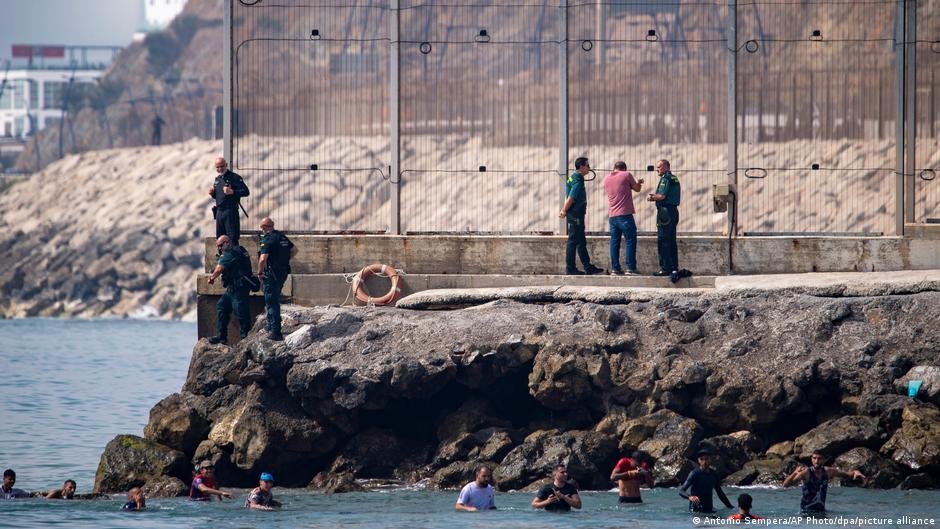
The call came as video footage showed crowds of people trying to walk around the breakwaters separating Moroccan and Spanish territory or otherwise scale the border fence. Spanish Prime Minister Pedro Sanchez pledged an “immediate response.”
Spain’s Interior Ministry said later on Thursday that its armed forces would send personnel to Ceuta to support the border guards.
“The Armed Forces will reinforce the Guardia Civil in the exercise of its powers and any others that may be necessary to maintain civil security in the city of Ceuta,” the ministry said.
What had happened in Ceuta during the day?
The Guardia Civil said that crowds broke through the fences into Spain after overwhelming police at the city’s breakwater. Video footage showed hundreds swimming across from the Moroccan side, using inflatable inner tubes and other flotation aids.
“The situation is absolute chaos,” Rachid Sbihi, head of the association that represents Spain’s Guardia Civil in Ceuta, told the Associated Press. “It’s not possible to give precise numbers but there are thousands of migrants crossing,” he said, adding that the border had “totally collapsed.”
The scenes were reminiscent of a similar flashpoint at the border crossing in May of 2021 when more than 8,000 people entered the territory in just two days.
In recent days, rescue parties had already noted increased numbers of people trying to swim around the border checks.
What did the regional government say?
Juan Jesus Vivas, head of the Ceuta regional government, called for the Spanish government in Madrid to declare an emergency on grounds of national security, asking for more police and for the army to be deployed on the border. This followed a meeting of the city’s board of spokespeople, who reached a unanimous agreement.
“Yesterday, I spoke out to warn of the extreme gravity of the migration crisis we are enduring,” Vivas wrote online. “Today, mere hours later, the situation is even more critical: another night of mass arrivals, nearly a thousand people waiting outside the CETI [Temporary Migrant Reception Center], our reseources completely overwhelmed, and another life lost at sea.”
He said that the small city was facing “a humanitarian and social emergency” of national proportions.
“We cannot face this pressure alone — pressure that has resulted in the arrival of between 1,500 and 2,000 people in just 10 days, equivalent to 2% of our population.”
He wrote that “with every passing hour, the situation becomes more difficult” in the territory of around 85,000 people.
How did Prime Minister Pedro Sanchez respond?
Soon after the call for help from Ceuta, Spanish Prime Minister Pedro Sanchez said the government in Madrid was “fully committed to providing an immediate response” to the situation.
“We are mobilizing all necessary resources, working with Moroccan and international authorities, and preparing the necesssary measures to restore normalcy as soon as possible,” Sanchez wrote, adding that he had just said as much directly to Vivas.
“This is the moment to build solutions, with responsibility and cooperation,” he said, not going into specifics in the post.
Sanchez’s Interior Ministry said that the Moroccan government was “closely cooperating” with Spain to handle the situation and that Moroccan police were stopping “numerous people” trying to cross the border. It said that both countries had agreed to work together “for the return, as soon as possible, of all the people who entered Ceuta illegally.”
Interior Minister Fernando Grande-Marlaska made plans to visit Ceuta on Friday and evaluate the situation, the ministry said.
Why is the rush happening now?
It’s not yet clear why large groups are suddenly seeking entry to Ceuta in the past few days, even though a couple of relatively recent developments at least bear a tangential relationship to the issue.
Earlier in July, the Spanish Supreme Court ruled that migrants arriving by sea could not immediately be pushed back across a border in the same way as they could at a land border crossing.
The Ceuta and Melilla enclaves in North Africa bordering Morocco do present exceptional cases where this ruling is concerned, in that it is technically possible to enter them “by sea” despite the fact that you are essentially circumventing a border crossing on land, not crossing the Strait of Gibraltar or the Mediterranean.
One less recent development that attracted international attention, meanwhile, is the Spanish government’s offer of amnesty and residency permits to migrants who can demonstrate that they had already entered the country without legal authorization. However, that rule only applies to people who can prove they were already in Spain when it came into force, so it does nothing to improve the prospects of staying for people entering by irregular means now.
Edited by: Sean Sinico
Don’t let the algorithm hide the news. If you rely on our team for trusted reporting, please take a moment to select us as your Preferred Source on Google, so you’ll always see our verified news first.
About The Author