Paleontologists have uncovered important fossils in northeastern Thailand. The finds will help close evolutionary gaps in Earth’s history — and could boost a fledgling dinosaur tourism industry.
Image: Lillian Suwanrumpha/AFP
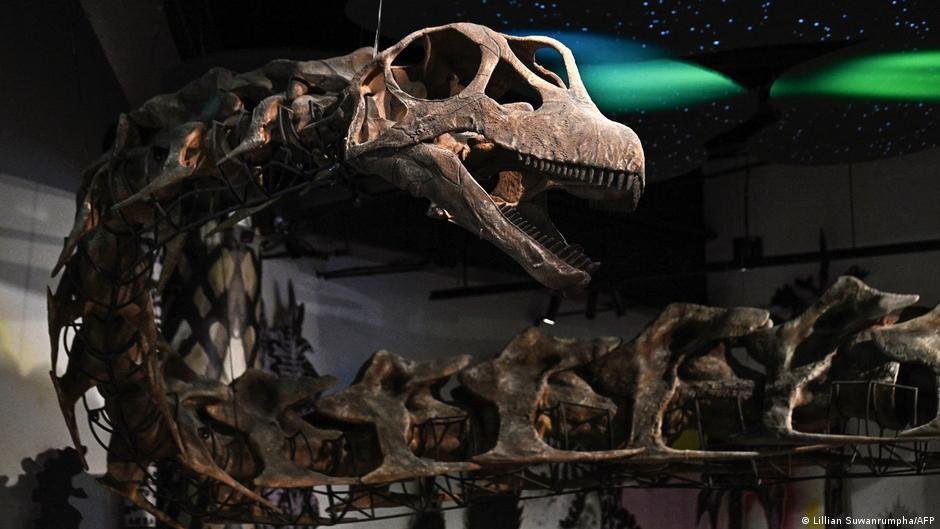
The skeleton of a Nagatitan chaiyaphumensis, a herbivorous long-necked sauropod, is now on show at the Thainosaur Museum in Bangkok. At around 27 meters (88 feet) long and weighing 27 tons — as much as nine adult Asian elephants — it’s considered the largest dinosaur ever discovered in Southeast Asia.
Image: Lillian Suwanrumpha/AFP
The fossils of the giant herbivore were found 10 years ago in northeastern Thailand, but first had to be investigated and verified before researchers could clearly identify them. Nagatitan chaiyaphumensis was only officially scientifically recognized in May 2026 after a publication in the journal Scientific Reports.
Image: Chanakarn Laosarakham/AFP
Most dinosaur fossils are discovered in northeastern Thailand, in Phu Wiang National Park, which is why the region is jokingly referred to as “Thailand’s Jurassic Park.” Thitiwoot Sethapanichsakul, a PhD student from University College London, told the AFP news agency that the dry climate and sparse vegetation leave fossil-bearing rocks exposed, and easy to find.
Image: Watsamon Tri-Yasakda/AFP
The remains of another herbivore, Minimocursor phunoiensis, were also discovered at the Phu Noi site in northeastern Thailand. It is considered one of the best-preserved dinosaur skeletons ever found in Southeast Asia. Uragasaurus was also identified in July 2026 — the first dinosaur of its kind in Thailand.
Image: Chanakarn Laosarakham/AFP
Many of the Thai finds date from the transition period between the Jurassic and Cretaceous periods around 140 million years ago and provide important clues to the evolution of dinosaurs. “The timeframe of our discoveries fills a geological gap or missing link present in records of other countries,” paleontologist Suravech Suteethorn from Thailand’s Mahasarakham University told AFP.
Image: Chanakarn Laosarakham/AFP
Together with his father Varavudh, Suteethorn uncovers the huge neck of a fossil at Phu Wiang National Park. The two paleontologists hope that the bones represent another new species of dinosaur in Thailand. “Our local dinosaurs are like missing jigsaw pieces that help establish evolutionary connections,” said Suravech.
Image: Chanakarn Laosarakham/AFP
The dinosaur discoveries have also brought economic benefits to the region, in the form of a dinosaur museum in Khon Kaen. The predominantly rural region has historically been one of the poorest in Thailand, and the discoveries are launched a burgeoning dinosaur tourism sector.
Image: Chanakarn Laosarakham/AFP
Despite the sensational finds and public interest, funding for paleontology in Thailand remains limited, and remote research expeditions are often expensive. “There are many fossils hidden here that are waiting for us to uncover,” said Suravech Suteethorn. “We seek help from the Thai government, but it’s very difficult.”
Image: Chanakarn Laosarakham/AFP8 images1 | 88 imageshttps://p.dw.com/p/5LR4g