Enable audio


Tap to listenClick to listen
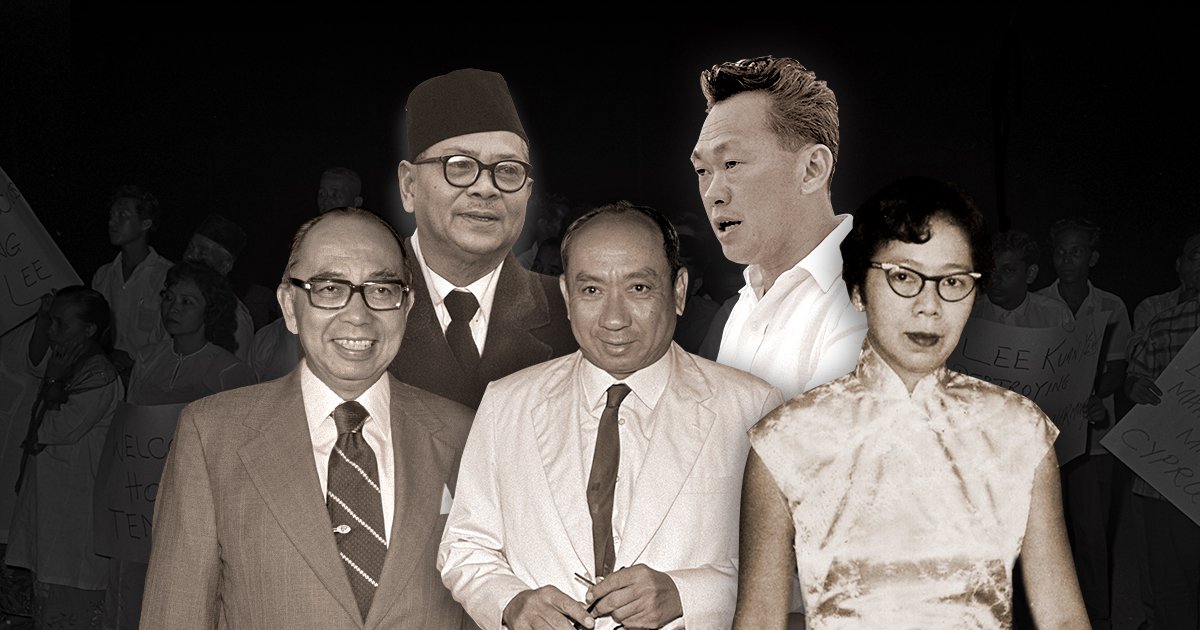
Goh Keng Swee

But I’ve had enough of Malaysia. I just want to get out.
I could see no future in it, that the political cost was dreadful and the economic benefits, well, didn’t exist.
So it was [an] exercise in futility.
Credit: From the oral history interview of Goh Keng Swee (Accession No. 000046, Track No. 36), Oral History Centre, National Archives of Singapore
Lee Kuan Yew

I showed my wife the documents because my wife is a good draughtsman. I wasn’t happy. I wanted the Water Agreement[s] to be brought in, because the Water Agreement[s] [were] agreement[s] between the PUB or the City Council [then] and the State of Johor.
Now, [they were not agreements] between two independent governments. [I thought]: When we separate, our relations will be that of two independent governments and if they disavow or they dishonour [these] Water Agreement[s], we shall be in deep trouble, we’ll have no water to drink. So I wanted the Water Agreement[s] included.
How do we bring the Water Agreement[s] which [are] between a local government [then Singapore City Council] and a state government [Johor] into this Separation document so that [they] become agreement[s] between two independent governments, and will have to be honoured as such?
Credit: From the oral history interview of Lee Kuan Yew (Accession No. 000080, Track No. 82), Oral History Centre, National Archives of Singapore
Kwa Geok Choo

My main … what I feel is my duty in such a thing … is to see whether there are any ambiguities which can later lead to disagreement and conflict, which can be interpreted one way or another way. That, as a draughtsman, is how I look at the thing.
Is there any sentence where the meaning is not clear? It is not for me to say whether the meaning is correct, [whether] it is right that you should do this, or it is wrong that you should do that.
My whole attitude is, what is it you want to do? Has it been spelt out clearly in words which nobody can argue about?
Credit: From the oral history interview of Kwa Geok Choo (Accession No. 000118, Track No. 32), Oral History Centre, National Archives of Singapore
Kwa Geok Choo

No, I didn’t need to be told these things. He just said: ‘I’m going off.’ That’s that and I knew that when he goes off like this, you don’t tell the whole world that he’s gone down to Kuala Lumpur to negotiate these delicate things.
So there are certain things he may have told me just don’t … No, I don’t think it was necessary. I knew what … this is a cloak and dagger thing. You don’t … you don’t tell people.
If my son had blurted out: ‘Papa’s not here’, that would have been trouble. But my son would have known better, my big boy. My children wouldn’t have known, the younger ones wouldn’t have known.
I was there just as a camouflage. As far as the world knew, I mean, he was on holiday in Cameron Highlands. So when they asked me: ‘Where’s your husband?’ ‘He’s playing, he’s on a golf course.’
Credit: From the oral history interview of Kwa Geok Choo (Accession No. 000118, Track No. 32), Oral History Centre, National Archives of Singapore
Lee Kuan Yew

And it was the most painful press conference I’ve had in my life, because it was, one, really an admission of defeat.
Because what we tried to do, bringing Malaysia about, had failed in less than two years after more than 15 years of effort, from 1950… 13 years [of effort from] 1950 to 1963 in two years we’d given it up.
And we were also letting down all our, not just political partners in the [Malaysian] Solidarity Convention, but a lot of people who had their hopes raised of a different kind of future, because of our participation in Malaysia and the kind of Malaysia we were prepared to fight for.
Credit: From the oral history interview of Lee Kuan Yew (Accession No. 000080, Track No. 83), Oral History Centre, National Archives of Singapore
Kwa Geok Choo

He [Mr Lee] was upset after the thing [Separation] was over. When the thing is on, there is no time to be upset. There’s no time to be jittery and nervous while you’re doing it.
No, no. I think where he had the nearest to a nervous breakdown was after it was over, after the press conference [on the afternoon of Aug 9] when we came back and slept in this room. Then, he was very, very upset.
Credit: From the oral history interview of Kwa Geok Choo (Accession No. 000118, Track No. 32), Oral History Centre, National Archives of Singapore ~ ~ ~ ~ • ~ ~ ~ ~
Note: The audio files were edited for length and to remove pauses, but the content is
otherwise presented as recorded and the meaning of the original remarks preserved.