Record-low Danube water levels: Ships are stranded, fishermen lose income, nuclear plants cut output, and amid summer heat, water is scarce across neighboring countries.
Image: Darko Vojinovic/AP Photo/picture alliance
Where excursion boats once docked, algae now grow on dry ground. An eerie silence reigns in Islaz, Romania. Europe’s second-longest river is carrying less water than it has in decades. The extent of the drought is strikingly evident along the entire length of the Danube all the way to the Black Sea.
Image: Nicolae Dumitrache/AP Photo/picture alliance
To local fisherman Doru, the river is barely recognizable. The 71-year-old has lived on the Danube for decades. He used to have to swim to reach the small island in the river. Today, the water only comes up to his chest. “In two years, we’ll be able to just walk across,” he says. Other fishermen also report dramatically declining catches and a future full of worries.
Image: Daniel Mihailescu/AFP
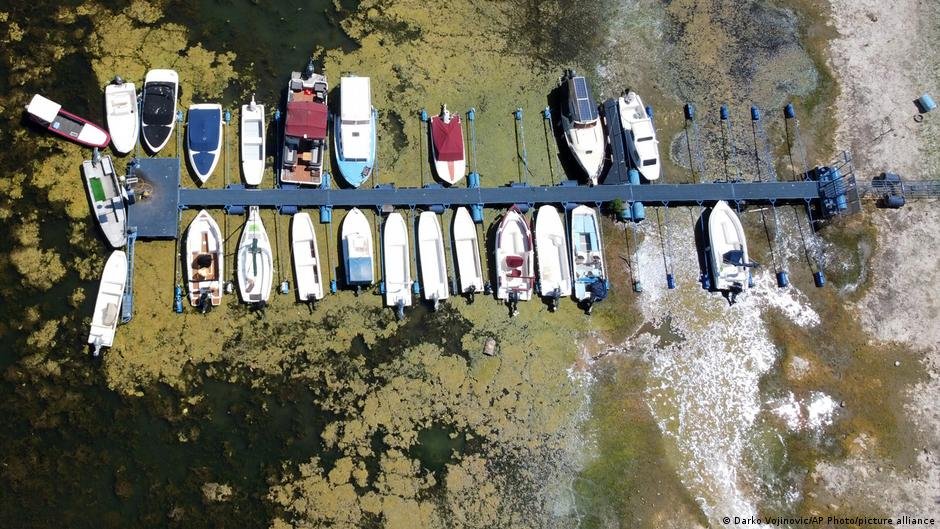
Its not just Romania that’s suffering. In Novi Sad, Serbia, hundreds of boats lie stranded along the Danube as hydropower output drops. Bulgarian fishermen report lost work, and Austria faces drought and low water levels. Across the river’s entire course, fears are growing that relentless heat and worsening water shortages may soon become the new normal.
Image: Darko Vojinovic/AP Photo/picture alliance
In Petrovaradin, Serbia, boats are anchored due to the extremely low water level of the Danube. The effects of the ongoing drought are hitting international shipping with full force. Freighters are now only allowed to sail with light loads or must wait for days. Ferries between Romania and Bulgaria have been temporarily suspended.
Image: Darko Vojinovic/AP Photo/picture alliance
A view of the Danube in Budapest. The low water levels are now threatening the energy supply. Hungary has reduced the output of its MVM Paks nuclear power plant, which relies on water from the Danube for cooling. In Romania, both reactors at the Cernavoda nuclear power plant were shut down simultaneously for the first time due to the exceptionally low water levels.
Image: Robert Nemeti/Anadolu/picture alliance
Low water levels on the Danube near Opatovac, Croatia, have exposed the remains of a historic ship. From a drone’s-eye view, the wreck — believed to be more than a hundred years old — is visible in its entirety. According to local sources, the ship is said to have sunk between World War I and World War II.
Image: David Jerkovic/Pixsell/IMAGO
In Greifenstein, Austria, numerous boats are lined up close together on dry land. A cruise ship carrying 186 passengers ran aground near Widin, Bulgaria, and had to be evacuated.
Image: Roland Schlager/APA/AFP
This aerial view shows the low water level of the Danube near Backa Palanka in Serbia. For centuries, the river has been a trade route, a lifeline, and a symbol of Europe. Shipping, tourism, and energy supplies are being affected by the drought. Scientists are warning of more frequent heat waves. What is visible along the Danube today could soon affect other regions of Europe as well.
Image: Nenad Mihajlovic/AFP8 images1 | 88 imageshttps://p.dw.com/p/5I28r
About The Author