


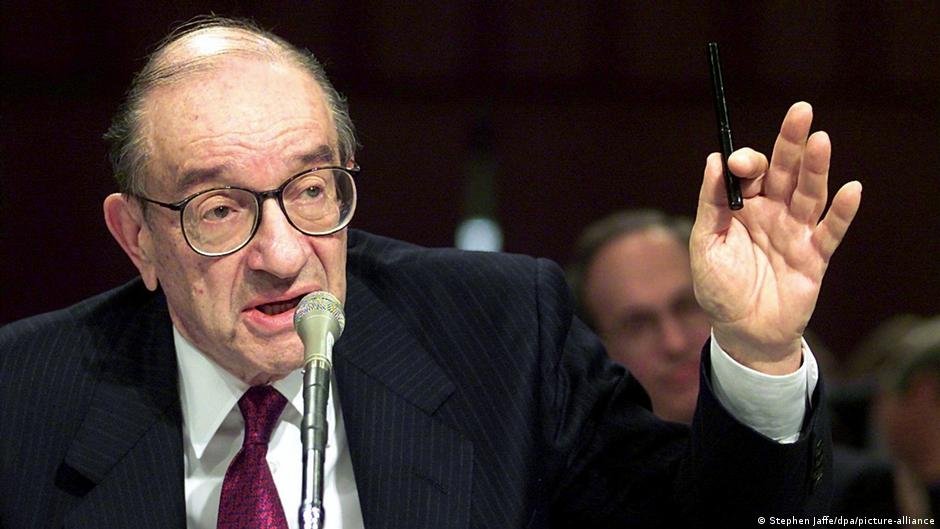
For many years, the global financial world hung on Alan Greenspan’s words, his facial expressions, and his every movement. Even the thickness of his briefcase was observed, evaluated and interpreted.
For nearly 20 years, Alan Greenspan steered United States monetary policy — and with it, the economy — as Chairman of the US central bank, the Federal Reserve, or Fed for short. He was “Mr. Dollar,” the guru of the international financial world, the pacemaker of the global economy.
George W. Bush awarded him the Presidential Medal of Freedom, and Britiain’s Queen Elizabeth II knighted him. He was regarded as upright, brilliant and witty. Greenspan himself liked to say that he began each day with two hours of reading documents in the bathtub, where he was at his most creative. His reputation was flawless.
Later, however — after the financial crisis — that would change. But first, a look at the beginning.
To view this video please enable JavaScript, and consider upgrading to a web browser that supports HTML5 video
The measure of all things
When Greenspan took office at the Fed in 1987, the shoes he had to fill were very large. His predecessor, Paul Volcker, had brought galloping inflation under control with a daring high-interest-rate policy. But Greenspan was in no way inferior to Volcker in terms of reputation.
Around the turn of the millennium, when he was reappointed for another four years at the head of the Fed, politicians praised him as “the greatest central banker in the history of the world.” No wonder: Under his monetary policy leadership, the US economy experienced one of the longest periods of prosperity in its history.
Greenspan was a cult figure. Even a furrowed brow would make investors wonder what it meant. Equally legendary were his convoluted and often completely incomprehensible statements, known as “Greenspeak.”
“Since becoming a central banker, I have learned to mutter with great incoherence,” Greenspan told Congress in 1987. “If I seem unduly clear to you, you must have misunderstood what I said.”
According to Bob Woodward’s biography, Greenspan even phrased his marriage proposal to his second wife, Andrea Mitchell, so incomprehensibly at first that the then 71-year-old had to repeat it.
Universal remedy: Lower interest rates!
Greenspan faced his first major test as Fed Chairman shortly after taking office. After the stock market crash on 19 October 1987, known as “Black Monday,” he opened the monetary floodgates to prevent panic among investors. He cut the key interest rate, which had stood at around 7% when he took office. This made loans cheaper, entrepreneurs invest, consumers spend, and the economy got moving again.
He also lowered interest rates during later crises — in the 1990–91 recession, the Asian financial crisis of 1997, and the collapse of the Long-Term Capital Management hedge fund in 1998.
His actions assured financial markets that the Fed would act decisively in times of crisis. This policy even got its own name: the “Greenspan Put.”
Shock paralysis after 9/11
When two planes flew into the World Trade Center in New York City on September 11, 2001, the world was thrown into chaos. The economy was in shock. Greenspan reached for his tried-and-tested remedy and lowered the key interest rate in several steps from 6% to 1%. Such a low level had not been seen in the United States for 46 years.
It worked: The American economy picked up again, and the Dow Jones index surged more than a third between late 2002 and early 2004. Even though the economy recovered, the Fed kept interest rates at this low level for the following years. Only in 2004 did Greenspan hit the brakes and raise rates. It was too late. Markets did not respond to the rate hikes as usual, and long-term rates actually fell further.
Because of those low rates, many Americans had become heavily indebted. Banks had bundled these risky loans and sold them as securities around the world. Even the higher rates could no longer stop the swelling and eventual bursting of the US housing bubble in 2007. A year later, the world was shaken by the financial crisis.
The risky behaviour of banks had been encouraged by the deregulation of the financial system in the preceding years. Greenspan not only believed in the power of low interest rates, but also that markets would regulate themselves. In doing so, he helped transform the financial world from the tightly regulated postwar system into a deregulated market in which financial excesses became possible.
Reputation shaken after the financial crisis
The financial crisis not only brought the global economy to the brink, but it also shattered the good reputation of the “Maestro.” Most experts agree that his policy of cheap money and support for deregulation helped create the conditions for the US housing crisis and the subsequent worldwide financial meltdown.
Stephen Roach, chief economist at Morgan Stanley, criticised Greenspan: Instead of moderating the boom, he “poured more punch into the bowl to keep the partygoers happy.”
Nobel laureate Paul Krugman wrote on his New York Times blog that Greenspan had denied the existence of a bubble and actively blocked efforts to introduce stronger financial regulation. Thus, Greenspan was seen as a co-trigger of the worst economic crisis since World War II.
It fell to his successors, Ben Bernanke and later Janet Yellen, to manage the crisis, as Greenspan retired in 2006 and later worked as a consultant for major financial firms. Greenspan did not see himself as a major driver of the financial crisis.
“70% of my decisions were right; the remaining 30% contributed to the financial crisis,” said Greenspan, adding that he had repeatedly warned of excesses in the housing and credit markets.
However, in front of a Senate committee, he admitted he had been wrong about Wall Street’s willingness to regulate itself.
“Those of us who have looked to the self-interest of lending institutions to protect shareholders’ equity — myself included — are in a state of shocked disbelief,” he said.
Jazz was his first love
Greenspan, who was considered modest and shy, was not just a man of money. His first love was jazz.
Born in 1926 into a Jewish family in New York City, he wanted to become a musician in his youth. In high school, he played clarinet and saxophone. He later studied at the renowned Juilliard School in New York City and toured with a band in 1944 and 1945.
In 1944, he switched to economics. He began studying at New York University, earning his master’s degree in 1950. He then worked for a few years as a trader at the commodities exchange in Chicago.
In 1954, he founded the consulting firm Townsend, Greenspan & Co. with a partner. The company quickly became successful and gave Greenspan contacts with many of America’s largest companies and their managers.
Another love was the artist Joan Mitchell, whom he married in the 1950s. He later lived with television presenter Barbara Walters, before falling in love in 1984 with the well-known TV journalist Andrea Mitchell, who was 20 years his junior. They married in 1997.
Becoming the ‘Face of the Fed’
In the late 1970s, he advised Republican presidential candidate Ronald Reagan. After Reagan’s election victory in 1980, Greenspan became head of a commission that proposed reforms to the social security system. Seven years later, Reagan appointed him Chairman of the US central bank.
Although Greenspan described himself as a conservative Republican, he also enjoyed support from Democrats.
Greenspan was particularly influenced by the writer and philosopher Ayn Rand, whom he met in 1952. Rand advocated strict individualism and pure laissez-faire capitalism, in which the state’s only role was that of a night watchman.
Greenspan supported Republican Presidents Reagan and George W. Bush in their radical tax cuts and the associated reduction of government services. Nevertheless, he emphasised that the pursuit of profit should not come at the expense of others: “Material success is much more satisfying when it is achieved without exploiting others.”
Even in old age, Greenspan continued to speak out. During the pandemic year of 2020, US television stations aired monthly interviews with Greenspan and his wife, Andrea Mitchell.
Greenspan died at the age of 100 from complications related to Parkinson’s disease, Mitchell told NBC News on Monday.
This article was translated from German
About The Author







