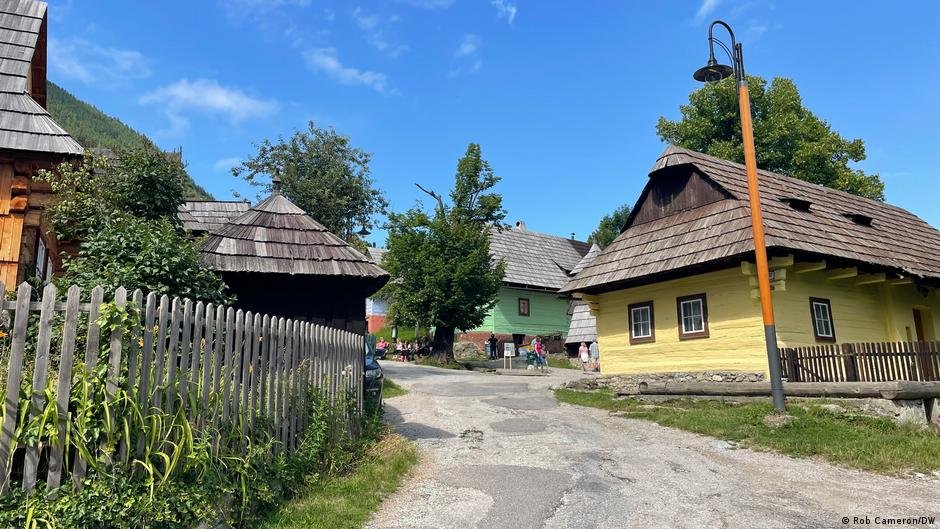
From the headlines in the world’s media, the story seemed simple: A tiny Slovak village wanted UNESCO to remove it from the World Heritage List because of the pressures of overtourism.
But that’s not quite what is happening in Vlkolinec, central Slovakia.
Interviews with residents, local officials and visitors suggest that the debate was less about UNESCO itself than about how to protect a living community from the pressures of tourism.
Accelerated transformation
“Those who come with humility, to admire the village and understand how people lived here, are always welcome,” said 68-year-old Anton Sabucha. “They don’t bother me. It’s the rude ones.”
Sitting beneath an awning outside his wooden house, Sabucha leafed through a history of the village, pointing to photographs of neighbors and relatives. His wife brought out a tray of fried dough pastries.
He remembered when around 200 people lived in Vlkolinec. Today, only 17 remain year-round.
UNESCO did not create Vlkolinec’s tourism problem. The village was designated a Folk Architecture Heritage Reserve in 1977, during the Communist era.
But Sabucha argued that its inscription on the UNESCO World Heritage List in 1993 accelerated the transformation, bringing visitors who too often forget that people still live in the centuries-old wooden houses.
Diminishing privacy
“You come out into your yard, wanting to sit quietly and have a coffee with your friends. Then the first tourist comes and asks, ‘How are you? What’s it like living here?’ Then another. Then another,” he told DW.
Sabucha has erected a barrier at the entrance to his property bearing the notices “No Trespassing” and “No Photos.” He said that despite this, some visitors still wander into private gardens, trampling flowers and treating the village as an attraction rather than a community.
“Someone sees the ‘No Photos’ sign and still has to take a picture. They simply don’t respect people’s privacy.”
Disappearance of traditional village life
But the biggest loss, he said, has been the gradual disappearance of traditional village life.
The surrounding meadows are no longer cut, the old agricultural terraces have become overgrown and many of the people whose lives have shaped the landscape are gone.
Tourism income, he argued, has done little to reverse that decline.
Residents receive around €400 ($455) a year from ticket revenues — “barely enough to buy a pallet of briquettes for the winter” — while many of those who now earn a living from tourism no longer live in the village, he said.
“For an ordinary tourist, these are just wooden houses. For us, they’re people. We know exactly who lived in each house.”
A living village
Justine, a tourist visiting from France, said the village’s appeal lay precisely in the fact that people still lived there.
“Usually places like this are museums. Here, people still live here. That’s unique,” she told DW.
When told that some residents wanted Vlkolinec removed from the UNESCO list because of tourism, she said she understood their frustration.
To view this video please enable JavaScript, and consider upgrading to a web browser that supports HTML5 video
“Having people walking around your village every day could become unpleasant,” she said. “But at the same time, tourism also supports the region. It’s difficult to know what’s best.”
UNESCO status helps preservation
Not everyone agrees that UNESCO is the problem.
Miro Parobek, who oversees tourism for the town of Ruzomberok, which administers Vlkolinec as a municipal district, acknowledged that tourism had brought challenges. But he argued that the answer was better management, not removing the village from the World Heritage List.
“Our first priority is to preserve the traditional architecture,” Parobek told DW. “But our goal is also for this to remain a living village. We want to support the people who live here.”
He said the town had already responded to residents’ concerns by replacing large festivals with smaller cultural events, while residents now met regularly with local officials through a dedicated working group.
The municipality also helped homeowners apply for grants to restore historical buildings and even provided twice-weekly transport into nearby Ruzomberok for older residents.
Parobek said every entrance ticket carried the same message: “Vlkolinec is not an open-air museum. Please respect the privacy of the people who live here.”
Balancing tourism, heritage and residents’ wishes
He acknowledged that the balance between protecting residents and welcoming visitors was not always easy.
Much of Parobek’s optimism rested on plans that had yet to materialize.
Ruzomberok was seeking Norwegian funding for a package of measures aimed at reducing pressure on the village, including a park-and-ride below the hillside settlement, improved footpaths and drainage, the restoration of traditional barns and terraces, and the conversion of the former village school into a community and cultural center.
The project would also create more opportunities for local residents to work as guides and custodians, he said.
Is removal from the list possible?
Anton Sabucha is in a minority. But even if he somehow gets his wish, having Vlkolinec struck off the World Heritage List is an almost impossible task.
UNESCO has removed sites only three times since the program was established in 1978: Germany’s Dresden Elbe Valley after the construction of a four-lane bridge, Liverpool’s historical waterfront following large-scale redevelopment and Oman‘s Arabian Oryx Sanctuary after most of the protected reserve was stripped of its status.
In each case, UNESCO acted because the sites had irreversibly lost the qualities for which they had originally been inscribed.
There is no precedent for a community asking to be removed voluntarily.
And there is no sign that Vlkolinec is about to become the first to succeed in its request.
Edited by: Aingeal Flanagan
About The Author