The World Cup’s hidden runners: referees keep pace with players and pressure
Soccer Football – FIFA World Cup 2026 – Round of 16 – Mexico v England – Estadio Azteca, Mexico City, Mexico – July 5, 2026 Referee Alireza Faghani with assistant referees George Lakrindis and Andrew Lindsay during the warm up before the match REUTERS/Henry Romero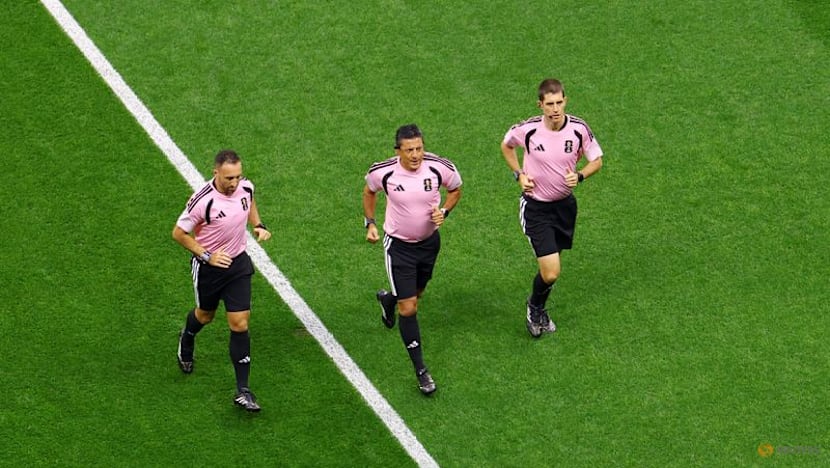
Read a summary of this article on FAST.
Get bite-sized news via a new
cards interface. Give it a try.
Click here to return to FAST
Tap here to return to FAST
FAST
KANSAS CITY, Missouri, July 8 : When a World Cup match turns on a split-second decision in the dying moments, the referee is expected to be in the right place at the right time — no small ask when battling everything from Miami humidity to Mexico City’s lung-busting altitude.
While fans focus on players chasing goals, referees are sprinting just as hard, typically covering 12 to 13 kilometres per match according to FIFA — a distance comparable to many outfield players.
That reality has transformed how football’s governing body prepares officials for the sport’s biggest stage.
“Referee preparation for the 2026 World Cup began almost four years ago,” FIFA told Reuters.

Guess Word
Crack the word, one row at a time

Buzzword
Create words using the given letters

Mini Sudoku
Tiny puzzle, mighty brain teaser

Mini Crossword
Small grid, big challenge

Word Search
Spot as many words as you can
The build-up has resembled that of elite athletes. Officials have undergone repeated physical assessments, with training ramping up sharply in the six months before the tournament.
The challenge extends far beyond distance. A referee may spend one match battling humidity in Miami and another chasing play at more than 2,200 metres above sea level in Mexico City, with long flights, changing time zones and unforgiving temperatures creating demands that resemble an endurance event.
FIFA said lessons from the 2025 Club World Cup in the U.S. proved invaluable in preparing officials for “heat, humidity and also different time zones”.
GAME-LIKE SIMULATIONS
Officials train endurance, strength, speed, agility and acceleration, often through game-like simulations while performance experts scrutinise every sprint, heartbeat and recovery cycle.
The objective is simple: arrive at every decisive moment before the controversy does.
Research has linked fatigue to poorer positioning, narrower viewing angles and slower reactions — all ingredients for the kind of mistake that can live forever in World Cup folklore.
That is why FIFA now treats referees much like players.
The World Cup officiating team consists of 52 referees, 88 assistant referees and 30 video match officials from 50 member associations.
Based in Miami, they live in an environment built around training, nutrition, recovery and technical preparation, with 12 medical specialists and 10 physiotherapists, plus a chef trained in sports nutrition.
GPS devices monitor workload, heart-rate sensors gauge exertion and blood-lactate testing helps staff determine how the body is coping. Training loads are then adjusted with scientific precision.
“We use data trackers at the same level as players,” FIFA said.
RECOVERY
The three days prior to matches feature simulated match sessions, along with short, explosive acceleration and speed work.
Afterwards, recovery takes centre stage.
“(The two days following games) are dedicated to active recovery training, along with massages and cryotherapy, which help achieve a faster and more effective recovery,” FIFA said.
FIFA has also introduced hydration supplements and redesigned training schedules to limit exposure to direct sunlight.
The demands are easy to miss because referees rarely feature on highlight reels.
Yet studies have found that high-intensity running can account for more than a third of their movement during elite matches, with heart rates often climbing to between 80 per cent and 100 per cent of maximum levels.
All the while, officials are tracking player movements, spotting potential fouls, anticipating tactical patterns and hunting for the best possible viewing angle — often at full sprint.
Despite the preparation, injuries remain a risk.
In the U.S. 2-0 victory over Australia in the group stage, German referee Felix Zwayer collapsed with cramping in stoppage time, requiring players from both teams plus an assistant referee to help stretch his leg so he could finish the match.
As the tournament’s quarter-finals approach, the spotlight remains on players — but behind every defining moment is a referee racing to keep pace, knowing one whistle can change everything.
Source: Reuters
Sign up for our newsletters

Get the CNA app
Stay updated with notifications for breaking news and our best stories
Get WhatsApp alerts
Join our channel for the top reads for the day on your preferred chat app

Get bite-sized news via a new
cards interface. Give it a try.
Click here to return to FAST
Tap here to return to FAST
FAST